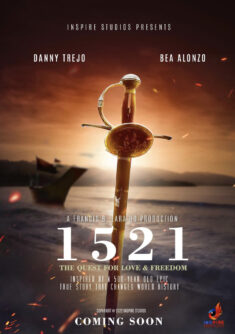
1521-THE QUEST FOR LOVE AND FREEDOM
A cheap POCAHONTAS retread with a grudge against the faith.
Should You Watch It?
Here is the decision, plainly. 1521 is poor filmmaking wrapped around a story that has a bone to pick with Christianity. The performances can't carry the weak dialogue, the Spanish armor looks like plastic, and the whole thing plays as a beat-for-beat copy of Disney's POCAHONTAS. On craft alone, there's little reason to spend two hours here.
The worldview makes it worse. The movie stereotypes Catholicism as interested only in exploiting the Filipino people, with the Gospel used as a cover for sinister motives. The one Spaniard who truly believes in loving God and neighbor is written as too weak to resist. Meanwhile the film treats indigenous paganism warmly and pushes a flattening religious pluralism.
There are real, honorable values buried in it — a people fighting valiantly for their freedom and sovereignty. But they don't redeem the package. So our answer is simple: skip it.
The Story
NO SPOILERS — WE KEEP THE SURPRISESIt's the early 1500s, and Spanish explorer Ferdinand Magellan (Danny Trejo) has reached the Philippines. On Mactan Island, a tribe led by Lapu-Lapu (Michael Copon) means to hold its ground against the reach of empire.
Caught between the two worlds is Enrique (Hector David Jr.), Magellan's aide, who falls in love with one of the tribe's female spiritual leaders (Bea Alonzo). Their bond is doomed from the start: duty will soon demand that Enrique take part in Magellan's designs on Lapu-Lapu and his people. A battle is coming.
Is It Any Good?
One star, and it's earned honestly. This is a historical drama whose production values fall well short of what the genre demands. The costumes betray the budget — that plastic-looking Spanish armor is hard to unsee — and the dialogue is weak enough that the cast can't rescue it.
Worse, there's nothing original underneath. The story tracks Disney's POCAHONTAS so closely, beat for beat, that you'll always know what comes next. There is little here to hold your attention as entertainment and less to admire as art. If the film has any value at all, it's as a case study in what happens when the tools of filmmaking become available to everyone and the storytelling doesn't keep pace.
The Worldview
1521 wears its politics openly, and a discerning viewer should know what they are. The movie champions freedom and independence — the Mactan tribe fights valiantly for its sovereignty against the powers of the Holy Roman Empire and Spain — and that instinct toward liberty is worth honoring.
But the film buys that theme at the cost of honesty and fairness toward the faith. Catholicism is stereotyped as interested only in exploiting the Filipino people, with the spreading of the Gospel treated as mere cover for sinister motives. The single member of Magellan's expedition who genuinely believes — Enrique, who insists true Christianity is built on love of God and neighbor, not conquest — is ultimately shown to be too weak to resist, and he joins the effort to force the Filipinos into submission anyway. Set against this, indigenous paganism is portrayed warmly, and the movie leans on a false religious pluralism that flattens all belief into interchangeable options.
It's also revisionist. The filmmakers admit their story is fiction, but the record matters: historians hold that after Magellan peaceably persuaded a local rajah to convert, that ruler urged Magellan to help settle a rivalry with Lapu-Lapu. Magellan was an explorer, not a colonist; forced Spanish colonization didn't begin until forty-five years later.
The film longs for freedom but misnames its source. Scripture says the truest liberty comes not from empire's absence but from Christ: "If the Son sets you free, you will be free indeed" (John 8:36).
The Content Guide
The specifics — spoilers included by nature — so you can judge for your own family.
Dominant Worldview and Other Worldview Content/Elements
Strong mixed pagan worldview is pro-freedom and pro-independence worldview, but it has some politically correct revisionist history of the Spanish in the 1500s in the Philippines where Christianity, specifically Roman Catholicism, and Spanish explorers are portrayed as oppressive and tyrannical, except for one Spanish Catholic character, Enrique, who explains that true Christianity is based on love, not conquest, but Filipino indigenous paganism is portrayed positively, and the movie falsely stresses religious pluralism,
Foul Language
No foul language
Violence
Two scenes of bloodless, sanitized sword and spear violence, plus a man is stabbed to death by multiple spears after being defeated in battle, and a man is killed by a gunshot
Sex
Man refers to woman as a “whore,” as an insult.
Nudity
No nudity
Alcohol Use
No alcohol use
Smoking and/or Drug Use and Abuse
No smoking or drugs;
Miscellaneous Immorality
None.
Talk About It
Questions for the drive home, the dinner table, or the youth group.
The movie prizes freedom above almost everything. What does the Bible say true freedom is — and who gives it?
John 8:31–36 · Galatians 5:11521 shows a Christian character who knows the right thing but is too weak to stand for it. Where do we find the strength to do right when it costs us?
Philippians 4:13 · 1 Corinthians 16:13The film insists true Christianity is about loving God and neighbor, not conquest — even as it condemns the faith elsewhere. How would you separate the genuine command of Christ from the sins done in His name?
Matthew 22:37–40 · Micah 6:8This story rewrites history to fit a message. Why does telling the truth about the past matter, even in fiction?
Proverbs 12:22 · Ephesians 4:25The Final Word
There's a worthy longing at the center of this movie — the ache for freedom — but it's married to shoddy filmmaking and a story that treats the Christian faith as a mask for greed. The result isn't worth your evening. Our answer is skip it. For a better night in, browse our latest family-friendly picks.