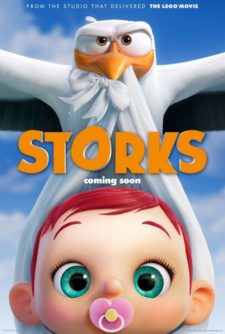
STORKS
Funny family adventure, better watched where parents guide the conversation.
Should You Watch It?
STORKS is a funny animated adventure with genuine heart. It celebrates babies, family bonds, parental attention, and the desire to fulfill one’s purpose. The relationship between a boy and his parents is especially warm, as his parents begin to recognize what they have been missing.
But the movie never brings God into its story of how babies come to be. It also includes two brief images of storks delivering babies to same-sex couples. Those moments sit awkwardly beside the film’s otherwise strong pro-family and pro-life themes.
Because the content is light but the worldview is mixed, your family may find something worthwhile here without receiving a clear answer to the question, “Where’s God?” Watch it at home, where you can guide the conversation.
The Story
NO SPOILERS — WE KEEP THE SURPRISESThe storks have stopped delivering babies and now deliver packages instead. Tulip, a human girl raised by storks, grows into a klutzy young woman whose life changes when she and Junior accidentally activate the storks’ unused baby-making machine.
Now they must deliver a baby girl to a boy and his parents without their boss finding out. Their journey brings them into comic danger and forces several characters to consider what family truly means.
Is It Any Good?
Three stars means STORKS is an enjoyable but imperfect animated comedy. It has very funny moments, especially when Junior, Tulip, and the baby encounter a large pack of crazy wolves.
The movie also has heart. The boy’s relationship with his mother and father grows more meaningful as they begin paying attention to him, and the search for the baby’s parents prompts Tulip to search for her own. Those emotional connections give the adventure a warm center.
The Worldview
STORKS carries forward the pagan legend that storks deliver babies, taking the superstition into a modern comic adventure. God does not enter the picture when the storks’ baby-making machine is involved, leaving the film with a mixed pagan and humanist outlook.
Still, the movie affirms much that is valuable. Having babies is celebrated. Children want connection with their mothers and fathers. Characters are encouraged to fulfill their purpose, and family responsibility receives sincere praise. These strong moral, pro-life, and pro-family elements give the story much of its heart.
The film also includes brief images of storks delivering babies to same-sex couples. That choice complicates the movie’s otherwise traditional emphasis on mothers, fathers, and children.
The film’s longing for family and new life points toward a truth Scripture states plainly: “Behold, children are a heritage from the LORD, the fruit of the womb a reward” (Psalm 127:3).
The Content Guide
The specifics — spoilers included by nature — so you can judge for your own family.
Content Summary
Mixed pagan worldview with light pagan and humanist elements (including some pagan superstition about storks and babies taken to comical extremes for laughs and comical adventure but with no references to God) mitigated by strong moral, pro-life, pro-family elements extolling fulfilling one’s purpose, but with some politically correct homosexual content briefly showing at least two same-sex couples receiving babies from storks in a short montage clip, and two alpha male wolves want to lead a wolf pack in raising a human baby, a plot development that appears same-sex in one scene; no foul language; light slapstick comedy with falls, two storks fly into a large window, wolf pack chases stork and girl with baby, and wolves are at first scary and consider eating baby but become comical and fall in love with the baby in a parental way; no sex; images of bare-chested babies; no alcohol; no smoking or drugs; and, villain is deceitful, and wolves take baby.
Talk About It
Questions for the drive home, the dinner table, or the youth group.
The movie celebrates babies and family life. Why does Scripture call children a heritage and reward?
Psalm 127:3 · Mark 10:13–16The boy’s parents begin paying more attention to him. What does loving attention look like in your family?
Deuteronomy 6:6–7 · Ephesians 6:4The story asks characters to fulfill their purpose. How can you use your gifts to serve others rather than yourself?
Ephesians 2:10 · 1 Peter 4:10The film gives a mixed answer about where babies come from. What does Scripture teach about God’s role in creating human life?
Psalm 139:13–16 · Genesis 1:27The Final Word
STORKS offers funny adventure, warmth, and strong pro-family themes, but its mixed worldview and brief same-sex-couple imagery make it better for home viewing, where parents can guide the conversation. Our answer is WAIT FOR HOME. For another option, see.