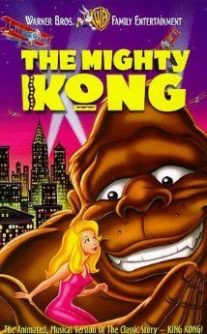
THE MIGHTY KONG
A colorful Kong remake best saved for home viewing.
Should You Watch It?
THE MIGHTY KONG is gentler than the original KING KONG. It is also a musical, with character development and some wholesome elements. But the animation is only fair, the story drags, and the island chase lacks excitement.
The content is mostly mild for a G-rated movie, yet some scenes may be too much for children age six and under. The film also treats a false religion involving human sacrifice as wrong while leaving an immoral statement about culture and laws unchallenged. Environmental elements further blur the distinction between the value of animal life and human life.
Because the movie has some merit but is not especially engaging, watch it at home, where you can guide your children through its troubling ideas.
The Story
NO SPOILERS — WE KEEP THE SURPRISESWild animal filmmaker and Broadway producer C. B. Denham hires Ann Darrow for a secretive voyage aboard the Java Queen. Their destination is Skull Island, where strange reports tell of natives worshipping a “monkey god.”
Ann meets the ship’s first mate, Jack Driscoll, and the cabin boy, Ricky, who has a pet monkey. When the expedition reaches the island, Ann becomes entangled with the natives and the enormous gorilla they call the Mighty Kong.
Is It Any Good?
Two stars means this is a modest, uneven animated musical. The characters receive enough attention to have a human quality, and the songs add some charm.
The animation is fair, but the characters do not move as smoothly as those in more upscale animated movies such as ANASTASIA or BEAUTY AND THE BEAST. The story is boring at times, the humor is weaker than it could have been, and the island rescue chase is not exciting.
The Worldview
The film contains some moral elements, but its worldview is mixed. It rejects the natives’ false religion and human sacrifice, yet it leaves the captain’s claim that the practice is simply “not our culture, not our laws” unrebuked. That treats moral truth as dependent on culture rather than recognizing that some acts are wrong regardless of local custom.
Environmental elements also suggest that animal lives may be as important as human lives. The movie’s concern for Kong does not clearly distinguish humane treatment of animals from the unique value of people. Scripture teaches both responsible care for creation and the special worth of human beings, who are made in God’s image.
The film’s moral impulse is strongest when it opposes cruelty and sacrifice. But its unanswered ideas about culture and the value of life dilute those more wholesome elements. “So God created man in his own image” (Genesis 1:27).
The Content Guide
The specifics — spoilers included by nature — so you can judge for your own family.
Content Summary
Pagan worldview with a few moral elements, some environmental elements hinting that animal lives are as important as human lives &, although a false religion using human sacrifice is rejected, a politically correct, immoral statement supporting multiculturalism is not rebuked; giant ape fights dinosaur, snake & prehistoric "birds" & wrecks parts of New York City with airplanes shooting briefly at him & train hits car; and, stealing & kidnapping.
Talk About It
Questions for the drive home, the dinner table, or the youth group.
The film shows a false religion using human sacrifice. Why are some actions wrong even when a culture accepts them?
Isaiah 5:20 · Acts 5:29The story raises questions about the value of animal life and human life. What responsibilities did God give people toward creation, and what makes human beings unique?
Genesis 1:26–28 · Proverbs 12:10The captain says that another culture’s laws should determine whether outsiders intervene. When should Christians respect cultural differences, and when must they speak against wrongdoing?
Micah 6:8 · Acts 4:19–20The Final Word
THE MIGHTY KONG is gentler than the original and offers some wholesome character moments, but its fair craft, slow stretches, frightening scenes, and unchallenged moral confusion make it better for home viewing. WAIT FOR HOME lets parents guide the conversation.