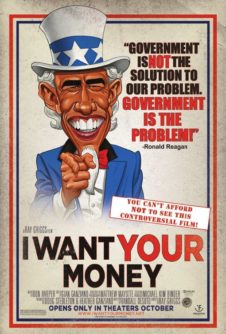
I WANT YOUR MONEY
A funny, urgent case for responsible government and civic action.
Should You Watch It?
If you want a clear, energetic conservative argument about taxes, government regulation, national debt, and America’s economic future, this documentary makes a strong case. It uses humor, historical speeches, expert interviews, and animated political clashes to contrast Ronald Reagan’s policies with Barack Obama’s.
The film is especially effective when its cartoons turn economic arguments into memorable lessons. The voice actors capture several famous political figures, and Ray Griggs’s calm narration provides summaries and citations for the facts being presented. The documentary is openly partisan, so you should watch it as an advocacy film rather than a neutral survey.
For older children and adults who share—or want to examine—its concerns about big government and taxation, this is worth seeing.
The Story
NO SPOILERS — WE KEEP THE SURPRISESThis documentary examines the economic direction of the United States by contrasting Ronald Reagan’s policies with Barack Obama’s. Animated political figures debate taxes, government regulation, and the size of government, while conservative and libertarian leaders offer commentary.
Historical speeches, expert interviews, narration, and citations build the film’s case about unemployment, national debt, and the future of the country.
Is It Any Good?
Four stars means this documentary succeeds on every major level emphasized by the source review. It is hilarious, informative, and ultimately inspiring.
The animated segments are the highlight. The political cartoons are described as absolutely hilarious, and the voice actors do a wonderful job capturing figures including Ronald Reagan, Richard Nixon, Barack Obama, Nancy Pelosi, George W. Bush, and Sarah Palin. The historical speeches, interviews, calm narration, summaries, and citations complete an engaging presentation.
The source’s only quibble is that the film accepts negative portrayals of George W. Bush and Sarah Palin as unintellectual. Even so, the review considers the documentary excellent.
The Worldview
The film presents a very strong moral, capitalist worldview. It honors American values and argues against Communist/Marxist socialism. Its central economic conviction is that lower taxes and less government regulation benefit the economy, while high taxes, big government, and large national debt threaten the nation’s future.
The documentary is openly conservative, drawing on conservative and libertarian leaders and contrasting what it describes as the successful history of conservative policies with the failure of Democratic policies under President Obama. It also functions as a call to action for citizens concerned about the direction of the United States.
The source notes about two or three positive references to God. The film’s emphasis on responsibility with money connects with Scripture’s call to faithful stewardship: “Moreover, it is required of stewards that they be found faithful” (1 Corinthians 4:2).
The Content Guide
The specifics — spoilers included by nature — so you can judge for your own family.
Content Summary
Very strong moral, capitalist worldview honoring American values and opposing Communist/Marxist socialism, with about two or three positive references to God; one “h” word and one “d” word; some cartoon boxing violence and a cartoon figure of Hillary Clinton slaps cartoon President Bill Clinton several times for leering at Nancy Pelosi and Sarah Palin; no sex scenes but cartoon of President Clinton leers at cartoon characters of Nancy Pelosi and Sarah Palin and remarks how nice they look and his cartoon wife slaps him several times; some upper male nudity during cartoon boxing sequence; no alcohol use; brief smoking; and, some miscellaneous items such as cartoon characters cheat but the situations are designed to teach a lesson about high taxes and redistribution of wealth.
Talk About It
Questions for the drive home, the dinner table, or the youth group.
What does it mean to be faithful with money and public responsibility?
1 Corinthians 4:2 · Luke 16:10The film argues about taxes, debt, and government spending. How should Christians think about stewardship of shared resources?
Matthew 25:14–30 · Proverbs 21:5How can you tell the difference between a persuasive argument and a complete account of the truth?
Proverbs 18:17 · 1 Thessalonians 5:21What responsibilities do citizens have when they are worried about their nation’s future?
Jeremiah 29:7 · 1 Timothy 2:1–2The Final Word
Funny, clear, and openly conservative, I Want Your Money turns economic policy into an accessible civic lesson. Its cartoons, interviews, narration, and Reagan speeches make the case memorable. For older children and adults concerned about America’s direction, this is WORTH THE TRIP.