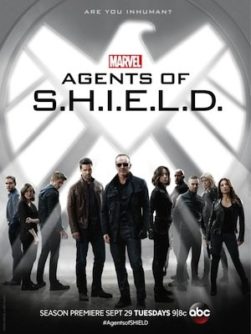
AGENTS OF S.H.I.E.LD: EMANCIPATION, ABSOLUTION and ASCENSION
Marvel's thrilling, redemptive finale points toward faith, love, and sacrifice.
Should You Watch It?
These final three episodes of Season Three play like a redemptive action movie. The writing is full of suspenseful twists and funny lines, while the direction and acting create a powerful emotional impact.
More importantly, the episodes present an unusually direct Christian allegory. A Cross necklace becomes a symbol of faith, while love, hope, sacrifice, forgiveness, and the rejection of revenge shape the story. The action includes tremendous uses of force, shootings, bloody wounds, and grotesque transformations. There is also light foul language.
If your older children or teenagers can handle those concerns, this is some of the strongest and most meaningful Marvel television available. For younger children, use discernment.
The Story
NO SPOILERS — WE KEEP THE SURPRISESThe agents of S.H.I.E.L.D. face Hive, a demonic alien who has taken over the body of a former enemy. Hive plans to unleash a pathogen that will let him control the minds and souls of everyone on Earth.
As the agents fight to stop him, Daisy, Lincoln, Coulson, and their fellow agents are forced to confront mind control, guilt, revenge, and the cost of saving others. A Cross necklace passes among several heroes as the battle between good and absolute evil intensifies.
Is It Any Good?
Four stars means these episodes are among the best episodic television the source review has seen. The scripts are extremely exciting, with suspenseful twists and turns as well as many funny lines.
The direction and acting meet the material's emotional demands and deliver a terrific emotional punch. The episodes are so moving that the reviewers were brought to tears several times. Taken together, they work as a riveting, redemptive action story with unusually strong Christian meaning.
The Worldview
These episodes present a powerful Christian allegory centered on a Cross necklace. The villain is compared to the Devil, and biblical language describes his plans for Armageddon. The story also speaks of salvation, sin, souls, evil, and a person giving his life to save mankind.
The worldview strongly exalts faith, love, hope, sacrifice, and forgiveness. It rebukes revenge, greed, manipulation, and the desire to control other people. Hive claims that he wants to unite humanity, but the story exposes that unity as domination because he seeks control over people's minds and souls.
The episodes align with biblical teaching when they present evil as destructive, reject revenge, and honor sacrificial love. Their science-fiction framework and demonic villain are allegorical rather than a complete biblical account, but the central moral direction is clear: love gives itself for others, while evil seeks power through coercion.
The story's longing for salvation through self-sacrifice echoes Jesus' words: “Greater love has no one than this, that someone lay down his life for his friends” (John 15:13).
The Content Guide
The specifics — spoilers included by nature — so you can judge for your own family.
Content Summary
Very strong Christian, moral worldview, with overt references to the cross and salvation, as well as the villain is compared to the Devil and biblical language is used to reveal his plans for Armageddon, it’s said that someone died to pay for everyone’s “mistakes” and to save mankind, it’s said that a woman “lost her soul” to a demonic villain, but she’s delivered, it’s said that evil preys on the weak, positive references to God (including “Thank God” is said two or three times), “your sins” is mentioned in one line, and love, faith, hope, sacrifice, and forgiveness are extolled while revenge and mind control are shunned and overcome; four light obscenities and one light profanity in one episode, six light obscenities and one muffled “Jesus” in second episode, and six obscenities in third episode; television violence including tremendous uses of force, fighting, shootings, bloody wounds, wounded woman is losing excess blood, and her wound has to be cauterized until they can get her medical attention, human beings being are turned into grotesque creatures with inhuman powers; discussions of love and man mentions wanting to see women, but no sex; no nudity; brief alcohol use in one episode; no smoking or drugs; demonic villain says he’s trying to help the human race by uniting them, but it’s pointed out he’s doing it against their will and to control their minds and souls to get absolute power, some lying, and revenge but it’s rebuked.
Talk About It
Four questions for the couch, the commute, or the couple bingeing it together.
Hive claims that controlling people can unite them. Why is love different from control?
1 Corinthians 13:4–7 · Galatians 5:13The story treats sacrifice as an expression of love. What makes a sacrifice loving rather than merely painful?
John 15:13 · Romans 5:7–8The episodes rebuke revenge. What does Scripture ask us to do when someone has hurt us?
Romans 12:19–21 · Ephesians 4:31–32Several characters struggle with guilt and the need for forgiveness. How does the Bible describe the difference between condemnation and forgiveness?
Romans 8:1 · 1 John 1:9The Final Word
These episodes combine exciting action, sharp writing, moving performances, and a striking Christian allegory. The violence and light language call for discernment with younger children, but older viewers can find faith, hope, love, forgiveness, and sacrifice here. Our answer is WORTH WATCHING.