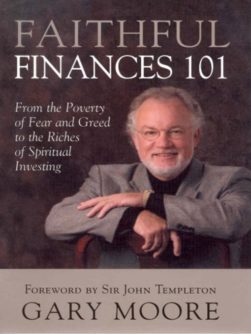
FAITHFUL FINANCES 101
A clear Christian framework for handling money faithfully.
Should You Watch It?
FAITHFUL FINANCES 101 offers a strong Christian approach to money without reducing the Bible to a single proof text. Gary Moore examines financial questions in context, showing that principles such as borrowing cannot be responsibly understood through a simple “never” or “always.”
The book’s central strength is its perspective. Money is not to be worshiped. It is a tool that can be used to bless others. Moore also explains the giving principle that shaped Sir John Templeton’s life and success: “It is more blessed to give than to receive.”
The source calls this book “must reading” and especially recommends it to people who need financial help or want to express God’s will in this area. If that describes you, FAITHFUL FINANCES 101 is worth seeking out.
The Story
NO SPOILERS — WE KEEP THE SURPRISESFAITHFUL FINANCES 101 follows Gary Moore’s effort to build a comprehensive biblical perspective on economics. Drawing from his experience as a successful financier and from years working with Sir John Templeton, Moore examines how believers should understand borrowing, prosperity, giving, and the purpose of money.
Is It Any Good?
Four stars means this is a notably strong and useful work. The source praises Moore’s clear, intelligent perspective and his thoroughly sound theological approach.
Its method is also a major strength. Rather than building an economic theory on one isolated biblical statement, Moore considers the broader biblical text and applies it to practical financial questions. The source’s only complaint is that Moore names experts and pundits who offer less comprehensive advice or hold different perspectives.
The Worldview
FAITHFUL FINANCES 101 treats economics through a distinctly Christian worldview. It rejects proof-texting and instead seeks to understand financial questions in the context of the whole biblical text. That approach allows Moore to distinguish between appropriate and inappropriate borrowing rather than offering a simplistic rule.
The book also places money in its proper position. Wealth is not something to worship or pursue as an ultimate good. Money is a tool that can bless others, and generosity is presented as a central principle of faithful prosperity.
The source especially connects this perspective with Sir John Templeton, who lived by the principle, “It is more blessed to give than to receive.” That emphasis aligns with Jesus’ teaching: “It is more blessed to give than to receive” (Acts 20:35).
The Content Guide
The specifics — spoilers included by nature — so you can judge for your own family.
Content Summary
Christian worldview of economics. GENRE: Non-Fiction/Self-Help
Talk About It
Questions for the drive home, the dinner table, or the youth group.
What does it look like to treat money as a tool rather than something to worship?
Matthew 6:19–21 · 1 Timothy 6:17–19When might borrowing be wise, and when might it become harmful? What biblical principles should guide that decision?
Proverbs 22:7 · Romans 13:8How can your family use money to bless other people this week?
Acts 20:35 · 2 Corinthians 9:6–8Why is it important to consider the whole counsel of Scripture instead of building a financial belief on one isolated verse?
Acts 20:27 · 2 Timothy 3:16–17The Final Word
FAITHFUL FINANCES 101 brings clarity to a subject that troubles many people. Its comprehensive biblical approach, emphasis on generosity, and practical treatment of financial questions make it a valuable resource for believers of all ages. WORTH THE TRIP.