
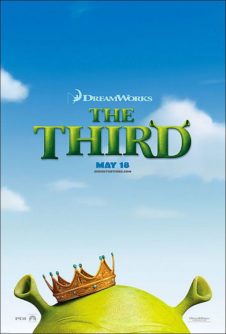
SHREK THE THIRD
Deconstructing fairy tales with warmth, wit, and heart.
Should You Watch It?
Shrek the Third is a funny, skillfully made sequel with more heart than its deconstructionist humor might suggest. It affirms family, children, love, goodness, trusting your talents, and taking personal responsibility. The film also explores the fear of parenthood and the weight of leadership.
The costs are real but limited. Some jokes are mean spirited, and some gender-bending humor could confuse younger children. Cartoon violence and jokes built around accidental killing also treat life too casually at times.
For older children and adults, this is a lively movie with morally uplifting content and unusually thoughtful comedy. Use your discernment with younger children. The practical answer: WORTH THE TRIP for older children to adults.
The Story
NO SPOILERS — WE KEEP THE SURPRISESPrince Charming is stuck performing in a cheap dinner theater, but he has not given up on claiming the throne of Far Far Away.
Meanwhile, Fiona’s dying father believes Shrek could become a good leader. Shrek wants no part of kingship and sets out with Donkey and Puss-n-Boots to find Arthur, another heir who is away at boarding school. When Charming returns with a band of storybook villains, Shrek and his friends must help Arthur face responsibility and save the kingdom.
Is It Any Good?
Four stars means this is an exceptionally funny and well-made film. Unlike the previous sequel, it is funny from the opening scene. The writing, plotting, and development are the strongest of the Shrek series, and the production is carefully layered to appeal to both older and younger viewers.
Its comedy ranges widely, making fun of fairy tales, schools, magic, emotionalism, rationalism, and much more. Some of that humor is mean spirited, but the movie’s intelligence and heart keep it from becoming empty parody. It is one of the funniest, best-made movies the source review had seen in some time.
The Worldview
Shrek the Third is a fractured, deconstructionist fairy tale that makes fun of almost everything while still affirming family, children, love, goodness, trusting your talents, and personal responsibility. Its humor targets fairy tales, fairies, majorities, minorities, schools, magic, emotionalism, rationalism, and psychotherapy.
The film promotes accepting responsibility and doing what is right. Sloth, lying, rejecting parenthood, and avoiding responsibility are condemned. At the same time, its worldview includes paganism, romanticism, humanism, and magic, usually treated humorously. Some jokes about gender could confuse young minds, while the apparent pro-life message about having babies stands out within the film’s broader comic approach.
At its center, the movie values family and the courage to accept responsibilities that cannot be avoided. Scripture likewise teaches, “Let each of you look not only to his own interests, but also to the interests of others” (Philippians 2:4).
The Content Guide
The specifics — spoilers included by nature — so you can judge for your own family.
Content Summary
Light moral worldview dominates with family highly valued and children, love, goodness, trusting your talents, and taking personal responsibility promoted, plus a good deal of paganism, romanticism, humanism, and magic, usually in a humorous context; seven references to poop and butt, some burping and passing gas, and a couple of vomiting scenes; lots of cartoon slapstick violence and several jokes built off killing someone accidentally, which should not be funny; Shrek lies in bed naked and several references to sexual activity, but very lightweight; upper male nudity; reference to drinking at a bar; reference to smoking dope at boarding school; sloth condemned, lying condemned, rejecting parenthood condemned, and avoiding responsibility condemned, with family highly valued.
Talk About It
Questions for the drive home, the dinner table, or the youth group.
Shrek is afraid of becoming a father and of accepting responsibility. What responsibilities might you be tempted to avoid, and how can God help you face them?
Galatians 6:5 · 2 Timothy 1:7The film values family, children, and love. What makes a family strong when its members are facing fear or change?
Colossians 3:12–14 · Ephesians 4:2–3Arthur initially resists the responsibilities connected with leadership. What is the difference between trusting your talents and seeking power for yourself?
Romans 12:3–8 · Mark 10:42–45The movie uses humor to make fun of many beliefs and traditions. When does humor help us see something clearly, and when can it become mean spirited?
Proverbs 15:1 · Ephesians 4:29The Final Word
Shrek the Third is a brilliant, funny sequel that affirms family, love, goodness, and personal responsibility. Its mean-spirited and gender-bending jokes call for discernment with younger children, but older children and adults can appreciate its heart and craft. WORTH THE TRIP.

