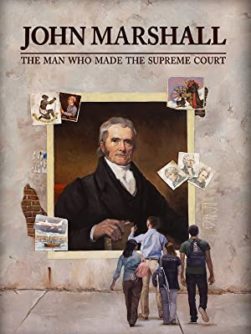
JOHN MARSHALL: THE MAN WHO MADE THE SUPREME COURT
Informative and absorbing history with a strong moral worldview.
Should You Watch It?
If you want to understand how the Supreme Court became an independent branch of the federal government, this documentary gives you a thorough and absorbing education. It presents John Marshall’s life, conflicts with Thomas Jefferson and Andrew Jackson, and rulings in eight important cases through scholars, historical locations, and actors performing excerpts from arguments and decisions.
The film’s strong moral worldview and high view of the Constitution give it real value. It also treats slavery, the rights of American Indians, and the forced removal of the Cherokee. But the academic discussion runs long, and the documentary never explains the biblical and divine foundations of the American system of law and government.
You should see it if your family has the time and interest for serious history. For younger viewers, parents may want to watch alongside them and discuss the difficult material.
The Story
NO SPOILERS — WE KEEP THE SURPRISESJohn Marshall served as Chief Justice of the Supreme Court from 1801 to 1835. Beginning with his military service under George Washington, law career, marriage, and support for the Constitution, the documentary follows his rise to the court.
It then examines eight major cases involving judicial review, treason, contracts, interstate commerce, a national bank, American Indian rights, and the slave trade. Constitutional and history scholars explain the cases while actors, historical sites, and archival paintings bring the period to life.
Is It Any Good?
Three stars means a good, worthwhile documentary with notable limitations. JOHN MARSHALL is very informative, absorbing, and detailed. Viewers interested in the development of the Supreme Court and the early United States government will be captivated by the politics and cases.
The many scholars discuss the material at length, while visits to places connected with Marshall and his rulings give the history a physical sense of place. The actors are especially effective at bringing historical figures and arguments to life. A dynamic semi-classical score by John Keltonic adds energy, although the soundtrack is kept extremely low.
The main drawback is length. At 146 minutes, the documentary is a bit long, and its academic approach may limit its appeal.
The Worldview
The documentary has a strong moral worldview with very strong pro-American, patriotic, and pro-Constitution elements. It venerates the United States Constitution as the supreme human law of the nation and presents Marshall’s judicial career as powerful and influential.
It also offers a fair presentation of Marshall’s career while leaving important matters for viewers to consider. The film does not discuss the biblical and divine foundations of the American system of law and government, including the belief that God’s Law stands above the Constitution. It does not discuss the Tenth Amendment’s broad powers for state governments or scholarly arguments that Marshall’s understanding of it was flawed.
The documentary addresses Marshall’s slave ownership and his failure to grant inherent civil rights to the slaves involved in one case. It also discusses the rights of American Indians, the forced removal of the Cherokee, and the complicated historical circumstances surrounding President Jackson’s refusal to enforce Marshall’s ruling. The film does not mention that the Cherokee themselves owned African slaves.
The film’s central concern is the way law, constitutional authority, and government shape a nation. Scripture reminds us that earthly authority is not ultimate: “For there is no authority except from God” (Romans 13:1).
The Content Guide
The specifics — spoilers included by nature — so you can judge for your own family.
Dominant Worldview and Other Worldview Content/Elements
Strong moral worldview, with very strong Pro-American, patriotic, pro-constitutional elements, in a documentary about the most influential Supreme Court Justice, mitigated by a secular approach to the subject matter
Foul Language
No foul language
Violence
Some references to and paintings of war such as a painting of soldiers in the American War of Independence shows muskets being fired, and the soundtrack has sounds of bullets being fired and whizzing
Sex
No sex
Nudity
No nudity
Alcohol Use
Some alcohol use by constitutional scholars and historians discussing things at dinner, people drink a Mint Julip punch outside playing a game to discuss the movie’s subject, who enjoyed Mint Julips too
Smoking and/or Drug Use and Abuse
No smoking or drugs;
Miscellaneous Immorality
References to slavery, public sentiment against American Indians and to the hatred between a Supreme Court Justice and his cousin, who just happened to be the President of the United States.
Talk About It
Questions for the drive home, the dinner table, or the youth group.
Marshall’s career centers on the authority of law and government. What does Scripture say about the source and purpose of governing authority?
Romans 13:1–4 · 1 Peter 2:13–14The documentary discusses slavery and the forced removal of the Cherokee. How should Christians think about justice when laws or governments permit wrongdoing?
Isaiah 1:17 · Micah 6:8The film honors the Constitution but does not discuss God’s Law above human law. Why does Scripture teach that God’s standards are higher than every human authority?
Acts 5:29 · Psalm 119:89Marshall’s decisions helped shape the balance between federal and state power. How can authority be used to protect people rather than to serve pride or political control?
Mark 10:42–45 · Philippians 2:3–4The Final Word
Informative, absorbing, and morally serious, JOHN MARSHALL offers a valuable lesson in the formation of the Supreme Court. Its academic pace and secular framing require patience, but families interested in American history may find the time well spent. WORTH THE TRIP for older children and adults with an interest in government and law.