
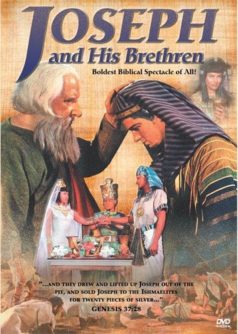
JOSEPH & HIS BRETHREN
An engaging reminder of God’s mysterious ways.
Should You Watch It?
This digitally remastered 1960 Italian film brings Joseph’s story to the screen with energy and warmth. It shows Joseph as wise, faithful, and willing to give God credit for his gifts, even as betrayal, slavery, false accusation, and prison reshape his life.
The movie is not especially concerned with historical or biblical accuracy. Its dialogue can be campy, and Potiphar’s comic behavior creates a sharp contrast with the seriousness of Joseph’s suffering. Still, the film makes the biblical account more vivid than words on a page alone.
There is a fair amount of non-graphic violence. A few background actors wear revealing outfits, and Potiphar’s wife repeatedly tries to seduce Joseph before falsely accusing him. Adults and older children can find value here; for young children, choose with discernment. The practical answer: WORTH THE TRIP for adults and older children, with discernment for young children.
The Story
NO SPOILERS — WE KEEP THE SURPRISESJoseph is Jacob’s favored son, admired for his wisdom and closely bonded with his youngest brother, Benjamin. After Joseph shares a dream in which his family bows before him, his brothers turn against him and sell him into slavery.
In Egypt, Joseph’s intelligence wins him better treatment and draws the attention of powerful officials. But when Potiphar’s wife tries to seduce him and he refuses, her false accusation sends Joseph to prison—where his ability to interpret dreams may change everything.
Is It Any Good?
Three stars means this is a worthwhile but imperfect biblical drama. The movie brings Joseph’s story to life in an engaging way, and its dramatic events remain accessible even when the production takes liberties with the source material.
The film’s weaknesses are clear. Much of the dialogue is campy, and Potiphar often plays like a vaudeville character—part bumbling idiot and part spoiled brat. The historical costuming is also loose, with hints of 1950s styles and an Egyptian setting shaped largely by the production designer’s imagination. Still, it looks Egyptian enough for the average viewer, and the story’s central movement remains effective.
The Worldview
The film is centered on the biblical story of Joseph. It presents Joseph as faithful and repeatedly gives God credit for his wisdom and ability to interpret dreams. Characters also pray before meals, while Egyptian gods are referenced in a few scenes.
The movie does not consistently preserve the biblical account. Some scenes were revised, and other liberties appear to have been taken for entertainment or decency. Most of these changes do not affect the main story, but viewers should distinguish the film’s version from Scripture itself.
The presentation is dated and sometimes theatrical. Some women wear tight-fitting, evening-gown-like dresses, a few background actors wear skimpy outfits, and Potiphar’s comic characterization makes parts of the film feel almost vaudevillian. Those choices can distract from the seriousness of Joseph’s faithfulness, even as the movie keeps that faithfulness at its center.
Joseph’s story points to God’s mysterious providence through suffering, betrayal, and reversal. As Joseph later says in Scripture, “you meant evil against me, but God meant it for good” (Genesis 50:20).
The Content Guide
The specifics — spoilers included by nature — so you can judge for your own family.
Content Summary
Entirely about the biblical story of Jo-seph, multiple mentions of God and His divine powers, characters offer prayer to God before eating their meals, Egyptian gods are referenced in a couple of scenes, some scenes were revised by the writers and do not reflect Biblical accuracy; two men with a knife fight over ownership of a sheep, man throws a stone at another man's head and knocks him out, man brings a knife to a lamb’s throat to kill it, but does not show the act itself, man cuts another man's arm with a knife as a form of medical treatment, slaves are beaten with whips or clubs and shown with cuts on their backs, man is hanged but the camera cuts away during the act and only the sound is heard, invading army stampedes over fallen men, floodgates open onto an unprepared army, and several people and ani-mals are shown as having drowned, some dead sheep due to famine are shown, man is slapped in the face and blood is drawn, and a man beats his slave; married women tries to tempt a man into bed with her; male slaves and Egyptian men are shown without shirts, and females wear revealing undergarments that partially show their backsides; some wine drinking at meals; and, woman falsely accuses man of trying to rape her, brothers make fun of sibling and plot to get rid of him, men lie to their father about a sibling’s death.
Talk About It
Questions for the drive home, the dinner table, or the youth group.
Joseph remains faithful when his circumstances change dramatically. What might faithfulness look like when life feels unfair?
Genesis 39:2–3 · James 1:2–4Joseph’s brothers act out of jealousy and then lie to their father. How can jealousy damage a family, and what helps restore trust?
Genesis 37:3–4 · Ephesians 4:25Potiphar’s wife tries to lead Joseph into sexual sin, but he refuses. What boundaries can protect us when temptation comes?
Genesis 39:7–12 · 1 Corinthians 6:18Joseph’s life shows God working through suffering and betrayal. Where do you see the difference between what people intend and what God can redeem?
Genesis 50:20 · Romans 8:28The Final Word
This is not the definitive telling of Joseph’s story, but it is an engaging and worthwhile reminder of God’s mysterious ways. Its campy style and biblical liberties are real, while its central picture of Joseph’s faithfulness remains valuable. For adults and older children, with discernment for young children, WORTH THE TRIP.









