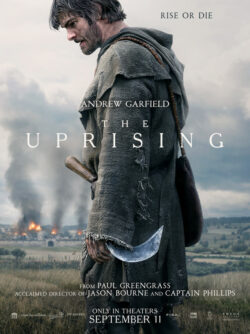
THE UPRISING
A gripping drama that shows what happens when a righteous cause trades God's justice for man's vengeance.
Should You Watch It?
Yes, but this one comes with a hefty dose of historical brutality. The movie tells a sobering story about peasants who rise against a corrupt Crown and reach for real justice. The action moves across muddy fields, torched manors, and the streets of London, and ordinary men throw off centuries of oppression in one desperate stand. This same revolt gave rise to the Robin Hood legend.
This story carries real weight: thoughtful, brutal, and morally complex. It offers strong moments of conviction, sacrifice, and grief over what violence costs even a righteous cause.
Ploughman's search for a justice beyond human corruption gives the story real weight, and Alice keeps him tethered to his own conscience when rage threatens to swallow it. The revolt itself turns dark fast.
Factions splinter, churches burn, and the mob starts to kill the innocent along with the guilty, until the line between oppressor and oppressed nearly disappears. This movie gives you a cause worth cheering for, then turns around and shows what can happen when the fight for what’s right goes too far.
The Story
NO SPOILERS — WE KEEP THE SURPRISESBased on the 1381 English Peasants' Revolt, Farmer Ploughman leads the people against the young King Richard II. He fights against unfair taxation and the aftermath of the Black Death. As the plot unfolds, deception and killings arise. The story asks, "Where is God in all of this?" The throne shows no mercy to the people. When the rebels seize power, they lose control and begin to kill the king's court and the citizens of the king's realm.
Is It Any Good?
Four stars for this movie's production value and a story that does real justice to the historic struggles of the 1381 peasants' revolt, when crushing taxes grind down a nation already gutted by the Black Death.
The cinematography impresses at every turn, the sets and costumes convince down to the last detail, and the score lifts each scene without ever calling attention to itself. Few movies reach this level of craft.
The violence hits hard. Sword fights, decapitations, and severed heads on display fill several scenes, and men parade the dead as trophies. Some moments show women enduring rough abuse under their skirts. Deception and brutal killing drive this story from start to finish, and the movie never looks away, proving that history, told with this much skill, cuts deeper than most fiction ever could.
The Worldview
This movie presents a strong moral and biblical worldview. The peasants believe that true justice comes from God, while injustice arises from human schemes. Ploughman acts out of conviction, and Alice keeps him accountable when grief and rage threaten to consume him. This conflict between divine justice and human corruption drives the plot.
An anti-biblical thread runs alongside the main theme, as the king's counselors misuse God's name for power, and the king searches for spiritual guidance but ultimately chooses his own path. Deceit permeates his hierarchy, leading the mob to swap justice for vengeance amid the violence. This adds a lighter aspect to the story, but its moral foundation remains intact.
The story also carries a subtle Romantic element, depicting the peasants as decent individuals oppressed by a corrupt system. However, the focus stays on the choices of Ploughman and Alice rather than blaming the system. In the end, the story maintains a strong moral backbone, tested but not broken by the surrounding deceit and violence.
The Content Guide
The specifics — spoilers included by nature — so you can judge for your own family.
Content Summary
Dominant Worldview and Other Worldview Content/Elements
Strong Christian, biblical worldview with the hero offering himself up when accused, showing mercy toward captured soldiers, and sparing the life of the king himself even as others call for blood, alongside overt Christian imagery throughout, including a man dressed as Jesus carrying a cross through the Corpus Christi festival, priests leading prayers, crosses and stained glass in nearly every scene, and rebels declaring "God will grant us our own miracle" and "we will stand in God's grace again"; undercut by an anti-biblical thread as the king's counselors invoke God's name to justify their own corruption and the king turns from a spiritual answer to follow his own way instead; and a light Romantic thread as the peasants rise as fundamentally decent people crushed by an oppressive system, with the revolt's slide into chaos reading at times like proof that the system corrupts otherwise good men
Foul Language
No foul language but characters trade insults, threats, and harsh dialogue during political confrontations and battle scenes
Violence
Strong violence including large-scale medieval battles with swords, spears, axes, knives, and bows. Characters get stabbed, slashed, beaten, and killed, with bloody wounds and corpses shown on screen throughout. Executions and realistic battlefield deaths as the revolt spreads. Sword fights, decapitations, and severed heads put on display, plus soldiers who beat and slash enemies during brawls. The council orders a mass slaughter of the rebels after promising to hear their demands, and the mob itself turns just as brutal, killing indiscriminately once the revolt spirals out of control
Sex
Soldiers grope women's private parts under the pretense of checking their age, and rape gets mentioned
Nudity
No nudity
Alcohol Use
No alcohol use;
Smoking and/or Drug Use and Abuse
No smoking or drug abuse;
Miscellaneous Immorality
Characters try to pressure the hero into compromising his mercy, but he refuses to abandon it. The king's counselors invoke God's name to mask their own schemes. The king breaks his word to the rebels, agrees to their demands, then orders his armies to slaughter them. The mob turns to vengeance and kills people who never wronged them, and the hero himself beats and slashes enemies despite showing mercy elsewhere.
Talk About It
Questions for the drive home, the dinner table, or the youth group.
God's name gets used to pursue a personal agenda. The Apostle Paul knew some preached of Christ for wrong reasons. Do we use God or His name for our advantage or personal gain? Philippians 1:15
The king uses deception to betray and kill his people. Sin began in the form of deception when Satan tempted Eve. Do we notice when someone deceives us, or when we deceive others? Genesis 3:13
The peasants let vengeance replace their pursuit of justice. Scripture teaches that vengeance belongs to God alone, not to man. Do we trust God to make things right, or do we take justice into our own hands? Romans 12:19
The king searches for a spiritual answer, then follows his own understanding instead. Scripture warns us not to lean on our own understanding, but to trust God fully. Do we ask God for direction only to walk our own path anyway? Proverbs 3:5-6
The Final Word
THE UPRISING shows off real production value from start to finish. The acting holds strong, and every piece of craft behind the camera pulls its weight, so the story grabs you and doesn't let go. Merciless killings from the peasants and the king alike fill the screen, so weigh your choice carefully before you watch. A story built on the search for God's justice still has to earn that search through blood, and this movie never lets you forget the cost. Kids and teens should sit this one out; this one's for discerning adults only.