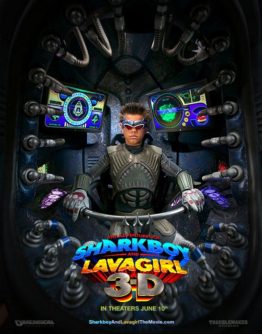
THE ADVENTURES OF SHARK BOY AND LAVA GIRL IN 3-D
A boy learns to dream better — and forgive — in this inventive fantasy.
Should You Watch It?
Robert Rodriguez, the mind behind SPY KIDS, has built another inventive, funny world for kids — this one imagined by his own young son. It's a fantasy about a bullied boy whose imaginary friends turn out to be real, and about learning to rebuild a dream after it's been smashed.
The film earns its praise honestly: it's genuinely creative, it builds to an exciting climax, and it lands a rare, strong message of forgiveness, repentance and reconciliation. It also stumbles a bit — the 3-D effects go murky in the darker scenes, and the acting isn't always convincing.
None of that undercuts what the movie is trying to do, and mostly does: encourage kids to dream well, not just big, and to let go of bitterness. The only real caution is for the very young, who might find some of the villain's antics genuinely scary. For families with kids seven and up, this one is worth the trip.
The Story
NO SPOILERS — WE KEEP THE SURPRISESTen-year-old Max tells his class about his imaginary friends — Shark Boy, raised by sharks after losing his father, and Lava Girl, a volcanic girl who emits flame and molten rock — and about Planet Drool, the fantastic world they call home. Nobody believes him, especially the class bully, who steals Max's dream journal. Then Shark Boy and Lava Girl actually show up at school. They need Max's help: Planet Drool is losing its light, and its dreams, fast.
Is It Any Good?
Three stars means this is solid, likable family filmmaking with real limitations. The 3-D effects turn murky in Planet Drool's darker scenes, since much of the story takes place after the villain has shut off the lights, and the acting doesn't always convince. Those are real flaws.
What carries the film past them is the allegory itself — elaborate, fanciful, and clearly born from a child's imagination rather than a studio memo. The story builds to a clever, exciting climax that should hold kids of all ages, and its "build a better dream" message gives it more staying power than its effects budget might suggest.
The Worldview
This is a movie with a strong moral worldview, and it knows exactly what it wants kids to walk away believing. Dreams matter — but not all dreams are worth chasing. When a dream gets smashed, or doesn't work out, the answer isn't despair; it's to "build a better dream, then work to make it real." That's a meaningfully different message than the culture's usual "follow your heart" or "do your own thing," because it insists that what you dream must also be good, not just deeply felt.
The film's clearest strength is its message of forgiveness, repentance and reconciliation — a genuinely Christian note that Rodriguez has also woven through his SPY KIDS films. It's a rare thing to find played straight in a kids' fantasy, and it's worth celebrating.
The one worldview wrinkle worth naming: a schoolteacher voices a mild version of child-centered, Romantic educational theory, suggesting teachers learn as much from students as students learn from them. It's a passing line, not a thesis, but discerning parents may want to talk it through.
Underneath the fantasy is a very old longing — that what's broken can be rebuilt, that failure isn't final. Scripture says it more completely: "Therefore, if anyone is in Christ, he is a new creation. The old has passed away; behold, the new has come" (2 Corinthians 5:17).
The Content Guide
The specifics — spoilers included by nature — so you can judge for your own family.
Content Summary
Very strong moral worldview, with strong Christian message of forgiveness and repentance, set in an allegorical fantasy land where dreams can come true, even bad dreams, but that encourages children to make only their good dreams come true, with slight nod to Romantic views of education and child-centered theories of education when grade school teacher says teachers become great when they realize that they can learn just as much from their young students as their students learn from them; no foul language; family action violence and some moments that might scare some young children under age six or seven, such as things get smashed, fighting, falling, scary characters, and electrical villain shocks people; no sex (Shark Boy and Lava Girl kiss one time, though); no nudity; no alcohol or smoking; and, nothing else objectionable.
Talk About It
Questions for the drive home, the dinner table, or the youth group.
Max's dream journal gets stolen, and his classmates mock him — but the story ends up being about forgiveness, not revenge. Why do you think forgiving someone who's hurt you is so hard, and what does God's Word say about it?
Colossians 3:13The movie says when a dream gets smashed, the answer is to "build a better dream." How is that different from just "following your heart," and how do you tell a good dream from a bad one?
Proverbs 16:3 · Philippians 4:8Shark Boy and Lava Girl encourage Max to keep working even when it's hard. What's a dream or goal you've given up on too easily, and what would it look like to pick it back up?
The teacher in the movie says she learns as much from her students as they learn from her. Where do you think that's true — and where does it go too far?
The Final Word
Robert Rodriguez has built another world worth visiting with your kids — imaginative, funny, and carrying a message of forgiveness that too few family films bother with anymore. The effects get murky and the acting is uneven, but the heart of it is right. Our answer: worth the trip — ages 7 and up.