
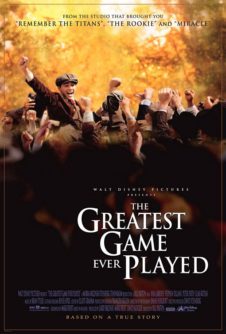
THE GREATEST GAME EVER PLAYED
A caddy's quiet dream becomes a David-and-Goliath triumph worth cheering.
Should You Watch It?
Yes — and gladly. This is the rare family film that gets nearly everything right: a father-son story, a mother-son story, a friendship, and an underdog tale, all braided together without a wasted scene. The source calls the structure "almost flawless," and it means it as high praise, not a hedge.
The costs are small. A handful of mild obscenities, some exclamatory "Oh God"s, a punch, some smoking, and light alcohol use round out the content — nothing that should give a family pause for long. The villains speak with classism and xenophobia, but the film doesn't endorse them; it lets a working-class caddy prove them wrong.
If you want a movie that makes you believe in storytelling again, and one you can watch with kids of any age, this is it.
The Story
NO SPOILERS — WE KEEP THE SURPRISESA poor boy named Harry Vardon grows up on a golf course he's told isn't for people like him — and grows up to become a champion anyway. Years later, a young caddy named Francis idolizes Vardon from a distance, forbidden by his own father from chasing the game he loves. When the 1913 U.S. Open comes to the very club where Francis works, he faces a choice: keep his promise, or step onto the course against the best golfers alive — including the idol he's never met.
Is It Any Good?
Four stars, and the source means it without reservation. The structure is called "almost flawless" — every plot beat lands, every relationship (father-son, mother-son, friendship) gets real weight, and each competing golfer, even rivals, comes across as a hero in his own right. The production is called "incredible": the special effects bring the golf itself to life, the score is "superb," and there are genuine laughs woven through. The direction of character is singled out as the film's best asset — nobody on screen is a cardboard cutout. This is craftsmanship at a level the source compares to beloved sleeper hits like October Sky.
The Worldview
This film exalts what Scripture exalts: a son reconciled to his father, a young man discovering that his talent is God-given rather than self-made, and the dignity of every person regardless of class. Loyalty, forgiveness, courage, and composure all get their due — virtues the story earns through struggle rather than simply asserting.
The one wrinkle is small: Francis disobeys and seemingly rebels against his father's wishes for much of the story, though the film brings the relationship back to reconciliation by the end. The villains of the piece voice classism, xenophobia, and casual imperialism — the film doesn't celebrate these attitudes, it exposes them, letting a working-class caddy's victory answer them.
The story leans openly on the image of David facing Goliath — a boy without status or pedigree, standing against giants with nothing but nerve and a gift he didn't give himself. That's a picture Scripture knows well: "The battle is the Lord's" (1 Samuel 17:47), and every good gift we carry into it was given, not earned (James 1:17).
The Content Guide
The specifics — spoilers included by nature — so you can judge for your own family.
Content Summary
Light Christian worldview with strong biblical morality emphasizing reconciliation between father and son, recognition of God's talent, understanding the uniqueness of each human being, as well as loyalty, forgiveness, courage, composure, and other biblical virtues, mitigated by ignoring father's advice and seemingly rebelling against father although there's reconciliation at the end; five mostly light obscenities, four exclamatory Oh Gods and My Gods, as well as overt discussion of God-given talent and reference to David against Goliath; man slugs another man in the jaw, man gets hit by golf ball and men break golf clubs; no sexual activity; no nudity; light alcohol use; much smoking; and, classism, xenophobia, and discussions of imperialism by the villains.
Talk About It
Questions for the drive home, the dinner table, or the youth group.
Francis goes against his father's wishes to pursue golf, but the story ends in reconciliation. When should we push forward with a dream despite a parent's disapproval, and when should we yield?
Ephesians 6:1–3 · Proverbs 3:5–6The film leans on the picture of David facing Goliath. What does it mean to trust that a gift from God, paired with courage, can outmatch impossible odds?
1 Samuel 17:45–47Harry Vardon and Francis both face people who think the game — or the world — isn't "for people like them." How does the Bible describe God's view of status and pedigree?
James 2:1–9 · Galatians 3:28A mocked young caddy becomes Francis's most loyal partner in the story. What does real loyalty look like, and who has been that kind of friend to you?
Proverbs 17:17The Final Word
This is the kind of film that reminds you why you love movies in the first place — a true underdog story told with heart, craft, and a quietly Christian view of talent, family, and courage. Small cautions aside, it's built for the whole family to watch together. Worth the trip.









