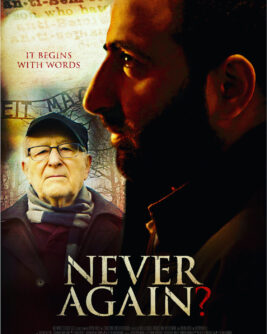
NEVER AGAIN?
A moving argument against anti-Semitism.
Should You Watch It?
You should see NEVER AGAIN? if you want a strong, accessible argument against anti-Semitism. The documentary gains power from the firsthand stories of Holocaust survivor Irving Roth and Kasim Hafeez, who describes his transformation from an anti-Semite into a vocal public defender of Israel.
The film’s emotional force comes from Roth’s account of losing his brother during the Holocaust and from Kasim’s conversation with an Israeli soldier about helping Syrian children injured during the civil war. Newsreel footage and interviews broaden the case against hatred of Jews and Israel.
The subject matter is painful, especially for younger viewers, but the content rating is positive. Watch it with older children and adults who can process Holocaust images and discuss the film’s call for peace, love and tolerance.
The Story
NO SPOILERS — WE KEEP THE SURPRISESNEVER AGAIN? follows two personal journeys. Irving Roth recounts his experiences as a Jewish teenager during the Holocaust. Kasim Hafeez explains how he was raised to hate Jews and Israel, became increasingly radicalized, and later traveled to Israel to discover a reality very different from what he had been taught.
Their stories are joined by newsreel images and interviews with Israelis, American Jews, rabbis and Pastor John Hagee.
Is It Any Good?
Four stars means this is one of the stronger recent entries in the growing field of documentary film. The movie adds dramatic tension to a staid documentary format by letting Roth and Kasim tell their own personal stories.
Its emotional high points are Roth’s description of losing his brother during the Holocaust and Kasim’s discussion with an Israeli soldier about helping Syrian children. The interviews, newsreel footage and images of Kasim visiting Israel support the film’s central argument without overwhelming those personal accounts.
The Worldview
The film presents a very strong moral worldview opposing anti-Semitism and hatred of Jews. It also opposes movements advocating the destruction of Israel as a Jewish state, including campaigns urging companies, governments and individuals to boycott, divest from and sanction everything connected with Israel.
The documentary argues that love, peace and tolerance should overcome hatred directed at ethnic and religious groups. It contends that keeping Israel as a Jewish state is vital to protecting Jews from anti-Semitic hatred and violence. The film also includes positive references to the Bible, Judaism and Christianity, including the Jewish roots of Christianity.
Its central moral claim aligns with the biblical rejection of hatred and bigotry. Its call to love others echoes Jesus’ words: “You shall love your neighbor as yourself” (Mark 12:31).
The Content Guide
The specifics — spoilers included by nature — so you can judge for your own family.
Dominant Worldview and Other Worldview Content/Elements
Very strong moral worldview opposing Anti-Semitism and hatred of Jews, including opposition to movements advocating the destruction of Israel as a Jewish state, with overt positive references to two or more Bible passages, Judaism and Christianity, including the Jewish roots of Christianity
Foul Language
No foul language
Violence
Light violence includes some newsreel footage and images showing soldiers with guns and soldiers marching, plus images of mass graves and emaciated Jewish prisoners in German concentration camps during World War II, but nothing gruesome as in other movies discussing the Jewish Holocaust
Sex
No sex
Nudity
Some images of upper male nudity during the liberation of German concentration camps by American soldiers
Alcohol Use
No alcohol use
Smoking and/or Drug Use and Abuse
No smoking or drugs;
Miscellaneous Immorality
Nothing else objectionable.
Talk About It
Questions for the drive home, the dinner table, or the youth group.
What happens when people are taught to hate an entire ethnic or religious group? How can truth challenge those teachings?
John 8:32 · Ephesians 4:25Irving Roth’s story preserves the memory of people who suffered and died. Why does remembering matter, and how should Christians respond to the suffering of others?
Psalm 78:4 · Romans 12:15The film argues for love overcoming hatred. What does biblical love require beyond simply avoiding hateful speech?
1 Corinthians 13:4–7 · 1 John 3:16–18Kasim’s visit to Israel changed what he believed. How can listening, learning and meeting people challenge prejudice?
James 1:19 · Philippians 2:3–4The Final Word
NEVER AGAIN? is a powerful documentary with a clear moral purpose. Its Holocaust images are difficult, but its message against anti-Semitism and hatred is valuable for older children and adults. WORTH THE TRIP for families prepared to watch thoughtfully and talk afterward.