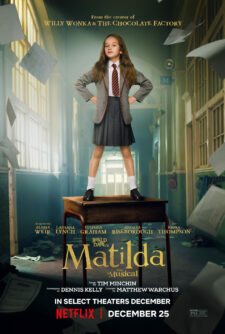
ROALD DAHL’S MATILDA THE MUSICAL
A dazzling revolt against injustice, but too dark for children.
Should You Watch It?
This is a highly original and entertaining musical with a strong moral center. Matilda’s classmates stand against oppression, the film promotes justice and the right to be a child, and one character wisely says, “Two wrongs don’t make a right.” Its large-scale children’s dance sequences can be riveting and powerful.
The cost is darkness. The headmistress treats children cruelly, threatens them with a torturous punishment, and confronts them in scenes that may frighten younger viewers. Matilda also uses telekinesis to move objects and make the villain believe a ghost is attacking her.
So the answer is clear: adults may find this a rewarding, energetic musical, but it is not suitable for children or young teens.
The Story
NO SPOILERS — WE KEEP THE SURPRISESMatilda is a highly intelligent 10-year-old British girl who loves books and excels at nearly everything. Her selfish, verbally abusive parents send her to a private school run like a prison by Agatha Trunchbull, a headmistress determined to crush children’s spirits rather than educate them.
Matilda finds support from the kindly Miss Honey and begins defending her frightened classmates. As the children discover their courage, Matilda’s ability to move objects with her mind gives their revolt an unusual power.
Is It Any Good?
Four stars means this is a standout movie musical. Director Matthew Warchus commands large crowds of child actors through elaborate dance sequences and choreography, while powerfully conveying the children’s emotional shift as they break free from oppression.
The musical numbers are frequent, and the scenes in which the children take a stand are riveting and jaw-dropping in their power. The film is audacious, entertaining, and highly original.
The Worldview
The film presents a light moral, Christian worldview through its concern for justice, freedom, children’s dignity, and the right to be a child. Matilda leads her classmates against a cruel authority figure, while Miss Honey represents kindness and the possibility that children can thrive when given the chance.
The movie also says that life is a miracle and includes the moral truth that “Two wrongs don’t make a right.” At the same time, it presents Matilda’s telekinesis as an occult talent. She uses this power to move objects, fling the female villain, and convince her that a ghost is attacking her. The power is used against an abusive headmistress, but its supernatural source remains a worldview concern.
The film’s longing for justice aligns with Scripture’s call to defend the vulnerable: “Learn to do good; seek justice, correct oppression” (Isaiah 1:17).
The Content Guide
The specifics — spoilers included by nature — so you can judge for your own family.
Dominant Worldview and Other Worldview Content/Elements
Light moral, Christian worldview where 10-year-old girl leads a student revolt for freedom, justice for children against a cruel headmistress at a school that’s akin to a prison, and the right to be a child, another teacher is kind, a character says, “Two wrongs don’t make a right,” and there are comments about life being a miracle, but girl uses her telekinesis power to move various objects with her mind and convince a female villain that a ghost is attacking her
Foul Language
One “d” word, two “h” words, and dozens of verbal insults against the title character and other children
Violence
A couple of comical slapstick scenes where an evil headmistress picks up a girl by her pigtails and rapidly twirls her by her hair and then throws her far across a field (the girl is unhurt), headmistress also pulls a boy’s ears and cruelly stretches them, headmistress frequently threatens the students with a punishment called “The Chokey” which is described to a comically horrible torture device that chokes and otherwise inflicts pain on children, telekinesis powers are used to fling a woman by her hair and across a field and make her think she’s being attacked by a ghost of a dead person from her past
Sex
No sex
Nudity
No nudity
Alcohol Use
Title character’s parents drink alcohol
Smoking and/or Drug Use and Abuse
No smoking or drugs;
Miscellaneous Immorality
A rude father is disappointed his newborn girl child isn’t a boy, and title character sings often about revenge and does pranks on her evil father such as turning his hair green and gluing a hat to his head, but she comes to peace with him later and frees him of these abuses.
Talk About It
Questions for the drive home, the dinner table, or the youth group.
Matilda sees children suffering under an unjust authority. What does Scripture ask us to do when we see oppression?
Isaiah 1:17 · Micah 6:8A character says, “Two wrongs don’t make a right.” How can you seek justice without answering wrongdoing with wrongdoing?
Romans 12:17–21The film describes life as a miracle. What does the Bible say about God’s care in creating each person?
Psalm 139:13–14Matilda uses telekinesis to oppose the headmistress. How should Christians think about supernatural powers that are not presented as coming from God?
Deuteronomy 18:10–12 · Acts 19:18–19The Final Word
This is a beautifully staged, highly entertaining musical about children standing against injustice. Its dark tone, harsh treatment of children, and supernatural telekinesis make it unsuitable for children and young teens. For discerning adults, it is WORTH THE TRIP — ADULTS ONLY. For other family viewing, see.