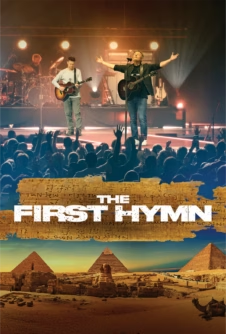
THE FIRST HYMN
An 1,800-year-old worship song comes home to the church that lost it.
Should You Watch It?
Here is a documentary built entirely to point at God — and it does. A scrap of parchment, barely intact, holds the oldest known Christian hymn, and this film follows the effort to bring it back into the mouths of believers. Along the way it teaches real theology, real history, and real reverence for the Trinity, without a single objectionable scene to weigh against it.
It's not flawless craft. The film juggles three subjects — ancient history, biblical theology, and modern music production — and the seams show. Scenes shift focus quickly, and at times the movie feels like two documentaries stitched into one 87-minute runtime, tedious in stretches rather than tightly told.
But the content is safe for every age, and the purpose is worth honoring: reviving forgotten praise for a new generation. Watch it as a family, and let the history lesson double as a worship service.
The Story
NO SPOILERS — WE KEEP THE SURPRISESA scrap of ancient parchment, discovered in the ruins of an Egyptian city and dated to roughly 1,800 years ago, holds the oldest Christian hymn ever found. John Dickerson, a Wheaton College professor captivated by both Scripture and music, sets out to bring it back to life. He travels to the ruins where it was first sung, then enlists two songwriters — Australian Ben Fielding and American Chris Tomlin — to help him restore the song's melody and meaning for today's church, without losing what made it sacred in the first place.
Is It Any Good?
Three stars means this: a documentary with real substance and a few structural stumbles. It earns its craft points by showing rather than just telling — visiting the Egyptian ruins where the parchment surfaced, walking through the Oxford discovery in the 1800s, and taking viewers inside Nashville recording studios to demystify how a modern worship song gets made.
Where it falters is focus. The film covers ancient history, biblical theology, and music production all at once, and the constant shifting between them makes long stretches feel disjointed and tedious rather than gripping. It's the kind of ambition that would have benefited from two films instead of one.
The Worldview
This film exalts worship itself — the idea that praise offered to God eighteen centuries ago can still be sung today, unbroken across time. Its theology is explicit and orthodox: the song at its center speaks plainly of one God who is Father, Son, and Holy Spirit, and the film treats that doctrine with care rather than glossing over it. Interviews throughout dig into the culture and beliefs of the early church, giving the film real substance beneath its music-documentary surface.
There is little here to push back against. The persecution and torture the early church endured is mentioned, but only briefly, and it's treated honestly rather than gratuitously — a true cost of the faith these worshippers held. The film's ambition is simply to hand the modern church back something it lost, and by its own measure, it succeeds.
The ache underneath this whole project is one Scripture already answers: the desire to join our voices to worship that has never stopped. "One generation shall commend your works to another, and shall declare your mighty acts" (Psalm 145:4).
The Content Guide
The specifics — spoilers included by nature — so you can judge for your own family.
Dominant Worldview and Other Worldview Content/Elements
Very strong Christian, biblical worldview with many references to God, the Bible, the early Christian church and the culture of their worship of God and Jesus, with a strong emphasis on the Holy Trinity
Foul Language
No foul language
Violence
Violent persecution and torture of Christians are briefly mentioned
Sex
No sex
Nudity
Upper male nudity is seen in some pictures and statues
Alcohol Use
No alcohol use
Smoking and/or Drug Use and Abuse
No smoking or drugs;
Miscellaneous Immorality
Nothing objectionable.
Talk About It
Questions for the drive home, the dinner table, or the youth group.
This hymn survived 1,800 years to be sung again. What does it mean that generations of Christians we'll never meet were worshiping the same God we worship now?
Psalm 145:4 · Hebrews 13:8The song's core message is that God is one being in three persons. Why does this doctrine matter enough to build a whole worship song — and a documentary — around it?
Matthew 28:19 · 2 Corinthians 13:14The film briefly mentions Christians who were persecuted and tortured for their faith. How does knowing what earlier believers suffered change the way you think about your own worship?
Hebrews 11:36–38 · Romans 8:35–39John Dickerson wanted the modern version to stay true to the "root and core" of the ancient song. Why does faithfulness to truth matter even when we're free to make something new?
Jude 1:3 · Psalm 96:1The Final Word
A film this clean, this Trinity-centered, and this eager to hand the church back a piece of its own history is easy to recommend. It stumbles in structure but never in spirit. Our answer stands: worth the trip. Gather the family, and let an 1,800-year-old song remind you how long God's people have been singing.