
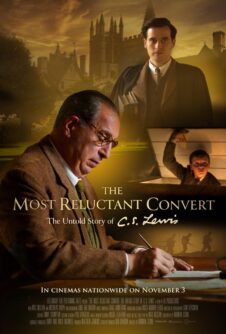
THE MOST RELUCTANT CONVERT
A powerful, reasoned journey from atheism to Christian faith.
Should You Watch It?
This is an unusually strong choice for teenagers and adults. The film presents C.S. Lewis’s movement from atheism to Christian faith as a careful, rational journey rather than a sudden emotional turn. Its arguments about Jesus Christ are clear enough that the film may be especially useful to share with non-Christian friends.
The story also carries heavy material. Lewis’s mother dies of cancer, his father collapses emotionally, and World War I brings scenes of friends being killed, maimed, and mutilated. There are also sexual references, alcohol use, and smoking.
Max McLean gives a terrific performance as Lewis, and the re-enacted scenes bring the story alive. Watch it with older children and adults, but choose something gentler for young children.
The Story
NO SPOILERS — WE KEEP THE SURPRISESMax McLean walks onto a set and becomes C.S. Lewis, looking back on the experiences that shaped his beliefs. Lewis describes a painful childhood, the intellectual influences that formed him, his experiences during World War I, and his years at Oxford University.
As an atheist surrounded by Christian thinkers, Lewis wrestles with suffering, reason, mythology, and the claims of Jesus. The film follows his reluctant movement toward the Christian faith.
Is It Any Good?
Four stars means this film is exceptionally effective. Its unusual format, with Max McLean speaking as Lewis while actors re-enact parts of the story, is surprisingly powerful.
McLean does a terrific job as Lewis. The supporting actors bring the story alive, and the careful arguments give the film intellectual force without losing its emotional impact. The result is a moving and inspiring drama that can engage both Christian viewers and non-Christian friends.
The Worldview
The film presents a very strong Christian worldview through the story of an atheist who moves from blasphemy and occult interest toward a rational, deep, explicit faith in Jesus Christ. Lewis begins by seeing the universe as empty, senseless, and chaotic, marked by pain. His mother’s death deepens his anger toward God, while books, philosophy, mythology, and Christian writers gradually challenge his assumptions.
The film exalts reason, truth, intellectual honesty, and the possibility that suffering does not disprove God. It also presents Christian friendship and careful conversation as important influences in Lewis’s transformation. The worldview analysis in the source describes his faith as centered on Jesus Christ and the conclusion that Jesus is Lord and Savior.
The film’s central movement—from unbelief toward faith—aligns with the Christian conviction that truth can renew a person’s mind and life. Scripture says, “Do not be conformed to this world, but be transformed by the renewal of your mind” (Romans 12:2).
The Content Guide
The specifics — spoilers included by nature — so you can judge for your own family.
Dominant Worldview and Other Worldview Content/Elements
Very strong Christian worldview in a story about an atheist who blasphemes God coming to a rational, deep, explicit faith in Jesus Christ
Foul Language
One “h” obscenity and lots of discussion of the painful death of a mother by cancer and the horrors of World War I
Violence
Scenes of mother dying with nurses holding her down because people were operated on at home and battle scenes of World War I where friends are killed, maimed and mutilated and title character is shot
Sex
Young boy lusts after teacher, and in the Army hospital, a pretty nurse steps behind a hospital screen to fornicate every night with one of the other soldiers with a few giggles heard on the soundtrack
Nudity
No nudity, but the nurse, in the shadows, starts taking off her clothes
Alcohol Use
Alcohol use and discussion about staying up all night
Smoking and/or Drug Use and Abuse
Smoking;
Miscellaneous Immorality
Father is very hard on his two sons, just as fathers were at that time, and his father breaks down completely when his wife dies and never recovers.
Talk About It
Questions for the drive home, the dinner table, or the youth group.
Lewis begins by asking how suffering fits with belief in God. How can Christians bring honest grief and hard questions to God?
Psalm 13 · Romans 8:18–25Lewis’s thinking is shaped by books and conversations with Christian friends. Who has helped you think more carefully about faith, and how can you help someone else search for truth?
Proverbs 27:17 · 1 Peter 3:15The film presents Jesus as more than a good moral teacher. What did Jesus claim about Himself, and why does that claim matter?
John 8:58 · John 14:6Lewis moves from unbelief toward faith through a search for truth. What does Scripture say about the renewal of the mind?
Romans 12:2 · 2 Corinthians 5:17The Final Word
This is a moving, intelligent, and powerfully performed account of C.S. Lewis’s journey to Christian faith. Its grief and wartime suffering make it unsuitable for young children, but teenagers and adults can find much to discuss and share. WORTH THE TRIP — TEENAGERS AND ABOVE.









