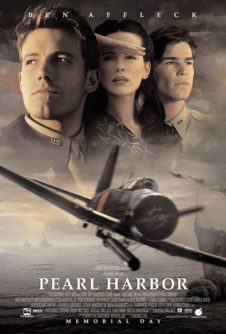
PEARL HARBOR
A spectacular, redemptive war epic weighed down by language and lust.
Should You Watch It?
Here's the shape of it. Michael Bay's recreation of the attack on Pearl Harbor and the Doolittle raid on Tokyo is genuinely spectacular — a piece of historical spectacle that earns its runtime. Layered underneath is a solidly moral core: one of the two young pilots at the story's center chooses to keep his love chaste, and the film rewards that choice rather than mocking it. That's rarer than it should be in a modern war romance.
It also costs you something. There's a real quantity of foul language — roughly forty obscenities and profanities combined — plus a scene of implied fornication and other moments where lustful intentions are plain. None of it is graphic, but it's present and it adds up.
If you're an adult or have teenagers old enough for a PG-13 war epic with real content to discuss, this one has more going for it than against it. If you're choosing for younger kids, wait — or watch it yourself first.
One sentence: worth seeing with teens and adults, but know what you're bringing them into.
The Story
NO SPOILERS — WE KEEP THE SURPRISESRafe and Danny are childhood friends who grow up to become Army Air Corps pilots as World War II dawns. Rafe falls for Navy nurse Evelyn — then ships out to fly with volunteers in England, where his plane goes down over the sea and he's presumed dead. Months later at Pearl Harbor, a grieving Evelyn finds comfort in Danny. Then, on the eve of December 7, 1941, Rafe turns up alive — just as Japan's fleet prepares to strike.
Is It Any Good?
Three stars means this: real craft, uneven writing. Michael Bay and his team stage the Pearl Harbor attack and the Doolittle raid with tremendous verisimilitude — the spectacle is the movie's strongest reason to exist. Where it stumbles is the love triangle and the youthful-heroics dialogue, which feel flat and predictable; the script and story turns could have used more work, though the cast does what it can with the material. A subplot featuring a Navy cook, played warmly by Cuba Gooding Jr., helps carry the weaker stretches. The result is a film that's more successful as a historical re-enactment than as a romance — good, not great, but genuinely worth the watch for what it gets right.
The Worldview
This film wants to be a love letter to "the brotherhood of heroes" who survived Pearl Harbor and helped defeat the forces of National Socialism in Japan — and largely, it succeeds at that. Its moral center holds: Rafe chooses to keep his relationship with Evelyn chaste even while his friend doesn't, and the story quietly rewards that restraint rather than treating it as naive. The ending carries a redemptive turn as well, one the story earns without preaching it.
That said, the film isn't clean. It carries romantic elements that lean, at moments, toward the sexual permissiveness of a film like Titanic before pulling back from it, some mild revisionist history bent mainly toward pacing and stock drama rather than accuracy, and pagan elements — foul language, implied sexual immorality, and an image of a Japanese Buddhist shrine — that keep this from being a clean recommendation for every viewer.
Still, the film's deepest longing is one Scripture recognizes: love that sacrifices itself for another. "Greater love has no one than this, that someone lay down his life for his friends" (John 15:13). That's the story this film is really trying to tell, even where its execution falters.
The Content Guide
The specifics — spoilers included by nature — so you can judge for your own family.
Content Summary
Moral worldview with strongly patriotic & solidly Christian, redemptive elements undermined by mild revisionist history (mostly meant to move story along & provide stereotypical entertainment), Romantic elements &, worst of all, some pagan elements including foul language, sexual immorality & image of Japanese Buddhist shrine; about 32 obscenities, 11 strong profanities & 18 mild profanities; lots of action & war violence with slight blood including explosions, gunfire, planes chasing one another, boats sinking, planes crashing, & men drowning, plus some intense hospital scenes including burn victims & nurse uses finger to stop blood flowing (but scene is not graphic); implied fornication; partial nudity; alcohol use; smoking; and, revenge & lust.
Talk About It
Questions for the drive home, the dinner table, or the youth group.
Rafe keeps his relationship with Evelyn chaste, even under pressure, while his friend Danny doesn't — and the film rewards Rafe's choice in the end. What does Scripture say about the cost, and the reward, of pursuing purity?
1 Thessalonians 4:3–4 · 1 Corinthians 6:18The movie calls its pilots a "brotherhood of heroes" who sacrifice for one another and their country. How does Jesus define the greatest kind of love?
John 15:13The film includes some "revisionist history" for the sake of drama and pacing. Why does it matter to tell a true story honestly, even when entertainment tempts us to bend it?
Proverbs 12:22The reviewer says the ending is "redemptive" without spoiling how. What does real redemption — after loss, grief, or a moral failure — actually look like, on screen or in your own life?
2 Corinthians 5:17–18The Final Word
Pearl Harbor is Michael Bay at his most sincere — a spectacular, occasionally hokey, ultimately redemptive tribute to the men and women who lived through one of America's darkest days. It also earns its caution flag, with real profanity and implied sexual sin along the way. Our answer stands: worth the trip — teens and up. Choosing for younger kids this weekend instead? Start here:.