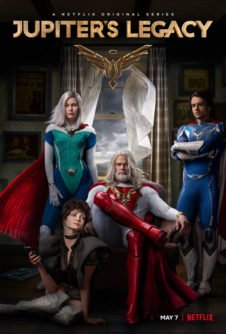
JUPITER’S LEGACY: Season One
Strong moral ideas cannot redeem excessive, unacceptable content.
Should You Watch It?
JUPITER’S LEGACY: Season One has real strengths. It promotes helping others, mercy, justice, opposing evil, and making the world a better place. It also includes two brief, positive Christian references to Jesus. Several moments are touching, exciting, and profound.
But the series repeatedly undermines those strengths with excessive negative content. Nearly every episode contains large amounts of foul language, including strong Jesus profanities. The season also includes strong occult elements, vague New Age mysticism, depicted sexual activity, drug abuse, and some very strong violence.
The three-star rating means the season has worthwhile ideas and compelling moments, but the content is too excessive and unacceptable overall. For your family or your own viewing, skip it.
The Story
NO SPOILERS — WE KEEP THE SURPRISESIn 1929, Sheldon Sampson and several companions follow Sheldon’s visions to a mysterious island, where they undergo strange tests and become superheroes.
Ninety-two years later, Sheldon leads the Union of Justice as The Utopian. His wife, brother, and friends have become superheroes too, while their adult children struggle with their parents’ reputations and demanding moral code. As supervillains grow more dangerous, the family and the Union face a conflict over justice, mercy, and whether heroes should ever kill.
Is It Any Good?
Three stars means this is a mixed but sometimes effective season. JUPITER’S LEGACY has touching, exciting, and profound moments, with strong moral ideas at its center. At times, the 1929 storyline is more interesting and captivating than the present-day story.
The eight episodes can also become slow and cumbersome, especially when the flashbacks interrupt the story. The season ends with a major cliffhanger twist that arrives unexpectedly and may not make sense. The makeup used to age the characters is also not entirely believable.
The Worldview
JUPITER’S LEGACY presents a mixed worldview through a conflict between legalism and lawlessness. Sheldon’s moral code promotes service, compassion, mercy, justice, and protecting human life, but it leaves little room for grace. His children and other superheroes question whether the code has become impractical and whether strict law can create its own injustice.
The season includes a traditional Christian prayer before a meal ending in the name of Jesus Christ. A funeral scene also positively mentions Jesus Christ’s death and resurrection and quotes John 11:25. However, the rest of the season contains little overt Christian content. Its mysterious island journey becomes spiritually vague, with strong occult elements, communication with the dead, psychic powers, and a New Age-like encounter with deceased loved ones.
The series also includes humanist-sounding attacks on traditional morality, along with mystical, legalistic, and antinomian ideas. It promotes compassion, reconciliation, service, justice, and opposing evil, but mixes those virtues with immoral and non-Christian material. Scripture records Jesus saying, “I am the resurrection and the life” (John 11:25).
The Content Guide
The specifics — spoilers included by nature — so you can judge for your own family.
Dominant Worldview and Other Worldview Content/Elements
Strong mixed pagan worldview in TV series about a group of first generation superheroes and their children (both groups of individuals are depicted as flawed in varying degrees), with some strong positive moral, patriotism, Pro-American elements promoting defeating evil and putting evildoers on trial and in jail, the rights of American citizens to make their own decisions, compassion, looking out for other people, trying to reconcile with wayward children, mercy, service, justice, and having a moral code, with a traditional Christian prayer before a meal in the Name of Jesus Christ, the Son of God, and a funeral scene where the priest mentions Jesus Christ’s physical death and resurrection and quotes Jesus from John 11:25 about being “the resurrection and the life” (but rest of series doesn’t seem to contain any other such overt Christian content), mitigated by some humanist sounding attacks on traditional morality and not living up to the traditional values you espouse, some strong occult contents (including people, especially one man, talk to dead people and a young woman is said to be psychic, and she and her father use mental powers), a scene of partially depicted illicit lesbian sex (it’s clear what’s happening, but it’s not up close and graphic), an anti-communist comment mixed with some capitalist and anti-capitalist content, and some New Age, mystical, legalistic, and antinomian content with talk about whether to follow or not follow a special moral code for superheroes in a time of social and moral chaos where supervillains no longer are restrained by any moral considerations
Foul Language
Excessive foul language in nearly all episodes, such as 27 obscenities, one Jesus profanity and one light profanity in first episode (LLL), 19 obscenities, six strong profanities and two light profanities in second episode (LLL), 29 obscenities, six strong profanities and one light profanity in third episode (LLL), 21 obscenities (including one “f” word), three strong profanities and two light profanities in seventh episode (LLL), and at least 15 obscenities (including one “f” word), one Jesus profanity and two light profanities in eighth episode (LL)
Violence
Some extreme violence and lots of action violence includes man’s skull is caved in by a punch, and there are images on an autopsy table of his open head cavity (not very bloody, however), there’s an autopsy scene of his corpse, some shocking deaths, lots of fighting and punching and kicking, energy attacks between superheroes and two or three supervillains, one superhero uses his heat vision against a supervillain, one amoral character with superpowers throws a thief with superpowers high into the air (she steals what the thief and her cohorts were stealing, and it turns out to be a bag of a crystal opioid of some kind, young woman with superpowers grabs one man with lesser superpowers and throws him through the wall of her apartment for what looks like up to a mile or more, middle-aged man commits suicide by jumping off a roof after the 1929 stock market crash and later his corpse with a bloody head wound regularly visits and talks to one of his sons, etc.
Sex
Partially depicted oral sex between two young women in one episode when young man who rooms with them accidentally steps into their apartment, implied fornication in another episode, depicted fornication in one episode, and marital intercourse depicted in another episode, plus a few sexual comments but relatively light
Nudity
Upper make nudity in two or more scenes, but no explicit sexual nudity
Alcohol Use
A few scenes of drunkenness and some alcohol use
Smoking and/or Drug Use and Abuse
Scenes of snorting opioids, especially by rebellious and obnoxious daughter of male lead who ends up missing work and in a hospital because of her drug addiction (it’s implied that her drug addiction is bad, but these scenes also seem to promote it);
Miscellaneous Immorality
Strong miscellaneous immorality overall such as Christian, moral father is seen as a little bit hypocritical and too harsh and concerned more about the welfare of other people than committing more time to his two children, his rebellious daughter often comes across as rude and obnoxious (so it’s hard to sympathize with her frequent attacks against her father, though some viewers may not feel this as much as others), father preaches a form of pacifism that appears to be impractical, but his pacifism is also designed out of a concern for retaining the free will of the American people, there’s deceit and betrayal, attempted robbery, a dead capitalist is found to have misused his workers’ pension fund, but one of the man’s heirs wants to set things right, etc.
Talk About It
Questions for the drive home, the dinner table, or the youth group.
When does a moral code protect people, and when can strictness leave too little room for mercy?
Micah 6:8 · Matthew 23:23The series presents a father who wants to serve others but struggles to care well for his own children. How can love of neighbor and love of family be practiced together?
1 Timothy 5:8 · Mark 12:31The season includes Christian references alongside occult and New Age ideas. How should Christians test spiritual claims and teachings?
1 John 4:1 · Acts 17:11The story asks whether violence and killing can be justified to stop evil. What does Scripture teach about justice, vengeance, and the authorities’ responsibility?
Romans 12:19 · Romans 13:1–4The Final Word
JUPITER’S LEGACY: Season One has moral ambition, Christian references, and occasional moments of genuine power. But excessive language, occult and mystical material, sexual activity, drug abuse, and very strong violence make the season unacceptable overall. Our answer is SKIP IT. For better options, see.