
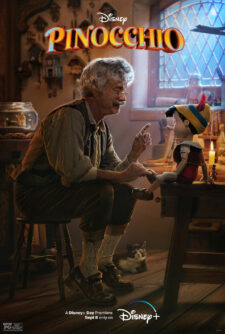
PINOCCHIO (2022)
An entertaining remake that loses the original’s moral power.
Should You Watch It?
This live-action Pinocchio is well produced and entertaining up to a point. Tom Hanks gives a nice performance as Geppetto, and the movie includes comedy, adventure, jeopardy, and positive lessons about truth, honesty, bravery, caring for others, unselfishness, and doing the right thing.
But the remake lacks the charm, details, humor, and power of the 1940 animated classic. Its songs feel over-produced, its early comedy is less effective, and one joke involving horse dung is unnecessary and distasteful. More seriously, the movie weakens the original’s redemptive ending and introduces messages the source review describes as woke, post-modern, politically correct, and transgender-oriented.
Since it is already streaming, WAIT FOR HOME and choose something stronger if your family wants the original’s moral and emotional impact.
The Story
NO SPOILERS — WE KEEP THE SURPRISESGeppetto, a widowed clock maker, wishes that his wooden puppet, Pinocchio, could become a real boy. The Blue Fairy brings Pinocchio to life, makes Jiminy Cricket his conscience, and gives him a path toward becoming a real boy through truthfulness, bravery, and unselfishness.
But on his way to school, Pinocchio is diverted by Honest John, a crafty red fox who promises success and fame. Geppetto then sets out to find him.
Is It Any Good?
Two stars means this is a polished but disappointing remake. The production is well made and entertaining in places, with some comedy, adventure, and jeopardy. Tom Hanks gives a nice performance as Geppetto.
The trouble is that the new film cannot match the original’s charm, detail, humor, or emotional power. The comedy in the first half hour is less carefully effective, the songs feel over-produced, and the story’s plot lacks the strength of the animated version. The remake also weakens the original’s redemptive ending, leaving its transformation without the same force.
The Worldview
The film stresses truth, honesty, bravery, caring for others, being unselfish, and doing the right thing. Pinocchio is sometimes fooled by dishonesty, tall tales, and fame, but he begins to grow a conscience that helps him choose rightly.
The movie also retains false magical thinking about Fate guiding one’s life and wishes on a star coming true. More troublingly, the source review finds that the remake’s changes diminish the original’s redemptive ending, remove its themes of death, resurrection, and reward, and include politically correct and transgender sensibilities. The Blue Fairy breaks her promise to Pinocchio, and the ending implies that a child can declare himself to be a real boy even when the facts say otherwise.
The film’s emphasis on conscience and moral growth can point toward the biblical call to changed living, but its account of transformation is weakened by magical thinking and a confused view of truth. Scripture says, “Therefore, having put away falsehood, let each one of you speak the truth with his neighbor” (Ephesians 4:25).
The Content Guide
The specifics — spoilers included by nature — so you can judge for your own family.
Dominant Worldview and Other Worldview Content/Elements
Light moral worldview stresses truth, honesty, bravery, caring for others, being unselfish, and doing the right thing, but it’s marred and diminished by woke, post-modern, politically correct, deceitful, leftist, transgender sensibilities and a broken promise (the ending implies, for example, that a child can just declare themselves to be a real boy, even if the facts prove otherwise), plus the movie, which is a live action remake, adopts the original story and movie’s false magical thinking philosophy about “Fate” guiding one’s life and making wishes on a star that can come true
Foul Language
No foul language, but there’s a gratuitous crude scene where the title character falls down in the street next to some horse dung
Violence
Relatively light slapstick violence and sometimes scary action violence includes pratfalls, characters being hit, characters are trapped in the belly of a giant sea monster (the whale in the original story becomes a whale-looking sea monster for politically correct reasons)
Sex
No sex
Nudity
No nudity
Alcohol Use
An image of a drunken toy appears briefly at one and rebellious boys drink root beer, which turns them into donkeys to be sold to salt mines to work as slaves
Smoking and/or Drug Use and Abuse
No smoking or drugs;
Miscellaneous Immorality
Title character is sometimes fooled by dishonesty, tall tales and fame, but he starts to grow a conscience that helps him to do the right thing, plus the Blue Fairy breaks her promise to Pinocchio and a school teacher says Pinocchio can’t attend school because he’s not a “real boy,” which seems to be another politically correct, transgender message, this time against conservatives and parents who don’t want government teachers to teach transgender politics to schoolchildren.
Talk About It
Questions for the drive home, the dinner table, or the youth group.
Pinocchio is tempted by success and fame instead of doing what is right. How can you tell when an opportunity is pulling you away from wisdom?
Proverbs 4:14–15 · 1 Corinthians 10:13Jiminy Cricket is appointed as Pinocchio’s conscience. What helps your conscience become more trustworthy and obedient to God’s truth?
Romans 2:15 · Hebrews 5:14The film emphasizes truth, honesty, bravery, and unselfishness. Which of these virtues is hardest to practice, and what would faithfulness look like this week?
Micah 6:8 · Philippians 2:3–4The remake presents wishes and Fate as forces guiding life. How is biblical trust in God different from wishful thinking?
Proverbs 3:5–6 · James 4:13–15The Final Word
This Pinocchio offers polished entertainment and positive moral lessons, but it falls short of the original’s charm and redemptive power. Because it is already available at home, our answer is WAIT FOR HOME—and consider something stronger for family movie night.

