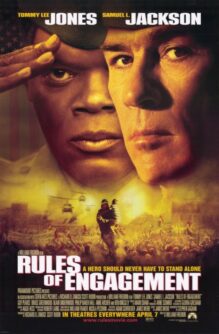
RULES OF ENGAGEMENT
An exciting, morally serious military drama for discerning adults.
Should You Watch It?
If you want a tense courtroom drama that takes the moral pressures of combat seriously, this is a strong choice for an adult audience. The film honors American service members while asking difficult questions about split-second decisions, civilian deaths, military justice, friendship, and loyalty.
The cost is substantial. The movie contains more than 75 strong obscenities and profanities, along with very violent combat footage. Its treatment of Muslim protestors and brief religious references may also trouble some viewers.
So, adults who can engage this material thoughtfully may find the film rewarding. For children and young teens, choose something else.
The Story
NO SPOILERS — WE KEEP THE SURPRISESDuring the Vietnam War, two Marine platoon leaders make decisions that bind their lives together. Decades later, one has become a Marine colonel and the other a Marine attorney.
When a rescue mission at an American embassy ends in the deaths of many protestors, the colonel faces court-martial. His old friend agrees to defend him as the military, the government, and public opinion turn against him.
Is It Any Good?
Four stars means this is an excellent, highly effective drama. The acting talents of Samuel L. Jackson, Tommy Lee Jones, and Guy Pearce are ideally suited to the material. Their characters project convincing military bearing, and the performances give the moral questions emotional weight.
William Friedkin creates tense, exciting drama, while Stephen Gaghan’s script intelligently explores the moral ambiguities of war. The film’s excitement seldom flags, and its examination of soldiers’ character and difficult combat decisions is provocative without becoming simple. A couple of abrupt scenes near the end are the film’s main weakness.
The Worldview
The film presents military service as honorable and treats the people who serve in the United States Armed Forces with respect. It is strongly patriotic, but its questions about justice, duty, friendship, and the burden of command reach beyond one nation.
The movie also leaves difficult moral questions for viewers. Is it ever acceptable to fire on civilians who may be firing back? Should soldiers give warning first? Can combatants who control an attack be treated as prisoners, or do their continued power and opportunity matter? The film does not offer easy answers.
It avoids substantial religious content, though it includes a few very brief references to Islamic religious slogans and Islamic terrorism. Some Arab or Muslim groups may be upset by this material and by the film’s portrayal of the conflict. The movie’s moral worldview is strongest when it examines responsibility, truth, and the character of those entrusted with force; it is less developed in its treatment of faith.
The film’s concern with justice and moral responsibility connects with Scripture’s call: “He has told you, O man, what is good; and what does the LORD require of you but to do justice, and to love kindness, and to walk humbly with your God?” (Micah 6:8).
The Content Guide
The specifics — spoilers included by nature — so you can judge for your own family.
Content Summary
Moral worldview that explores the moral dilemmas soldiers face in combat plus a few very brief references to Islamic religious slogans & Islamic terrorism, a false religion that distorts Judaism & the historical teachings of Jesus Christ; 54 mostly strong obscenities & 26 mostly strong profanities; very strong combat violence such as explosions & gunfire hitting bodies with blood spurting (but not as bad as the gruesome images from SAVING PRIVATE RYAN) plus bloody images of wounds & two men engage in brutal fistfight in a house; no sex; no nudity; alcohol use & one scene of drunkenness; and, villainous character hides evidence that would exonerate another man of a murder charge, but is defeated in the end, & another man lies to protect his career.
Talk About It
Questions for the drive home, the dinner table, or the youth group.
The film asks whether soldiers may fire on civilians who are also firing at them. How should a person weigh justice, mercy, and the protection of others under pressure?
Micah 6:8 · Romans 12:18The characters face commands, loyalties, and moral responsibility. When should loyalty to a person or institution give way to truth?
Acts 5:29 · Ephesians 4:25One character hides evidence to protect his position. What does Scripture say about bringing hidden wrongdoing into the light?
Luke 12:2–3 · Ephesians 5:11–14The story is built around friendship tested by danger and public judgment. What does faithful friendship require when the truth is costly?
Proverbs 17:17 · Galatians 6:2The Final Word
RULES OF ENGAGEMENT is a well-made, gripping drama with serious moral questions and strong respect for military service. Its heavy profanity, violent combat, and sensitive religious and cultural material make it unsuitable for children and young teens. For discerning adults, it is WORTH THE TRIP — ADULTS ONLY. For a family-night alternative, see.