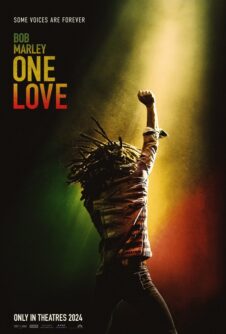
BOB MARLEY: ONE LOVE
Great music, real faith — buried under a false gospel.
Should You Watch It?
Here is the decision, plainly. The music is great, and there are genuine, inspiring references to God and faith scattered through this biopic. Those moments are real, and they matter.
But the movie is built on a false foundation and refuses to examine it. It never questions Marley's worship of former Ethiopian Emperor Haile Selassie as the second coming of Christ, never challenges the Rastafari cult's use of marijuana as a sacrament — in fact it excuses the drug use as part of a quirky religion — and never mentions the documented fact that Marley, his wife, and their children eventually returned to Christianity, baptized in the Ethiopian Orthodox Church before his death. That is revisionist history, and it points the viewer away from the truth rather than toward it.
Add strong language, on-screen violence, and marijuana use presented as spiritual, and the −3 rating stands on its own. A well-made film can still be one to skip — and this one is. Choose something else.
The Story
NO SPOILERS — WE KEEP THE SURPRISESJamaica, December 1976. Reggae star Bob Marley (Kingsley Ben-Adir) is planning a free concert to bring a violently divided country together. Two nights before the show, gunmen slip past his guards and open fire, wounding Marley, his wife Rita, and his manager.
In the aftermath, Marley leaves for London to chase his rising career while his family regroups in America. There he builds toward the album that will make him a global name — and dreams of carrying his music, and his convictions about Africa, back to the continent that shaped his beliefs.
Is It Any Good?
Three stars, and the music earns most of them. Like its namesake, BOB MARLEY: ONE LOVE has some great music, and the film moves with real energy when the songs take over.
The storytelling is shakier. The Jamaican accents are not always easy to follow, and the movie leans on brief flashbacks — a young Marley curled next to his mother on a bus, a first meeting with a Rastafari leader — to fill in a past it never fully explores. It's a competent, sometimes stirring portrait of a musician, but one that consistently declines to ask the hard questions its own subject raises. The result is polished and lively, and less honest than it should be.
The Worldview
At its center this film honors a false religion and never blinks. Rastafari is a monotheistic Jamaican cult whose adherents worship Haile Selassie — the film has Marley call him "King of Kings and Lord of Lords" — as the second coming of Christ. The movie presents this devotion, and the marijuana use offered as its sacrament, without challenge. It excuses the drug use as part of a quirky religion, so marijuana is promoted rather than rebuked.
Real Christian light does break through. Marley calls God "Jah," for Jehovah. His lyrics praise the Lord and warn that "there's no hiding place from the Father of Creation." He grew up reading the Bible and singing hymns with his mother in an orthodox Christian church. Those threads are true, and the film keeps them.
But the movie commits a deeper distortion by omission. It never mentions that Rita and the children were baptized in the Ethiopian Orthodox Church in 1973, and that Marley himself requested baptism before cancer took his life in 1981. A story that could have ended in a man's return to Christ instead leaves him fixed in the worship of a false one. That silence is the film's gravest fault.
Scripture leaves no room for the crown this movie hands to a mortal emperor: "I am the LORD; that is my name; my glory I give to no other" (Isaiah 42:8).
The Content Guide
The specifics — spoilers included by nature — so you can judge for your own family.
Dominant Worldview and Other Worldview Content/Elements
Title character has a false religion (Rastafarianism) that worships a false Christ and that views marijuana use as a sacrament, mitigated by some positive Christian, biblical, moral elements and references, but movie has strong revisionist history that neglects to mention that the title character (who grew up in a Christian home earlier in his life) and his wife and children eventually returned to Christianity before the title character’s untimely death (see our report on the evidence for this inside the Main Review)
Foul Language
At least one “f” word, two “s” obscenities, one Jesus profanity, and one OG profanity
Violence
Images of riots in the street, two gunmen shoot a woman off screen, invade a house and try to shoot a popular singing star but the singer’s manager steps in front of his friend and takes six bullets (everyone survives and recovers), and singer later angrily punches his manager and kicks him for trying to profit off a planned concert tour to Africa
Sex
Marital infidelity is implied and briefly discussed in one scene, but not shown
Nudity
Brief upper male nudity
Alcohol Use
Brief alcohol use
Smoking and/or Drug Use and Abuse
Some possible tobacco smoking and scenes with apparent marijuana smoking, which is excused as being part of a quirky religion, so marijuana use is promoted and not rebuked;
Miscellaneous Immorality
References to two Jamaican gangs fighting, title character is shown having a dream about himself as a boy being saved from a massive crop fire by his false Christ hero, and title character gets uncontrollably angry when he learns his manager tries to make a profit out of a benevolent concert tour planned for Africa and the title character’s fans living there.
Talk About It
Questions for the drive home, the dinner table, or the youth group.
The film has Marley call Haile Selassie "King of Kings and Lord of Lords." Who does Scripture say actually holds that title, and why does it matter who receives our worship?
Revelation 19:16 · Isaiah 42:8Marley grew up singing hymns and reading the Bible, then spent years devoted to a false Christ — and, by several accounts, returned to Christianity near the end. What does it mean that God pursues a person across a whole life?
Luke 15:4–7 · 2 Peter 3:9This movie leaves out the story of Marley's baptism and return to the faith. Why are we tempted to tell only the version of a story we prefer, and what does honesty before God require of us?
Ephesians 4:25 · Proverbs 12:22The film treats a drug as a path to the sacred and never questions it. Where does Scripture say true meditation and worship actually lead us?
Psalm 1:1–2 · John 4:23–24The Final Word
There's real music and real faith here, and it would be easy to be charmed. But a biopic that crowns a mortal man as Christ, promotes a drug as sacrament, and hides the true ending of Marley's own spiritual story is not one we can send you to. So our answer stands: skip it. For something the whole family can enjoy without reservation, try our latest family-friendly picks.