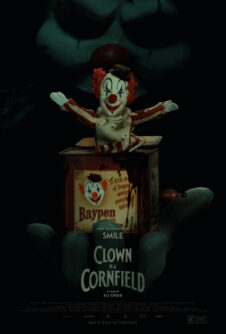
CLOWN IN A CORNFIELD
A slick slasher with a poisoned worldview.
Should You Watch It?
Here's the honest tension. Craft-wise, this is a good horror comedy — a smart script, real character depth, darkly funny lines, an appealing young cast, and a genuinely warm father-daughter relationship at its center. It moves like a freight train, and it's the rare slasher with a heart worth mentioning.
But the movie's ratings tell the other half of the story, and that half decides it. This is a −4 film: graphic, bloody killings played for laughs, at least 52 obscenities, teen drinking and marijuana, and a worldview that treats small-town America as the enemy and pushes a homosexual romance onto the very teenagers it puts on screen.
Good filmmaking doesn't cancel out any of that — it just makes the packaging more effective. So our answer is plain: skip this one. No amount of clever direction earns back what it costs your conscience to sit through.
The Story
NO SPOILERS — WE KEEP THE SURPRISESAfter her mother's death, teenager Quinn Maybrook and her father, Dr. Glen Maybrook, leave Philadelphia for a fresh start in Kettle Springs, a dying town in the American heartland. Quinn hates it — but she's trying to help her dad, and college is on the horizon.
The town once thrived around a factory whose mascot was a giant, sinister clown. The factory burned down years ago. The clown didn't. When Quinn sneaks out to a big teenage party after the annual Founders Day celebration, a horde of killer clowns comes striding out of the surrounding cornfield — and the night becomes a fight to survive.
Is It Any Good?
Three stars, and they're earned on the technical level. Co-writer/director Eli Craig — who found cult fame mixing mirth and murder in Tucker and Dale vs. Evil — knows exactly what he's doing. The script has plenty of twists and darkly funny lines, and the direction never lets the pace sag.
The cast helps enormously. Katie Douglas anchors the film as Quinn, and Aaron Abrams gives a terrific, genuinely moving performance as her father, whose bond with his daughter is the story's best surprise. There's real character depth here, uncommon in the genre.
In the tradition of the Scream movies, it's a slasher that knows it's a slasher and has fun with it. As pure filmmaking, it works. What it does with that skill is another matter entirely — and that's where the stars and the verdict part ways.
The Worldview
For all its craft, this film believes something, and what it believes runs hard against a biblical view. Its dominant worldview is Romantic and politically correct, and its portrait of small-town American life is openly hostile. The killers turn out to be the town's "strict" adults — the authority figures — recast as the true villains for resenting teenagers who don't appreciate where they live. The film's sympathies are clear, and they're aimed at the heartland it depicts.
The movie also puts a homosexual relationship at its emotional center. Two of the town's best-known teenage boys reveal a past relationship and restart it, sealing it with a passionate kiss affirmed by their peers. Aimed squarely at impressionable teenage viewers, it's less a plot point than a message — and one parents should weigh with real seriousness.
To its credit, the film does hold up one good thing without irony: the love between Quinn and her father is strong, sacrificial, and genuine. He fights to save her; she moved across the country to help him grieve. That thread is worth naming, because it shows the filmmakers know what real love looks like even as the rest of the story points elsewhere.
Beneath the blood and satire is the ache every horror story circles: the longing for a safe home in a world that keeps turning violent. Scripture answers that longing not with a clever escape but with a Shepherd: "Even though I walk through the valley of the shadow of death, I will fear no evil, for you are with me" (Psalm 23:4).
The Content Guide
The specifics — spoilers included by nature — so you can judge for your own family.
Dominant Worldview and Other Worldview Content/Elements
Very strong Romantic, politically correct worldview with an Anti-American, politically correct view of small-town America (the villains turn out to be “strict” adults) and a developing homosexual relationship between two male teenagers (they kiss romantically near the end of the movie), but there’s a strong and positive father-daughter relationship
Foul Language
At least 52 obscenities (including at least 35 “f” words), and one “I swear to G*d” profanity
Violence
Numerous graphic killings in extremely unique ways, with lots of blood showing and splattering, most kills cut away from the actual murderous act and leave it to the imagination, many are portrayed comically because they’re so outlandish, two people get impaled on pitchforks, two are decapitated, a girl is electro-shocked but not killed, a villain is smashed by a car, and his blood drenches the windshield, one teenage boy gets eviscerated with his intestines pulled out, a villain is stabbed in the neck by a person acting in self-defense, a father tries to kill his teenage son by hanging him
Sex
A clothed teenage girl jumps on her teenage neighbor to his surprise and starts passionately kissing him and making it clear she wants intimate sex, but the guy stops her by admitting he’s actually a closeted homosexual, and he and another teenage male kiss romantically, and their relationship is affirmed by other people
Nudity
A teenage male is shirtless while doing bodybuildng exercises
Alcohol Use
Lots of teenagers drink alcohol at parties
Smoking and/or Drug Use and Abuse
Some teenagers are shown smoking marijuana;
Miscellaneous Immorality
Two adult authority figures are revealed to be part of a group of murderous adults, and teenage girl sneaks out of her house to attend a teenage party.
Talk About It
Questions for the drive home, the dinner table, or the youth group.
This film paints small-town life and "strict" authority as the real menace. Where does Scripture teach us to respect and even honor rightful authority — and where does it warn us that authority can be abused?
Romans 13:1–7 · 1 Peter 2:13–17The heart of the movie is a father who fights to save his daughter. How does a sacrificial earthly father point us toward the love of our heavenly Father?
Psalm 103:13 · Luke 15:20Horror stories thrive on fear of death and violence. What does it mean to walk through fear without being ruled by it, knowing who walks with us?
Psalm 23:4 · 2 Timothy 1:7The movie is built, in part, to affirm a particular view of romance and identity to young viewers. How do we lovingly discern the messages entertainment sends, rather than simply absorbing them?
Romans 12:2 · Philippians 4:8The Final Word
There's real skill here — a sharp script, a strong cast, a father-daughter bond that lands. But skill in service of graphic violence, constant profanity, and an agenda aimed at teenagers doesn't change the math. Our answer stays the same as where we started: skip it. Looking for something for the whole family instead? Start with our latest family-friendly picks.