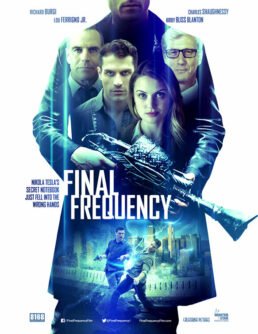
FINAL FREQUENCY
A morally serious thriller better suited to home viewing.
Should You Watch It?
FINAL FREQUENCY offers constant jeopardy, good acting and an accessible explanation of its scientific ideas. Its moral center is also stronger than its production: a heroine works to rescue her kidnapped professor and protect people who do not even know they are in danger.
But the movie’s low-budget production values weaken the experience. Melodramatic music can distract, some dialogue sounds distant, and the attempt to merge several genres becomes awkward. The suspense is effective at times, but the story is also predictable.
The film’s violence and intense suspense call for parental discernment, especially with younger children. For the best balance of its moral strengths and uneven execution, wait for home viewing.
The Story
NO SPOILERS — WE KEEP THE SURPRISESIn Los Angeles, science professor Stuart Conrad is kidnapped by people who want to use his research on Nikola Tesla’s theories about sound frequencies, mind control and earthquakes.
Esther, one of Conrad’s graduate students, discovers that his research is under attack. As seismic activity rises and the G-20 summit approaches, she follows clues, seeks help from trusted allies and tries to uncover the threat before more people are harmed.
Is It Any Good?
Two stars means FINAL FREQUENCY is reasonably entertaining but noticeably uneven. The jeopardy remains constant, and the writers explain scientific jargon clearly enough for unscientific viewers to follow.
Charles Shaughnessy and Richard Burgi are well cast and bring seasoned experience to the acting. However, lackluster production values, melodramatic music and occasionally distant dialogue reduce the film’s effectiveness. The story is somewhat predictable and awkwardly combines too many genres.
The Worldview
FINAL FREQUENCY presents a strong moral and patriotic worldview with redemptive elements. Its heroine protects Los Angeles citizens while trying to rescue her kidnapped professor. The film affirms the idea that all people are created equal and rejects the villain’s humanist, pro-evolution plan to play God and ensure that only the strongest survive.
The movie also presents love as capable of saving people from themselves. One character repents of arrogance and promises to treat others with greater respect. Its brief anti-American element comes through the villain’s complaints about government and taxpayer money, but the film’s larger moral direction rejects his ideas.
The film’s central longing is for people to value and protect one another rather than pursue power over others. Scripture says, “You shall love your neighbor as yourself” (Matthew 22:39).
The Content Guide
The specifics — spoilers included by nature — so you can judge for your own family.
Dominant Worldview and Other Worldview Content/Elements
Strong moral, patriotic worldview (BB, PP) with some redemptive elements (C) includes a heroine who wants to rescue a kidnap victim and help people who don’t even know they’re in peril, an affirmation of the American Declaration of Independence phrase that all men are created equal, heroin opposes the humanist, pro-evolution villain essentially wants to play God and make sure only the strongest people on Earth survive by taking matters into his own hands, villain claims the famous scientist Nikola Tesla believed in birth control as a “benign evolution,” a comment about love being able to save people from themselves, a man repents of his arrogance and promises to treat other people with more respect going forward, and servicemen are taken care of in a veterans home and President Donald Trump’s picture is seen on the wall of the veterans home, plus some Anti-American content where humanist villain makes a trite comment about not trusting the government to help with natural selection (the evolution theory that turns “natural” and impersonal physical processes into a false personal god) and complains about the government using taxpayer money for things he doesn’t find of value
Foul Language
No obscenities but one OMG profanity
Violence
Strong and light violence with some blood such as man jumps off a building, but the camera doesn’t show any bloody aftermath, a manipulative voice leads people to commit violence, man gets hit by a car, and there’s some blood depicted on his head afterwards, car revs the engine with intent to hurt a woman, hand to hand combat, bomb explodes and injures soldiers, villains shoot sound frequencies that injure many victims, people point guns at other people in a few scenes, man seen falling off a cliff, and a knife is thrown at a man’s neck, which causes cuts and some blood to flow from the wound
Sex
No sex, but a couple kisses
Nudity
No nudity
Alcohol Use
Man drinks alcohol out of a brown paper sack
Smoking and/or Drug Use and Abuse
No smoking or drugs;
Miscellaneous Immorality
Light name calling in one scene, lying, kidnapping, torture, greed, and breaking and entering, but rebuked.
Talk About It
Questions for the drive home, the dinner table, or the youth group.
Esther works to protect people who do not know they are in danger. What does loving your neighbor look like when helping others costs you something?
Matthew 22:39 · Philippians 2:3–4The villain wants the strongest people to rule over everyone else. Why does the belief that all people are equal matter for how we treat the vulnerable?
Genesis 1:27 · James 2:1–4One character repents of arrogance and promises to show others more respect. What makes repentance more than simply feeling sorry?
2 Corinthians 7:10 · Luke 3:8The story presents love as able to save people from themselves. Where does that idea reflect biblical love, and where does Scripture point beyond human love?
1 Corinthians 13:4–7 · 1 John 4:9–10The Final Word
FINAL FREQUENCY has a strong moral heart, steady jeopardy and capable acting, but its weak production values and intense content limit its appeal. For families, WAIT FOR HOME is the wiser choice, where parents can guide the experience.