
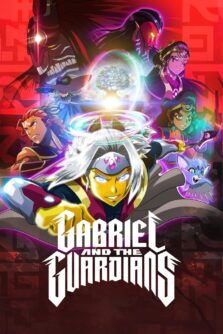
GABRIEL AND THE GUARDIANS: Episode 1.1
A promising anime debut for Angel Studios — but know before you watch.
Should You Watch It?
Here's what's good: Gabriel and the Guardians opens with real promise. The art style is pleasing, the action ambitious, and its hero has a moral core — friendship, loyalty, and power used for good. The show even leans on a laser-sharp Christian-adjacent worldview, drawing loosely on the Angel Gabriel's biblical story without talking down to its audience.
Here's what it costs: the animation is limited and some shots feel stilted. The exposition is rushed, leaving the villains "generic" rather than genuinely foreboding, and a second storyline in the mortal world feels tacked-on rather than earned. On the content side, expect moderate fantasy violence and a dose of dark magic — alchemy, necromancy, a resurrected monster mistaken for a pagan god.
None of this is disqualifying, but none of it is nothing either. If you're an adult who enjoys anime and wants to preview it before sharing it with older kids, it's worth your time. If you're looking for something to hand to children unsupervised, wait and watch it with them first.
The Story
NO SPOILERS — WE KEEP THE SURPRISESGabriel, a guardian of the heavens, would rather tend his sky garden than join his fellow celestials on the mortal battlefields below. But peace doesn't last. A monstrous thief breaches his realm in search of a powerful artifact, while down in the mortal world, a botched act of alchemy raises a giant that starts tearing a city apart. Something is coming for Gabriel whether he's ready or not — the only question is whether he'll answer the call.
Is It Any Good?
Three stars means real promise with real rough edges, and that's exactly what this pilot delivers. The show borrows a Japanese shonen-anime style reminiscent of Dragon Ball Z, and its backgrounds and magic effects are genuinely well done. The character designs are intricate, though the color choices — Gabriel's busy armor against a clashing pink halo — come off as garish.
The fight choreography is ambitious, with multi-dimensional staging and confident camera work during the sky-garden battle. But the animation itself is limited, and several shots feel stilted rather than fluid. Add to that a rushed setup for the villains and an underdeveloped second storyline that should have waited for episode two, and you have a strong foundation that hasn't yet become a strong show.
The Worldview
This is a strong, traditional worldview wearing fantasy clothes. Gabriel is drawn as a celestial guardian who values justice, bravery, and protecting those in his care — he seeks counsel from an elder angel, prays for strength before battle, and uses his "creation magic" to heal, not merely to fight. Two characters choose to warn enemies away rather than kill them, and mercy shows up in small but real ways, including a captor rescued by his own prisoner. The show never mentions God or Jesus by name, but its debt to the biblical Gabriel is plain, and its moral compass is unmistakably aimed the right direction.
That said, the borrowing is loose, and the source review flags real caution: this Gabriel may be "influenced by unbiblical aberrations" rather than a faithful retelling. The mortal-world subplot introduces alchemy, necromancy, and a resurrected creature mistaken for a pagan god — dark-magic elements that put real distance between this world and Scripture's own.
The show's title names its theme outright: a light that pierces the darkness. Scripture makes the same claim, and makes it better — "The light shines in the darkness, and the darkness has not overcome it" (John 1:5).
The Content Guide
The specifics — spoilers included by nature — so you can judge for your own family.
Dominant Worldview and Other Worldview Content/Elements
A strong traditional worldview set in a world of magic and fantastical creatures, the backstory emphasizes the conflict between “light and darkness,” the hero is a young celestial guardian “angel” who embodies the values of justice, bravery, and protecting his friends, two characters choose to warn their enemies to leave and only use combat as a last resort, a prisoner rescues his captor from a collapsing boulder, the hero uses his “creation magic” to heal the broken trees of his garden, and the show is loosely based on the stories about the Angel Gabriel in the Old Testament, perhaps influenced by unbiblical aberrations.
Foul Language
None
Violence
Moderate fantasy violence throughout, but no blood or gore, a man throws a hammer at a prisoner’s head, a giant ogre destroys several city buildings, a woman stabs her knife into a man’s shoulder blade, a woman shoots exploding arrows at her aggressors, a man and a woman engage in sword combat, a celestial boy and a monster engage in a tense magic battle inside a tree, a monster punches a boy in the face, a boy uses his magic baton to slice off a monster’s arm, and a monster knocks out a celestial fox
Sex
No sex
Nudity
No nudity
Alcohol Use
No alcohol use
Smoking and/or Drug Use and Abuse
None;
Miscellaneous Immorality
A bounty hunter is taken captive by a corrupt prison guard, a woman uses alchemy to resurrect a giant ogre (whom she mistakes as a pagan god), and a necromancer creates a monster from purple liquid.
Talk About It
Four questions for the couch, the commute, or the couple bingeing it together.
Gabriel would rather stay in his garden than join the fight against darkness. When have you hesitated to do what you knew was right, and what finally moved you?
Joshua 1:9 · James 4:17A woman in the story uses alchemy to try to summon divine power, and it goes badly wrong. What does the Bible say about seeking power through means God hasn't given us?
Deuteronomy 18:10–12 · Isaiah 8:19Gabriel prays for strength before he fights. How is real prayer different from calling on a power we've made up ourselves?
Philippians 4:6–7 · Ephesians 6:12This show is "loosely based" on the biblical Gabriel. Why does it matter to know the real story behind an adaptation before we let it shape how we picture something Scripture actually describes?
Luke 1:26–38 · 2 Timothy 3:16The Final Word
There's real craft and a genuinely good heart in this pilot — Gabriel's courage, his prayers, his instinct toward mercy all land well. But the dark-magic elements and the show's loose relationship to its biblical namesake mean this isn't one to hand over unsupervised. Our answer: worth watching — adults only. Looking for something to watch as a whole family tonight instead? Start here:.

