
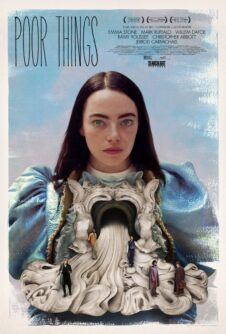
POOR THINGS
A sordid, blasphemous fairy tale dressed up as feminist liberation.
Should You Watch It?
No. The source is blunt about this, and so are we. Yorgos Lanthimos has real visual imagination — the film is "quirky" in its world-building — but nearly half its runtime, by the reviewer's own estimate, is obscene dialogue, sex, or nudity. That's not incidental; it's the engine of the movie.
What's underneath the spectacle is a worldview the reviewer calls Marxist, atheist, socialist, and hedonistic — a "feminism" that turns a woman's body into a tool of liberation right up until she gets bored of selling it. The heroine is repeatedly called beautiful by the men around her; the source says the filming doesn't back that claim up, inside or out.
There's no age or mindset for which this clears the bar. Adults looking for serious, well-made cinema will find craft undercut by excess; families have no reason to be here at all. The practical answer: skip it.
The Story
NO SPOILERS — WE KEEP THE SURPRISESIn Victorian London, a scientist known for stitching together hybrid creatures reanimates the body of a young suicide victim, using her own unborn child's brain. He calls his creation Bella and hires a mild-mannered medical student to track her recovery. As Bella grows more self-aware, the student falls for her, and she agrees to marry him — until an older, wealthy hedonist talks her into leaving for Lisbon first.
Is It Any Good?
Two stars means competent, sometimes striking filmmaking hollowed out by what it spends its time on. The source credits Lanthimos with a genuinely odd, inventive premise and world, but notes that if you removed the explicit dialogue, sex scenes, and nudity, the 141-minute runtime would likely shrink by half — a pacing problem rooted in content, not just editing.
The one specific craft critique offered is pointed: both of Bella's suitors call her the most beautiful woman they've seen, but the source argues the cinematography, hair, and makeup choices don't support that claim, making the dialogue hard to take seriously against what's actually on screen. Beyond that, the review doesn't dwell on performance or direction — it's more concerned with what the film is for than how well it's assembled.
The Worldview
This film has a clear thesis, and it isn't a hidden one. It promotes a Marxist, humanist, socialist brand of feminism — one openly hostile to the upper class, whose wealthy men are portrayed as either vain or cruel. Godwin, the surgeon-creator, keeps insisting science must be emotionless even as he clearly loves his creation like a father — a small, human crack in an otherwise cold worldview.
The film flirts with despair, too: Bella encounters a cynical nihilist who says humanity is irredeemable, that neither religion nor socialism nor capitalism can fix people. She rejects his hopelessness, but only to replace it with faith in godless science and social reform — improvement without a Redeemer. Notably, the film doesn't attack the church outright; an interrupted wedding takes place inside one, and the clergyman himself isn't mocked. That restraint is real, but it doesn't offset the film's larger commitments: atheism, hedonism, and a version of "liberation" that the source says simply turns women into sexual objects by another name — including an explicit lesbian scene played as tender affection.
Every longing this film chases — for freedom, for meaning, for a self remade — is a real human longing. Scripture names the same ache and answers it differently: "For my people have committed two evils; they have forsaken me, the fountain of living waters, and hewed them out cisterns, broken cisterns, that can hold no water" (Jeremiah 2:13). Bella digs many cisterns in this film. None of them hold.
The Content Guide
The specifics — spoilers included by nature — so you can judge for your own family.
Dominant Worldview and Other Worldview Content/Elements
Sordid Marxist humanist, ultimately pro-socialist, feminist take on society, including a hostility shown toward the upper class (the two men from the upper class are vain or terribly cruel), though the heroine runs into a cynical nihilist who says all people are irredeemable brutes and who believes neither religion, nor socialism, nor capitalism can change that (heroine believes the world can be improved, but she chooses to do it through godless science and socialism), but there is an interrupted wedding scene inside a church, and the movie does not attack the clergyman, and a middle aged surgeon is always talking about how science must be emotionless, but in the end, he clearly has feelings for his female Frankenstein creation with whom he’s like a father, and two women have explicit oral sex in one scene
Foul Language
Anachronistic foul language includes about 40 obscenities (including 27 or so “f” words), two Jesus profanities and 10 light profanities including such expletives as Good God and Mother of God
Violence
Some gruesome scenes inside a private and a public surgery room, one scene shows a surgeon opening up a man’s stomach to cut out a tumor, but he and the patient (also an expert surgeon) discover the cancer has spread, middle-aged surgeon describes how he took the brain of the child inside a recently deceased pregnant woman and placed the baby’s brain inside her head and resuscitated her (allusions to Frankenstein occur in the movie where the surgeon’s face has scars on it like it’s been torn apart and put back together, making him look like Frankenstein’s monster; he is
Sex
Many very explicit sex scenes of men with a naïve but hedonistic white woman who runs away with one lover and ends up being a prostitute in Paris, one scene shows the woman having explicit oral sex with a black prostitute in their brothel, and they lie in bed tenderly afterwards (there’s little tenderness in the explicit scenes of heterosexual sex), the older woman running the brothel seems to come onto the younger heroine in a creepy way, and lots of frank sexual dialogue
Nudity
Many images of full male and female nudity, many images of upper female nudity, some images of upper and rear male nudity, naïve heroine wanders a private surgery with cadavers laying around, and she curiously flicks one of the male cadaver’s private parts
Alcohol Use
Alcohol use, woman deliberately gets drunk in one scene, lovesick man shows up drunk, lovesick man gets drunk at a gambling table aboard a ship
Smoking and/or Drug Use and Abuse
Brief smoking, and a dying man in pain from cancer says he took morphine, amphetamines and cocaine to attend his adopted daughter’s wedding to walk her down the aisle, and he says he’s always loved cocaine;
Miscellaneous Immorality
Naïve woman gives lots of money to two sailors to give to some poor people, but it’s clear the sailors are just going to take the money for themselves, naïve woman’s obsessive lover kidnaps her and takes her on a Mediterranean cruise from Lisbon to Athens (the cruise is interrupted at Paris), the lover turns to obsessive gambling when the woman starts becoming more interested in reading philosophy books (the lover has decided he truly loves the woman, but he’s a shallow rich man, the woman was shallow too until her moral conscience is awakened), and sad images of extreme poverty in one scene.
Talk About It
Questions for the drive home, the dinner table, or the youth group.
The film argues that people can improve society through science and socialism alone, without God. What does Scripture say happens when we try to build meaning without a Creator?
Jeremiah 2:13 · Romans 1:25Bella's story is framed as feminist liberation, but the source argues it just turns her body into currency again — this time by her own choice rather than a man's. What's the difference between true dignity and this kind of "freedom"?
1 Corinthians 6:19–20One character insists all people are irredeemable brutes, no matter what system governs them. How does the biblical view of human nature both agree and radically disagree with that claim?
Jeremiah 17:9 · 2 Corinthians 5:17The surgeon claims science should be emotionless, yet clearly loves his creation like a daughter. What does that contradiction reveal about the limits of a purely materialist worldview?
Genesis 1:27 · Colossians 1:16–17The Final Word
There's real imagination in this film's bones, but the source is right to call it one of the most obscene major-studio releases in memory — and its Marxist, atheist, hedonistic vision of "liberation" isn't one worth spending three hours inside. Our answer stands: skip it. For something your family can actually watch together, start here:.

