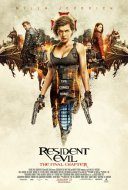
RESIDENT EVIL: THE FINAL CHAPTER
An occasionally redemptive allegory buried beneath dark, confusing violence.
Should You Watch It?
This sequel has a few worthwhile ideas. Its heroine must consider sacrificing her life to save mankind, and the ending forms a Christian moral allegory involving redemption. The film also offers an interesting question about whether artificial intelligence can do good while serving an evil organization.
But those strengths are buried under dark horror, lots of scary intense violence, foul language, and fight scenes made confusing by chopped-up editing and poor lighting. The movie also muddles its ideas about environmental catastrophe, capitalism, oligarchy, and Christianity. A villain’s Christian-sounding rhetoric and crucifix make the film’s moral perspective harder to understand.
The source review finds the film neither entertaining nor wholesome enough to recommend. For your family, skip it.
The Story
NO SPOILERS — WE KEEP THE SURPRISESA scientist develops a cure for his young daughter’s disease, but his evil business partner uses the work to create the T-virus, a bioweapon that turns people into vicious zombies.
Alice, the franchise’s heroine, learns that an airborne antidote may still exist. With only 48 hours, she must return to the Umbrella Corporation’s headquarters in Raccoon City, where the virus was unleashed, and retrieve the antidote before the remaining humans are destroyed.
Is It Any Good?
Two stars means the film has some exciting adventure moments but is undermined by major craft problems. Milla Jovovich makes a strong presence as Alice, and the story has a redemptive ending. The premise also raises provocative questions about artificial intelligence and moral responsibility.
However, the fight scenes are chopped up and sometimes shot so darkly that it is difficult to take interest in what is happening. The film could also use more humor and character development, especially for the people who come to Alice’s aid. It is a second-rate sequel whose potential is never fully realized.
The Worldview
The film presents a dark humanist world shaped by the evil Umbrella Corporation, a selfish oligarchy willing to destroy humanity to preserve its own power. Its villain promotes “global warming” and “overpopulation” as reasons to destroy the world, while another villain uses Christian-sounding rhetoric, appeals to Jesus, wears a crucifix, and acts like a religious fanatic. These choices confuse the film’s moral message.
Still, the story exalts sacrifice, redemption, and the protection of human life. Alice’s willingness to risk herself for mankind gives the film a Christian moral center, including a symbolic death and resurrection. The artificial intelligence called the Red Queen is also caught between programming that serves evil and programming that protects human beings.
The film’s central theme aligns with Christ’s teaching about sacrificial love: “Greater love has no one than this, that someone lay down his life for his friends” (John 15:13). Yet the movie’s confusing politics and distorted religious imagery make that good theme difficult to receive clearly.
The Content Guide
The specifics — spoilers included by nature — so you can judge for your own family.
Content Summary
Strong Christian, moral allegory where the heroine must decide to sacrifice her life in order to save mankind, with a death and resurrection, but a couple villains spout some Christian, biblical metaphors as if they’re religious “fanatics” (one of them much more so, even to the point of wearing a crucifix), and the movie’s set in a dark humanist world where a selfish businessman is the main villain, though (in the end) the filmmakers are taking a stance against an elite oligarchy running the world like its own personal, authoritarian fiefdom, plus the main villain makes some stupid, false, politically correct, environmentalist statements about “global warming” destroying the planet in 80 years (that’s definitely not going to happen!) and “over-population,” another left-wing, humanist (H) lie; six obscenities, two strong profanities using the name of Jesus and one light profanity; some extreme, slightly gory violence and lots of action violence includes woman gets some fingers sliced off, some decapitations of zombie creatures, zombie boy attacks cable car passenger and draws blood, zombies bite regular people and overcome them, fiery explosions, gunfire, heroine and head villain have a lengthy intense fight with lots of punching and throwing and kicking, point blank shootings, people fall from great heights, zombiefied dogs and creatures (one group of creatures have protruding ribcages and rows of vicious teeth) attack people, and people are swept into a turbine and cut to bloody pieces; no sex; no nudity, but heroine shows some cleavage; alcohol use; no smoking or drugs but heroin gets an injection to help her medically after being knocked out; and, betrayal, cruelty, selfishness, genocidal plan.
Talk About It
Questions for the drive home, the dinner table, or the youth group.
The film presents sacrifice as a way to save others. What makes sacrifice loving rather than merely dramatic?
John 15:13 · Philippians 2:3–4The Red Queen is programmed to serve an evil corporation while also protecting human beings. Can doing one good thing make an evil allegiance right?
Matthew 6:24 · Romans 12:9The villains use Christian language while acting wickedly. How can believers make sure their lives match their words?
Matthew 7:15–20 · Titus 1:16The story condemns selfish rulers who treat human lives as expendable. What does Scripture require from people with power?
Micah 6:8 · Mark 10:42–45The Final Word
The film has a redemptive idea at its center, but its poor editing, harsh violence, foul language, and confused messages overwhelm that good intention. For your family, SKIP IT. For better choices, see.