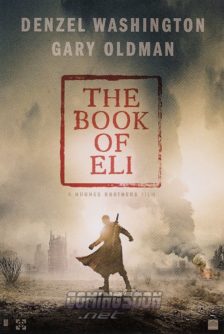
THE BOOK OF ELI
A brutal, brilliant wasteland epic that dares to say the Bible matters.
Should You Watch It?
Here's the short version: this is a four-star film with a Christian heart and an R-rated body, and both halves are real. Denzel Washington plays a man carrying a sacred book across a ruined America, praying, quoting Scripture, and teaching a young woman to pray for the first time in her life. He walks by faith, not by sight — the film says so outright, and means it. That kind of open, unembarrassed support for the Bible from a major studio release is rare enough to be startling.
But this is not a gentle film. The violence is extreme and often brutal — shootings, beheadings, an arrow through the neck, all shown without flinching. There are scenes of implied rape and one attempted rape, plus unnecessary profanity. Several scenes are genuinely hard to sit through.
If you're an adult who can watch that and still receive the film's message, this is a rewarding, even moving, watch. If you're choosing for a family or a teen, this one stays off the list.
The Story
NO SPOILERS — WE KEEP THE SURPRISESThirty years after a war has turned America to ash, Eli walks west, carrying a sacred book he believes will help rebuild what mankind lost. He trusts the voice that guides his steps and won't be turned from his path — until a young woman named Solara, hungry for hope and truth, asks to join him. Not everyone wants the book to survive, though. Some want it for what it can do to people who still believe in it.
Is It Any Good?
Four stars means this is filmmaking that earns its praise, and the source is unambiguous about why. Denzel Washington and Gary Oldman both deliver absorbing, committed performances, and the production standards are excellent throughout — this is a movie that looks and feels like a genuine post-apocalyptic epic, not a cut-rate imitation. The direction sustains a captivating, awe-inspiring tone across the whole runtime, and the character work carries real weight.
The Worldview
This film exalts something Movieguide rarely sees exalted this plainly: faith in God, practiced daily, under pressure. Eli prays. He teaches someone else to pray. He quotes Scripture and commits it to memory. He tells Solara to walk by faith, not by sight — and the film never contradicts him. By the end, he can honestly say he fought the good fight, finished the race, and kept the faith. The antagonist, meanwhile, wants the book not to destroy it but to weaponize it — to control hearts and minds rather than free them — and he gets his comeuppance. Justice, hope, love: the film's moral bones are sound, and its villain is held to account for what he's done.
What keeps this from being simple, unqualified praise is the cost of the storytelling. The violence is extreme and graphic, and the film includes rape and attempted rape as plot elements, even without explicit depiction. None of that is gratuitous celebration of evil — the film treats it as evil — but it is a lot to carry, and it's precisely why this review comes wrapped in extreme caution rather than a family recommendation.
The film's central image — a man walking across a wasteland by faith rather than sight — is Scripture's own language. "For we walk by faith, not by sight" (2 Corinthians 5:7). A film willing to say that out loud, and mean it, deserves to be taken seriously — by adults who can handle what surrounds it.
The Content Guide
The specifics — spoilers included by nature — so you can judge for your own family.
Content Summary
Very Strong Christian worldview, including themes of sacrifice, where the protagonist constantly prays, shows others how to pray, quotes Scripture, and, though he is not perfect, constantly tries to live what he believes and consistently walks by faith in God, not by what he can see, and evil antagonist tells his henchmen to burn all of the books that they bring him (one of which is THE DA VINCI CODE) because they are not the book he wants and knows holds power, plus strong moral themes of hope, love, and justice; 21 obscenities and one profanity; extreme, brutal violence depicted including man abuses his wife by pulling her hair, man is found after having hanged himself, multiple scenes of blood spurting after people have been shot and limbs have been cut off with a samurai-like sword, men fire guns and heavy artillery, men get sliced with sword, man is shot in private area with an arrow and man gets shot in the neck with an arrow, men get shot in the head and all of it is completely shown, man gets beheaded by sword, lots of punching, brawl fighting, lots of explosions with hand grenades and grenade launcher; man uses a derogatory word to encourage his men to fornicate, men rape a woman but cameras cut out before anything is shown, young girl tries to seduce older man but he rejects her because it is wrong, one scene of attempted rape where girl is rescued before it actually happens, and in the background of a brief camera shot a couple of men are shown trying to rape women, but no explicit sexual activity depicted; upper male nudity, female cleavage in a couple of scenes, and brief upper female nudity but nothing is explicitly shown; alcohol used depicted where men are encouraged to “get slammed” and men drink alcohol in a bar setting, but no blatant drunkenness shown; no smoking or drugs; and, some references to cannibalism, man turns away from coming to the aid of people in crisis and tells himself to “stay on the path, it’s not your concern,” but his perspective changes in the end as he realizes that he needs to live the truth he has learned, and evil antagonist wants to get his hands on the sacred book because he wants to use it as a weapon to control the minds and hearts of the people, but he gets his comeuppance in the end.
Talk About It
Questions for the drive home, the dinner table, or the youth group.
Eli tells Solara to "walk by faith, not by sight." What does that look like in your own life when the path ahead isn't clear?
2 Corinthians 5:7 · Hebrews 11:1Carnegie wants the book not to preserve it, but to control people with it. What's the difference between someone who loves truth and someone who wants to weaponize it?
John 8:32 · 2 Timothy 3:16–17Eli says at the end that he "fought the good fight, finished the race, kept the faith." What would it mean for you to be able to say the same thing at the end of your life?
2 Timothy 4:7Eli initially tells himself "stay on the path, it's not your concern" when others are in crisis — but his heart changes. What does Scripture say about our responsibility to people in need, even when helping costs us?
Luke 10:25–37 · James 2:14–17The Final Word
Rarely does a big studio film let its hero pray, quote Scripture, and walk by faith without irony or apology — and this one does, brilliantly acted and beautifully made. It also asks a lot of its audience with violence that's genuinely hard to watch and content no family should sit through. Our answer stands: worth the trip — adults only. Looking for something to watch with the kids instead? Start here:.