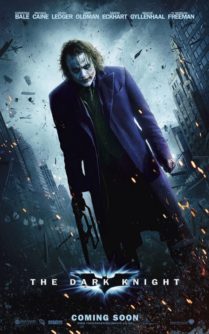
THE DARK KNIGHT
Brilliant moments, muddled soul — better rented than rushed out to see.
Should You Watch It?
Here's the honest answer: this Batman has real moments of greatness and a story that never quite becomes one. Christopher Nolan gives you some of the finest explosions and sound design in movie history, and several scenes between his characters land with real emotional force. But the plot leans on repeated beats rather than a real arc, the Joker never changes across two-plus hours, and the last twenty minutes drag for anyone not simply chasing spectacle.
The content matters too. This is intense, PG-13 violence with threats worse than what's shown, some strong language, sexual references, brief nudity, heavy drinking, and — more troubling than any of that — a worldview that shrugs at truth and lets its hero lie with the police commissioner's blessing.
There's craft here worth admiring, and adults who enjoy comic-book spectacle will find plenty to like. But if you're deciding for your family, or for your own theater dollar, this one can wait for a rental — and you might do better to watch the first film in this series instead.
The Story
NO SPOILERS — WE KEEP THE SURPRISESGotham has a new problem: a criminal calling himself the Joker, ruthless and chaotic, is challenging the mob for control of the city. At the same time, a new district attorney, Harvey Dent, is rising fast — and with help from Batman and Detective Gordon, he's building a case that could take down Gotham's organized crime for good. The Joker has other plans. He's set his sights on the judge, the police commissioner, and Harvey Dent himself — and Bruce Wayne's own hopes for the woman he loves are caught in the middle.
Is It Any Good?
Three stars means this: strong craft wrapped around a story that doesn't fully hold together. The music, sound design, and special effects are excellent — genuinely some of the best action filmmaking around, and several character exchanges hit hard emotionally. That's real, and it's why the movie has fans.
But structurally, it stumbles. The script offers one clear turning point and then a lot of repetition rather than a building arc. The Joker is psychopathic and menacing from his first scene to his last, but he never develops — watching him becomes monotonous rather than gripping. Batman himself doesn't visibly change either. Two villains in one film is a hard trick to pull off, and this one shows the strain: the final twenty minutes feel tedious rather than climactic. Good pieces, assembled into a movie that's less than the sum of them.
The Worldview
This film's worldview is, by its own logic, a mess — and it knows it. It mixes pagan, philosophical, and political perspectives that never resolve, and it lands on a relativistic, "truth doesn't matter" note by the end. That's a serious problem, and it shows up concretely: the hero and the police commissioner agree to lie to the public to protect a false hope, and the film never really wrestles with what that costs.
Alongside that murkiness sit some genuinely strong moral threads. The story draws a hard line between good and the mindless destructiveness of total evil. It shows citizens choosing not to let a villain redefine their sense of right and wrong. There's a redemptive nod toward needing God now, and passing references to Jesus. The film flirts with extolling vigilante justice, but pulls back — its conflicted, wealthy hero ultimately forsakes revenge for justice and chooses to capture his enemy rather than kill him. Its Romantic suspicion of order and discipline gets voiced, but is sometimes rebuked rather than simply endorsed.
The net effect is a film torn between real moral conviction and a shrug toward truth itself — and the shrug is the more dangerous half. Scripture doesn't leave room for that ambiguity: "Lying lips are an abomination to the LORD, but those who act faithfully are his delight" (Proverbs 12:22). A hero worth admiring tells the truth even when it costs him the ending he wanted.
The Content Guide
The specifics — spoilers included by nature — so you can judge for your own family.
Content Summary
Very confused and eclectic, or mixed pagan, philosophical and political perspectives ending on a relativistic, deconstructionist “truth does not matter” sentiment, with some strong moral references to good versus evil, the mindless destructiveness of total evil, justice, crime fighting, and citizens decide not to let villain destroy their sense of what’s right and wrong, a redemptive reference to we need God now and some references to Jesus, solid Romantic refutations of order and discipline but sometimes rebuked, some extolling of vigilante activity, but wealthy capitalist, conflicted vigilante hero forsakes murderous revenge for justice and captures the villain instead of killing him, but, otherwise, not a very cohesive worldview; eight mostly light obscenities such as use of the “h” word and four profanities, three of which are exclamatory; very strong and intense action violence and threats of violence, but very little blood or gore actually shown except for a few notable exceptions, thus people are constantly beat up, people are shot through the head, Joker takes a knife to threaten to cut people’s mouths open, people are blown up, people thrown off buildings, people burned alive, but the camera cuts away from most of these instances, but the almost skeletal scary side of the face of Two Face is shown and the scars of Joker are shown, plus chase scenes and fight scenes; fairly mild discussions of sex, though one person is remembered for being interrupted while having sexual relations, and another mostly dressed couple is interrupted in a bedroom; upper partial male nudity; lots of alcohol use, one man drinks to get drunk and avoid responsibility; no smoking; and, criminal activity and hero decides to lie to solve plot problem and police commissioner agrees with him.
Talk About It
Questions for the drive home, the dinner table, or the youth group.
Batman and the police commissioner agree to tell the public a lie to protect Gotham's hope. Does a good end ever justify a false witness?
Proverbs 12:22 · Ephesians 4:25The Joker never changes — he's chaos from his first scene to his last. What does Scripture say happens to a person who chases evil for its own sake?
Romans 1:28–32Harvey Dent starts out as Gotham's rising hope and ends up broken by tragedy. What keeps suffering from turning us into people we don't want to be?
James 1:2–4 · 1 Peter 5:8–10Batman refuses to kill the Joker even when he has the chance. Where does mercy-over-revenge come from, and how does it compare with what Jesus taught?
Romans 12:19 · Matthew 5:44The Final Word
There's real skill in this film — and a worldview too muddled to hand to your family without a long conversation afterward. Great explosions and a few unforgettable scenes don't rescue a script that repeats itself or a hero the movie lets lie without consequence. Our answer stands: wait for home — adults only. If you want something better made from the same world, the earlier film in this series is worth revisiting instead — or browse our latest for something to watch as a family tonight.