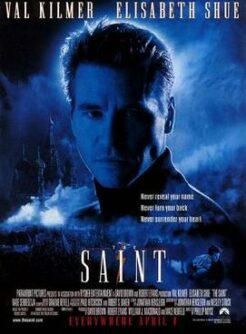
THE SAINT
Slick international intrigue with a tarnished moral halo.
Should You Watch It?
THE SAINT offers slick international locations, intrigue, action and Val Kilmer performing several characters with different accents. The central conflict gives Simon Templar a conscience: he steals for a living, but he eventually wants to correct the wrong he has helped create.
The cost is substantial for Christian viewers. The story makes a hero out of a thief and presents his personal code as a defense of his criminal life. It also includes implied and briefly depicted fornication, moderate violence, upper male nudity, smoking and briefly depicted cocaine use.
If you are a discerning adult who can weigh those concerns and still appreciate a mildly entertaining action film, this may be worth your time. For children and young teens, choose something else. WORTH THE TRIP — ADULTS ONLY is the practical answer.
The Story
NO SPOILERS — WE KEEP THE SURPRISESSimon Templar is a high-tech thief for hire who uses disguises, aliases and advanced skills to complete dangerous jobs. After a Russian billionaire hires him to steal a cold-fusion formula from American scientist Emma Russell, Simon unexpectedly falls in love with her. He must then decide what to do with the formula—and whether he can remain loyal to the criminal world that made him.
Is It Any Good?
Three stars means a slick, good-looking film that is mildly entertaining but held back by important flaws. THE SAINT benefits from international locations, action, intrigue and Kilmer’s performance as several different characters with different accents.
The plot is confusing and contains unexplained scenes. Emma’s fluctuating heart problem is not clearly explained, and the motivations behind the Russian billionaire’s speeches are hidden in pompous rhetoric. Simon and Emma’s relationship also strains credibility because she remains attracted to and trusts him after he steals her formula.
The Worldview
THE SAINT presents Simon Templar as a criminal who can still be a hero because he follows a personal code. He battles for justice where the law cannot or will not reach, avoids harming or killing people, and eventually tries to right the wrong connected to the cold-fusion formula. The film therefore treats private morality as sufficient justification for breaking the law.
The movie also contains strong humanist elements and some anti-Christian elements through its depiction of abusive Catholic teachers. Its pagan worldview celebrates a main character whose criminal identity is softened by conscience, loyalty and romantic love. The ending may show Simon correcting one wrong, but the premise still points toward a future in which he will steal again.
Scripture recognizes the need for justice but does not make personal ethics a license for wrongdoing. “Let the thief no longer steal, but rather let him labor” (Ephesians 4:28). Simon’s longing to do right would be better answered by leaving theft behind, not by giving theft a more attractive halo.
The Content Guide
The specifics — spoilers included by nature — so you can judge for your own family.
Content Summary
Pagan worldview celebrating a main character who is a criminal with strong humanist elements & some anti-Christian elements of abusive Catholic teachers; 8 obscenities & 1 profanity; moderate action violence including car crashes, murder by gunfire, implied beating, & girl falls to her death; briefly depicted & implied fornication; upper male nudity & woman in underwear; alcohol use; smoking & briefly depicted cocaine use; and, miscellaneous immorality including stealing & lying
Talk About It
Questions for the drive home, the dinner table, or the youth group.
Simon believes a personal code can justify breaking the law. What does Scripture say about respecting authority while still seeking justice?
Romans 13:1–4 · Micah 6:8The film treats stealing as Simon’s profession, even while giving him a conscience. Why is turning from wrongdoing more important than merely trying to use it for good?
Ephesians 4:28 · Proverbs 28:13Simon’s childhood suffering shapes his adult choices. How can suffering influence a person without determining the kind of person he becomes?
Ezekiel 18:20 · Romans 12:21The film includes an abusive religious authority figure. How should Christians respond when someone uses spiritual authority to harm others?
Matthew 18:6 · James 3:1The Final Word
THE SAINT is stylish and mildly entertaining, with international intrigue and an appealingly complicated thief at its center. But the criminal hero, sexual content, violence and pagan-humanist outlook make it unsuitable for children and young teens. For discerning adults, the answer is WORTH THE TRIP — ADULTS ONLY. For other options, see.