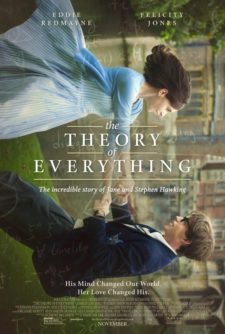
THE THEORY OF EVERYTHING
A moving love story with strong atheist ideas—for adults only.
Should You Watch It?
This is a deeply moving love story about Stephen and Jane Hawking, built around humor, perseverance, acceptance, and sacrifice. It shows Stephen’s extraordinary mind and Jane’s relentless care as his motor neuron disease takes away his physical abilities. Their love and commitment are inspiring, even as caring for Stephen and their children becomes increasingly difficult.
The spiritual conflict is central. Stephen holds that science can explain everything without God, while Jane maintains a strong Christian faith. The movie presents both of them as positive role models, but its romantic treatment of atheism requires discernment, especially alongside adultery and other adult themes.
If you are a discerning adult who can engage those ideas thoughtfully, this is WORTH THE TRIP — ADULTS ONLY.
The Story
NO SPOILERS — WE KEEP THE SURPRISESAt Cambridge University, brilliant but quirky doctoral student Stephen Hawking meets Jane, a fellow student who believes strongly in God. Their romance grows as Stephen pursues theories about time and the universe.
Then Stephen is diagnosed with a debilitating motor neuron disease and given only two years to live. Jane chooses to remain with him, and together they face family life, Stephen’s growing scientific success, and the physical limitations that increasingly reshape their marriage.
Is It Any Good?
Four stars means this film succeeds at the highest level of the source review’s quality scale. It is well shot and well told, with a love story that remains engaging and inspiring. Comedic moments are woven throughout, giving the drama warmth even as Stephen’s disease and the pressure on the family become more severe.
The film also presents the brilliance of Stephen’s mind and the perseverance of both Stephen and Jane. Its strongest artistic achievement is the way it eloquently portrays unconditional love, humor, pain, and sacrifice.
The Worldview
The film presents a strong positivistic scientism: Stephen holds that everything in existence can be explained and proven by science, leaving no need for God. His theories about time and the beginning of the universe stand in tension with Jane’s devout Christian faith. Though Stephen mostly reasons from an atheistic position, he does acknowledge the existence—or possibility—of God at one point.
Against that, the film strongly exalts love, sacrifice, perseverance, and care for someone who can no longer care for himself. Jane’s Christian faith gives her a contrasting framework, even as the ordeal of caring for Stephen and their three children overwhelms her. The movie’s treatment of atheism is romantic, but its picture of devoted service reflects important moral truths.
The film’s central longing is for love that endures through suffering. Scripture says, “Love bears all things, believes all things, hopes all things, endures all things” (1 Corinthians 13:7).
The Content Guide
The specifics — spoilers included by nature — so you can judge for your own family.
Content Summary
Strong atheist, humanist worldview where physicist protagonist develops theory to explain time and the universe apart from God, mitigated by strong Christian opposing worldview as wife cares for husband despite his crippling muscle disease so love and sacrifice are extolled even though things become hard for both her and husband; only one obscenity spoken, some adult themes shared with humor; man suffers from crippling disease and a tracheotomy is performed; adultery and female therapist lets patient look at porn magazine; no nudity; alcohol use; brief smoking; and, family becomes dysfunctional but they are reconciled somewhat.
Talk About It
Questions for the drive home, the dinner table, or the youth group.
Stephen believes science can explain the universe without God, while Jane believes strongly in God. How should Christians respond when people we love hold different beliefs?
1 Peter 3:15–16 · Colossians 4:5–6Jane’s care for Stephen involves sustained sacrifice and perseverance. What does love that endures suffering look like in ordinary family life?
1 Corinthians 13:4–7 · Galatians 6:2The film connects intellectual brilliance with questions about life’s meaning. Why is knowledge valuable, and why can’t knowledge replace knowing God?
Proverbs 1:7 · Romans 1:20When a family becomes strained by suffering, what kinds of help and reconciliation does Scripture commend?
Ecclesiastes 4:9–10 · Ephesians 4:32The Final Word
This is a beautifully told, inspiring story of love, humor, perseverance, and sacrifice. Its atheist ideas and adult themes require mature discernment, but adults prepared to engage them can find real value here. Our answer is WORTH THE TRIP — ADULTS ONLY.