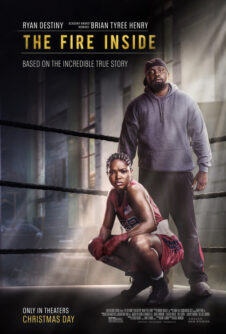
THE FIRE INSIDE
A knockout underdog story — with language that keeps the kids out of the room.
Should You Watch It?
Here's the decision in full. THE FIRE INSIDE is that rare sports movie with real depth — superbly written by Barry Jenkins, superbly directed by Rachel Morrison, and carried by a superb cast. It offers the rousing Olympic victories the genre promises, but it also gives you heartbreak, grit, and one genuinely beautiful friendship. It honors hard work, discipline, determination, and heart.
It also earns its PG-13 and then some. There are roughly 41 obscenities, including an "f" word, more than several "s" words, and two "GD" profanities. There's light sexual immorality between the teenage Claressa and her boyfriend, and mature themes of poverty and past abuse. And the film is marred by some prideful moments and a little political correctness, feminism, and revisionist history — notably leaving out Claressa's real Christian faith.
So: if you're an adult who loves a well-made underdog story and can handle the language, this one's worth your time — better at home, where you control the room. If you're choosing for children, choose something else.
The Story
NO SPOILERS — WE KEEP THE SURPRISESFlint, Michigan, 2006. Nearly eleven years old, Claressa Shields keeps jogging the long road to a boxing gym run by former pro Jason Crutchfield — who keeps telling her to go home, because he only trains boys. She keeps showing up anyway.
Her stubbornness wins him over, and he starts training her in earnest. Six years on, she's chasing a spot at the 2012 London Olympics — earning the nickname "T-Rex" for the ferocious determination that makes up for her short reach. But qualifying is only the first fight. Whether Jason can afford to be in her corner when it matters, and whether victory can lift her family out of poverty, is where the real story begins.
Is It Any Good?
Four stars, and they're earned. Sports movies live or die on that climactic surge toward victory, and THE FIRE INSIDE delivers it in spades — the run at the gold at the 2012 Olympics genuinely rouses. But the film reaches for something more than triumph, and it gets there.
What lifts it above the genre is the personal grit underneath the spectacle: heartbreaking stretches of struggle, both personal and professional, set against heartwarming moments of family and friendship. The centerpiece is the relationship between Claressa and her coach, Jason — compassionate, supportive, and quietly beautiful. It's a film that understands everyone needs someone in their corner, and it makes you feel it. Superbly written, directed, and acted from start to finish.
The Worldview
At its core, THE FIRE INSIDE carries a strong moral worldview. It exalts exactly what Scripture honors in a life: hard work, discipline, determination, and heart. Claressa's coach tells her she has more of all three than anyone in her family — and the film means it as praise, not flattery. She's proud to represent the United States, cheering fellow American athletes at the Games. The friendship at the film's center models loyalty and steadfast support. There are even quiet flickers of faith left in: Jason wears a Cross necklace and kisses it before a match, and Claressa's boyfriend looks up to God when she wins.
But the film also revises the woman it celebrates. In real life, Claressa was converted and baptized at thirteen and prayed before every match; the movie only vaguely shows her possibly praying once and never names her faith. That's a real loss — the story would have been stronger had it shown how Jesus is the God who truly looks out for those who trust Him. Pride, too, becomes one of Claressa's defining traits alongside her virtues.
There's some light political correctness around Flint's social problems, and some mild feminism — female boxers wanting equal stipends and equal respect, and some resentment toward the attention beach volleyball players draw. None of it is radical.
The film's deepest ache is the longing to be seen and supported — to have someone in your corner. Scripture answers it plainly: "The LORD is on my side; I will not fear" (Psalm 118:6).
The Content Guide
The specifics — spoilers included by nature — so you can judge for your own family.
Dominant Worldview and Other Worldview Content/Elements
Strong moral worldview about 16-, 17- and 20-year-old Olympic female boxer Claressa Shields who proudly represents the United States , but there is some politically correct content later about the social problems in Flint, Michigan, especially for poor people, plus some light feminist elements about female Olympic boxers getting equal stipends as the male boxers and about female boxers not getting the same amount of respect as their male counterparts and some feminist anger toward female beach volleyball players getting so much attention because of their physical looks during the volleyball matches, and there’s some revisionist history (for example, the movie doesn’t overtly mention Claressa’s Christian conversion and baptism at age 13 and only vaguely shows her possibly praying before one match), but the movie does show her coach wearing a Cross necklace and kissing the Cross before one of her boxing matches, and it also shows her boyfriend looking up toward God when Claressa wins an important match
Foul Language
About 41 obscenities (mostly relatively light obscenities but containing one “f” word and more than several “s” words), two GD profanities, and three light profanities
Violence
Lots of boxing matches, with many punches thrown, but nothing really graphic or bloody, and teenage girl’s mother has a party and one of the adult men wants to dance with her, but she punches him and knocks him out, so her mother kicks her out of the house
Sex
Teenagers kiss on a bed with the boy having his shirt off, but girl stops him from going further though there’s lightly implied fornication later between them after Prom Night with the boy having his shirt off then too, plus teenage girl tells her boyfriend one of her mother’s boyfriends sexually abused her as a child, and so she wants to take things slow with him, and her teenage sister gets pregnant and raises the baby, sometimes with help from her
Nudity
Upper male nudity in two scenes
Alcohol Use
Man drinks beer occasionally and adults are drinking at a party
Smoking and/or Drug Use and Abuse
Adults sometimes smoke but there are no drugs;
Miscellaneous Immorality
Pride becomes one of the main character’s character traits, in addition to hard work, determination, discipline, and heart or spirit.
Talk About It
Questions for the drive home, the dinner table, or the youth group.
Jason keeps showing up in Claressa's corner when no one else can. Who has been in your corner — and whose corner are you called to stand in?
Ecclesiastes 4:9–10 · Galatians 6:2The film celebrates hard work, discipline, and determination, but pride also becomes one of Claressa's defining traits. Where's the line between healthy confidence and pride, and what does Scripture say about it?
Proverbs 16:18 · James 4:6The real Claressa prayed before every match and was baptized at thirteen — a part of her story the film leaves out. Why do you think faith gets edited out of stories like this, and what's lost when it does?
Matthew 10:32–33 · Psalm 121:1–2Claressa faces poverty, past abuse, and repeated rejection, yet perseveres. Where does lasting endurance come from when your own determination runs dry?
Romans 5:3–5 · Isaiah 40:31The Final Word
This is a superb film — a stirring, well-made underdog story with a moral spine and one of the most beautiful friendships you'll see on screen. It's also loaded with rough language and mature themes that keep it out of children's reach. So here's our answer: wait for home — adults only, where you can watch on your own terms. Looking for something the whole family can enjoy? Start with our latest family-friendly picks.