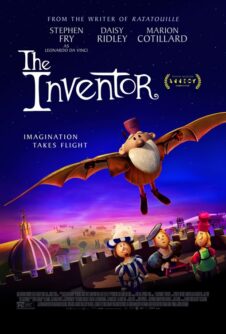
THE INVENTOR
Humanist Seeds of the Renaissance
What You Need To Know
In THE INVENTOR, famed genius Leonardo Da Vinci dazzles the 16th century with his gadgets and theories. As he nears the end of his life, his highest goal is to find ultimate purpose by discovering the immortal qualities of the human soul, including what lives on after death. However, his patrons in Rome, particularly the Pope, dislike his experiments in dissection and lack of focus. They order him to stop searching for the soul and use his artistic talents to make weapons to smite the Pope’s enemies.
Leonardo moves to serve the French Court instead, hoping to find a patron who’s excited about new ideas, but is dismayed to find out that the French King isn’t interested in discovery so much as how Leonardo’s genius can help his own public image. With help from Princess Marguerite, Leonardo begins trying to convince the King that a real display of power is in the strength of good ideas. He proves this by constructing an Ideal City during the daytime, while secretly searching for the soul and dissecting stolen corpses at night. With skeptics pressing in on every side, can Leonardo uncover the secrets of the soul before his time on earth runs out?
THE INVENTOR is a funny but earnest look at the end of Leonardo Da Vinci’s life through the lens of nostalgic stop-motion animation. This is charmingly blended with sequences of traditionally drawn animation and a sweet musical score. Although the movie’s visuals are engaging enough, there is very little action or clear character motivations for the movie’s target audience, children, to enjoy. In fact, it may be difficult for anyone but adults to understand the battle of ideas and worldviews that THE INVENTOR chooses as a topic.
Many scenes are entirely devoted to conversations between the idealistic Leonardo Da Vinci and his skeptics, or even his supporters, who try but fail to understand his goals. Sometimes
Leonardo must try to prove his point against religious officials, and sometimes he must resist, though never directly argue with, the commands of royalty. These philosophical scenes of dialogue are still visually stunning, often using one or two musical numbers or surreal sequences to keep a younger viewer’s attention, even if they won’t quite understand what’s being discussed.
The movie also suffers from some missing context, which only makes the main character’s journey harder to follow. For example, Leonardo Da Vinci talks wistfully to his Mona Lisa painting in key scenes as if he associates the painting with his search for the soul. However, these scenes are never directly explained. So, viewers would have to have prior knowledge of the famous artist to understand why many scenes like these are not random.
In terms of narrative, another thing that makes THE INVENTOR feel unresolved is the lack of follow-through when it comes to the movie’s main villain, the Pope. In the first few scenes, Pope Leo X is set up as a major threat and danger to Leonardo’s goals and life, but he disappears for most of the story. Even when Leonardo fails to obey the Pope, there are no significant consequences or even a follow-up, leaving the movie feeling unfinished.
THE INVENTOR is full of inspiring themes about making the most of our time in life and sharing our ideas with others. For example, Leonardo never reacts with anger or disrespect when his ideas are ignored. Instead, he finds new ways to inspire both the critics and those willing to learn. Also, an early conversation attributes Leonardo’s genius to God, and later, the Princess argues for the benefits of faith, claiming it “makes things possible.”
That said, THE INVENTOR does feature Leonardo Da Vinci’s nude artwork studies as well as heavy ideological themes. For example, when the Princess proposes that the answer to Leonardo’s deepest questions may be found in faith, he dismisses the idea and spends much of the movie glorifying man’s judgment, reasoning and ability to experiment. Sadly, the movie’s answer to Leonardo’s question about the purpose of life entirely ignores God. So, MOVIEGUIDE® rates THE INVENTOR as unacceptable entertainment.
The Content Guide
The specifics — spoilers included by nature — so you can judge for your own family.
Dominant Worldview and Other Worldview Content/Elements
Strong humanist, materialist worldview in a story about the last years in the life of Leonardo da Vinci ultimately rejects faith, and movie depicts the Pope as an ignorant tyrant, but there’s some references to faith, discussions about the reality or real possibility that man has a soul (though Leonardo searches for the soul in the material world by dissecting human cadavers), a conversation about the shortcomings of blind faith versus the possibilities that true faith opens up, and another conversation about the belief in God’s gift of genius to Leonardo, but Leonardo and the movie eventually dismiss God and the idea that Gid made the soul that Leonardo us trying to locate, plus, some oral elements stress the importance of discovery and sharing good ideas as opposed to seeking glory and power for oneself, the importance of the soul is eventually presented as sharing one’s passion with others as a kind of immortality while any further mention of God’s importance or purpose for creating mankind is left out, some politically correct feminist ideals are suggested when a princess abandons her duties to learn from Leonardo, and only women build the Ideal City that Leonardo builds, and the Ideal City that Leonardo builds is created around a strong environmentalist worldview
Foul Language
No foul language
Violence
Some strong and light violence (including action violence) includes non-gory brief cartoon examples of soldiers being decapitated in battle, two or three scenes of cartoon violence between characters that are obscured in a thick cloud, Leonardo distracts himself from the Pope’s reproofs by imagining the Pope being dragged into a cave marked “ignorance” by a wolf, an imaginary chase sequence where a character tries to flee from a shadowy and scary personification of death, and Leonardo dissects human cadavers
Sex
No sex
Nudity
Full nudity is shown several times in the form of Leonardo Da Vinci’s historically authentic sketches of the human anatomy, wherein no part of the body is censored, a cartoon illustration of partially naked cherubs is shown early in the movie, and Michelangelo’s partially-nude fresco figures on the Sistine Chapel ceiling are shown
Alcohol Use
No alcohol use
Smoking and/or Drug Use and Abuse
No smoking or drugs;
Miscellaneous Immorality
Leonardo tries to hide his dissections and the real purpose of his studies from his benefactors in the French court and steals bodies before they are buried (though they are never shown beyond a pair of grey feet), and King Francis is obsessed with his image and proving he is stronger than other kings who frequently call one another names as well as attack one another physically.