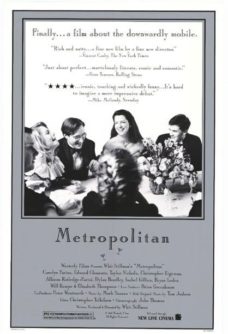
METROPOLITAN
A sharply observed social satire for discerning adults.
Should You Watch It?
METROPOLITAN is a witty, carefully observed portrait of young Park Avenue socialites facing the decline of their class. Its conversations about honor, faith, social mobility, and failure give the comedy more weight than its elegant parties might suggest.
The film’s sharply detailed setting succeeds in portraying a traditional upper-class world rarely shown accurately in American cinema. Its 1930s-style show tunes and Society Dance Band sound create an especially charming atmosphere, including a rendition of “A Mighty Fortress Is Our God.”
That refinement comes with adult content: several profanities and obscenities, substance abuse, excessive drinking, and partial nudity. Take the trip if you are a discerning adult who can engage its ideas without being pulled along by its decadence.
The Story
NO SPOILERS — WE KEEP THE SURPRISESDuring the Christmas holidays, an outsider from Manhattan’s West Side joins a tightly knit group of young Park Avenue socialites. They gather nightly in black tie and evening dress to discuss life, honor, and the impending demise of their class, which they call the UHB—Urban Haute Bourgeoisie.
As romance, rivalry, and questions of status enter the group’s orbit, the young people must confront what lies beneath their protected world.
Is It Any Good?
Three stars means METROPOLITAN is a good, distinctive film with real limitations. Whit Stillman’s writing, directing, and production create a sharply detailed social world, and the film succeeds as an accurate portrait of the traditional upper class.
The music is a major strength. The 1930s-style show tunes and Society Dance Band sound establish the period mood and authenticity, moving from semi-sweet sadness to cha-cha-cha. The result is a charming, ironic comedy-drama whose social observations give it substance.
The Worldview
METROPOLITAN views its upper-middle-class characters with irony, allowing viewers to approach them from their own point of view rather than simply condemning them. The film’s central theme is upper-middle-class failure: life inside the mansion feels safe, but stepping outside to accomplish something can mean having nowhere to go but down.
The characters discuss honor, social mobility, class decline, and the possibility of faith. Charlie argues that all humans have an innate belief in a Supreme Being and speaks of “a conscious act of faith,” yet admits that he has never experienced it and hopes to someday. The film recognizes spiritual longing but leaves that longing largely unresolved.
Its perspective is slightly conservative in its social observation, especially in its concern for the decline of a traditional upper class. Yet its world remains shaped by status, pleasure, romantic confusion, and decadence. The film’s reminder is close to Ecclesiastes: social position and pleasure cannot overcome death. Scripture therefore says, “Remember also your Creator in the days of your youth” (Ecclesiastes 12:1).
The Content Guide
The specifics — spoilers included by nature — so you can judge for your own family.
Content Summary
Several profanities and obscenities; substance abuse and excessive drinking; game of strip poker with partial nudity
Talk About It
Questions for the drive home, the dinner table, or the youth group.
The characters discuss honor and the decline of their social world. What does true honor look like when status and wealth cannot protect us?
Proverbs 22:1 · Philippians 2:3–4Charlie speaks of faith in a Supreme Being but has not experienced it himself. What is the difference between talking about faith and trusting God?
Hebrews 11:1 · James 2:17The film’s theme is upper-middle-class failure. What kinds of success does Scripture warn us not to mistake for a successful life?
Ecclesiastes 2:10–11 · Mark 8:36The characters live amid pleasure and social privilege. How can you enjoy good things without allowing them to become your master?
1 Timothy 6:17–19 · 1 Corinthians 6:12The Final Word
METROPOLITAN offers discerning adults intelligent social satire, memorable atmosphere, and serious questions about class, faith, and failure. Its adult content makes it unsuitable for children and young teens. For mature viewers able to weigh both its wit and its decadence, the answer is WORTH THE TRIP — ADULTS ONLY. For other family viewing, consider.