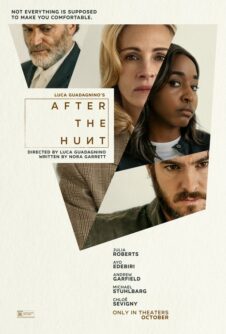
AFTER THE HUNT
A sharp campus satire that talks itself into nihilism — and profanity.
Should You Watch It?
This one is a hard pass, and the reasons are worth understanding. AFTER THE HUNT starts with real promise — a Yale professor caught between a colleague accused of rape and the student accusing him, with sharp, genuinely funny jabs at woke identity politics, the MeToo movement's "believe every woman" reflex, and the shallowness of campus activism.
Then it loses its nerve. The film keeps walking back its own best points until it settles into a foggy, cryptic ambiguity — an ending that suggests truth is simply unknowable, dressed in the nihilistic philosophy the lead character teaches in her own classroom. Layer on heavy obscenity, sexual assault content, brief nudity, and a conclusion that lands on the pro-homosexual side of the ledger, and there's little reason to spend two-plus hours here.
Smart people made this. It just doesn't earn the trust it asks of you. Skip it.
The Story
NO SPOILERS — WE KEEP THE SURPRISESAlma, a Yale professor with a hidden past and a mysterious chronic illness, is up for tenure alongside her best friend and colleague, Hank. At a dinner party, Alma's star pupil, Maggie, discovers something private that will matter later. Soon after, Maggie accuses Hank of assaulting her after that same party — while Hank insists he only confronted Maggie over academic dishonesty. Alma is caught in the middle, her husband can't quite help her, and the university erupts around all three of them. That's where the trail goes cold — for good reason.
Is It Any Good?
Three stars, and here's the honest math. The film is intelligent and often quotable — the campus dialogue moves fast, the class scenes on Foucault and identity politics have real bite, and the setup genuinely skewers wokeism and MeToo excess in ways few studio dramas attempt. That's the film's real achievement.
But it's also too talky, and it doesn't know how to land. Director Luca Guadagnino builds a story about power, privilege, and truth that deliberately "defies specificity" — never resolving whether Hank or Maggie is telling the truth, never letting either side fully win or lose. What plays as artistic ambiguity in the moment curdles, by the end, into a message that truth itself is unknowable. Sharp filmmaking in service of a hollow conclusion.
The Worldview
This film wants credit for challenging campus orthodoxy, and in places it earns that credit. It mocks shallow identity politics, undercuts the "believe every woman" absolutism of MeToo culture, and lets a Marxist student's plagiarism accusation turn out to be true rather than righteous. Those are real, countercultural swings for a mainstream drama to take.
But the film keeps taking those swings back. It softens its critique of Maggie even as she never apologizes for a vicious public attack on her mentor, while Alma is the one who ends up apologizing. And its ending settles into a pro-homosexual resolution, with the story ultimately siding with the very identity-politics currents it spent two hours mocking. Underneath both threads sits a deeper problem: the film's guiding philosophy, borrowed openly from Foucault, treats truth itself as unknowable and relative. That's not edgy nuance — it's nihilism dressed as sophistication.
Scripture doesn't hedge on this point the way the film does. When Pilate stood before Jesus and asked, sneering, "What is truth?" (John 18:38), he was standing in front of the answer. Christ had already said it plainly: "I am the way, and the truth, and the life" (John 14:6). A film that shrugs at truth isn't being humble — it's looking away from the only thing that can actually resolve the ache it spends two hours describing.
The Content Guide
The specifics — spoilers included by nature — so you can judge for your own family.
Dominant Worldview and Other Worldview Content/Elements
Strong humanist, nihilistic worldview supports the false, paradoxical idea that truth is unknowable and a young woman spouts a Neo-Marxist ideology at least once but the movie has some moral, traditional elements that skewer her radical politics and undercut the METoo movement and that mock woke identity politics and shallow transgender politics, but movie also has some political correct elements, plus movie ultimately is pro-homosexual
Foul Language
At least 62 obscenities (including at least 49 “f” words), four strong profanities mentioning the name of Jesus Christ, one GD profanity, one light profanity, and woman with some kind of periodic stomach issue/pain gets sick and vomits in two or so scenes (the medical problem is revealed toward the end of the movie)
Violence
Verbal references to sexual assault and there’s an attempt to force sex on a married woman but it’s rebuked, and it stops, plus there’s a reference to a man committing suicide after falsely being accused of fornicating with a teenage girl
Sex
Man starts to force sex on a married woman, but he stops when she resists and before any clothes come off, and lesbian female graduate student accuses thirtysomething male professor of rape (movie never reveals if it really happened or not), young woman kisses another woman who’s “transitioning” into a man, and woman later reveals she broke up with the trans character and is now in a lesbian relationship with another woman (movie seems to support homosexual relationships, but a line of dialogue insults the trans character pretty well)
Nudity
Upper male in one scene where a woman exposes her chest and there’s a scar where she had her breasts removed to “transition” into a man, and regular upper male nudity in another scene
Alcohol Use
Some alcohol use and drunkenness
Smoking and/or Drug Use and Abuse
Some tobacco smoking, people seem to be smoking marijuana in two or so scenes, and woman takes opioid pain killers for stomach pains;
Miscellaneous Immorality
An accusation of plagiarism by a Marxist graduate student turns out to be true, woman forges a doctor’s prescription for opioid painkillers, but she’s caught and punished by her employer (her employer is Yale University).
Talk About It
Questions for the drive home, the dinner table, or the youth group.
The movie suggests that truth is ultimately unknowable. Why does that idea matter when someone is accused of a serious wrong, and what does Scripture say truth actually is?
John 18:37–38 · John 14:6Multiple people in the film disagree about whom to believe. How can we take accusations seriously without either dismissing a victim or destroying an accused person before the facts are known?
Deuteronomy 19:15 · Proverbs 18:17One character apologizes; the other never does. What does real repentance look like compared to simply moving on unapologetically?
Luke 17:3–4 · 2 Corinthians 7:10The film pokes fun at identity politics and cancel culture, then ends up siding with some of the same ideas. Where do you see similar inconsistency in cultural debates today, and how should Christians respond?
Colossians 4:6 · James 1:19The Final Word
There's a smarter, braver movie buried inside AFTER THE HUNT — one that had the nerve to say what it started saying about wokeism and MeToo excess and stick with it. Instead, it retreats into ambiguity, heavy profanity, and a worldview that treats truth as a lost cause. Our verdict stands: skip it. For something your family can actually watch together, start with our latest.