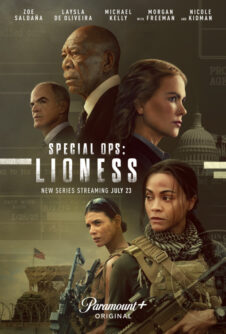
LIONESS: Episode 3.1: “The Spider and the Fly”
Espionage abroad collides with danger at home.
Should You Watch It?
No. If you came to this opening episode for the domestic tension pulsing beneath the tradecraft, this premiere presents both and challenges you to confront the real cost. The Ukraine mission unfolds with tension, effective staging, and moral unease that the show rarely embraces; the line about killing people "for a chess piece in a war that has nothing to do with us" delivers the episode's most insightful commentary.
However, know what you sign up for. The violence strikes hard with drone strikes, point-blank executions, a dog mauling a corpse, and the language shocks with over fifty f-words crammed into a single episode. A non-sexual shower scene includes brief nudity, and the interpersonal friction between rival teams occasionally disrupts the momentum.
If you prefer your spy thrillers grounded in genuine dread instead of gloss, this show delivers. If graphic combat and heavy profanity exhaust you rather than engage you, you will leave feeling depleted rather than gripped. Either way, the ending captures your attention for the next episode, although we advise skipping it altogther.
The Story
NO SPOILERS — WE KEEP THE SURPRISESSix months after nearly losing everything, Joe McNamara has traded the field for a desk. She now occupies a quieter position at CIA Headquarters, earned through hardship. However, silence does not last. A covert operation pulls her back into the fray: a double agent, a fragile deal, and a mission that thrusts her and her team into the heart of a live war zone. Back home, her family finally experiences some semblance of normalcy, like breakfast, homework, small mercies. The premiere poses a question that will haunt the season: how long can Joe keep those two worlds, war and home, from colliding?
Is It Any Good?
Call it three stars: a well-crafted premiere struggles under its own ambition. Zoe Saldaña anchors the show, conveying Joe's exhaustion and resolve without a wasted gesture. The shift from cartel warfare to the Russia-Ukraine front gives the season real geopolitical weight. The direction delivers confidence, the tension in the underground base skyrockets, and the open timeline jump represents a smart structural choice.
Where it stumbles lies in pacing: the power struggle between Joe's team and Cody's team consumes time without earning it, functioning more as table-setting than drama. Taylor Sheridan's broader canvas features greater swagger, but the dialogue occasionally strains for weight it hasn’t yet built.
Still, this television episode presents hard content honestly. The three stars do not serve as a hedge; they represent a score for a show that understands its purpose and challenges you to earn the payoff. The star it cost belong entirely to the violence and language, not the craft.
The Worldview
This series believes in duty as a kind of sacrament with the idea that some people are called to absorb violence so others can eat breakfast in peace. That's not a shallow belief, and there's something true in it: Scripture doesn't pretend the world is safe, and it honors those who stand in the gap for others. But the show's morality has no ceiling above itself.
When Joe's team asks whether they just killed people "for a chess piece in a war that has nothing to do with us," the question hangs in the air and gets no real answer. This is a world where survival and mission override any higher accounting.
Nothing here points past the war room to a justice or mercy that outlasts it. The story also quietly exalts secrecy and self-reliance as the price of protecting family, when the deeper ache is that Joe cannot actually keep her two worlds apart. This something the gospel speaks to directly: we were never meant to carry every burden alone or unseen.
Culturally, the ensemble is well cast and the production values are a clear step up, with Saldaña, Kidman, and Freeman giving the material more gravity than the script always deserves; the show clearly wants to be taken seriously as prestige television, and mostly earns that ambition, even where its moral compass wobbles.
The Content Guide
The specifics — spoilers included by nature — so you can judge for your own family.
Dominant Worldview and Other Worldview Content/Elements
Strong moral, Pro-American, patriotic worldview where a main character demonstrates selfless worldview guided by her strong desire to protect the weak, the U.S. military and intelligence community are played positively
Foul Language
Extremely heavy language throughout, including 54 "f" words and 21 "s" words, plus repeated uses of "Jesus Christ" and "G" as profanity/obscenity
Violence
Very strong, sustained combat violence, including drone bombings that kill soldiers, point-blank executions, and dogs attacking and eating a corpse (a dog is also stabbed in the fight). A woman is also hit by two cars and kidnapped; later she is attacked in her own home and forced to kill two enemy combatants
Sex
One scene of a husband and wife kissing in the shower; no sex is shown;
Nudity
Female rear nudity and partial breast nudity in a non-sexual shower scene;
Alcohol Use
A character has one drink after returning home from a mission
Smoking and/or Drug Use and Abuse
Characters smoke cigarettes
Miscellaneous Immorality
Bribery; rival intelligence teams undermine and distrust one another mid-operation; a soldier questions aloud whether they just killed people for a cause with no real stakes for them; mention of AI potentially "ending democracy."
Talk About It
Questions for the couch, the commute, or the couple bingeing it together.
Joe's team asks if they just killed people "for a chess piece in a war that has nothing to do with us." Have you ever gone along with something and only questioned it after the fact? Proverbs 4:26
The Final Word
This series believes in duty as a kind of sacrament with the idea that some people are called to absorb violence so others can eat breakfast in peace. That's not a shallow belief, and there's something true in it: Scripture doesn't pretend the world is safe, and it honors those who stand in the gap for others. But the show's morality has no ceiling.
When Joe's team asks whether they just killed people "for a chess piece in a war that has nothing to do with us," the question hangs in the air and gets no real answer. This is a world where survival and mission override any higher accounting.
Nothing here points past the war room to a justice or mercy that outlasts it. The story also quietly exalts secrecy and self-reliance as the price of protecting family, when the deeper ache is that Joe cannot actually keep her two worlds apart. This is something the gospel speaks to directly: we were never meant to carry every burden alone or unseen.
Culturally, the ensemble is well cast, and the production values are a clear step up, with Saldaña, Kidman, and Freeman giving the material more gravity than the script always deserves; the show clearly wants to be taken seriously as prestige television, and mostly earns that ambition, even where its moral compass wobbles. Our verdict stands - skip it.