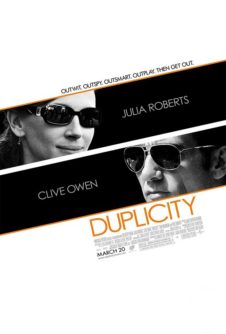
DUPLICITY
A clever, complicated spy game best reserved for discerning adults.
Should You Watch It?
Duplicity is a fun but morally compromised spy thriller and heist movie. Its crackling dialogue and fine performances give the story energy, while the extended question of whether Ray and Claire can trust each other supplies genuine tension.
The movie is also more complicated than it needs to be. Multiple flashbacks and shifts in time may make it difficult to follow, and the moral conclusion is only half-hearted because some dishonesty is rewarded. Pre-marital sex and plenty of foul language are present without being rebuked.
You may enjoy the cleverness if you are an adult prepared to weigh its worldview and content, but this is not a family movie. The practical answer: WORTH THE TRIP — ADULTS ONLY.
The Story
NO SPOILERS — WE KEEP THE SURPRISESRay Kovic, a British spy, meets Claire Stenwick, a CIA agent, at the U.S. Consulate in Dubai. Five years later, Ray works as an industrial spy in New York City, where he discovers Claire is helping his employer steal a rival company’s secret formula.
Ray and Claire decide to pursue the formula for themselves while pretending not to like each other. Their dangerous game of espionage, romance and deception raises one question: can either of them trust the other?
Is It Any Good?
Three stars means Duplicity is entertaining and competently made, though its complicated structure keeps it from being thoroughly satisfying. The dialogue crackles, and Julia Roberts, Clive Owen, Paul Giamatti and Tom Wilkinson give fine performances.
The relationship between Ray and Claire creates additional tension as they play mental games and test each other’s trust. The rivalry between the two companies and their CEOs adds another layer to the title’s meaning.
The multiple flashbacks and shifts in time may be hard for many viewers to follow. The result is a fun movie that is slightly less entertaining than it could have been.
The Worldview
Duplicity presents a strong pagan worldview alongside some light moral implications. Its central concern is trust in a world where industrial espionage requires people to play double and triple games of deceit. The film shows, somewhat half-heartedly, that crime and dishonesty do not pay, but some characters still get away with dishonesty.
The story does not offer a particularly morally uplifting vision. Its romantic relationship includes implied pre-marital sex, and the dishonesty surrounding the characters is not consistently rebuked. The film’s idea that people cannot be fully trusted aligns with the Bible’s sober view of human faithlessness, but Scripture points beyond that failure to God as the One who can truly be trusted.
The source review also connects the film’s question about deceit with Rahab’s protection of the Hebrew spies in Joshua. That biblical account distinguishes her act of serving the Lord from a world built on selfish dishonesty.
The film’s deepest longing is for someone trustworthy. “It is better to take refuge in the LORD than to trust in man” (Psalm 118:8).
The Content Guide
The specifics — spoilers included by nature — so you can judge for your own family.
Content Summary
Strong pagan worldview with some light moral implications; about 39 obscenities (including one “f” words and many “h” words), 14 strong profanities and eight light profanities; light violence includes a man tailing a man is knocked down so the man can get away and a thief handcuffed to furniture has his eyes and mouth taped up and struggles later to get free; implied fornication, kissing and man kisses female partner’s naked back after implied sex has occurred; upper male nude, brief partial rear female nudity in one shot and another shot from the side shows partial view of woman’s breast; alcohol use; no smoking; and, lying, deceit, dishonesty, stealing, and CIA spy drugs British spy unconscious to steal some state secrets he stole, but movie also implies that crime and dishonesty don’t really pay and that constant dishonesty can lead to a serious lack of trust.
Talk About It
Questions for the drive home, the dinner table, or the youth group.
Ray and Claire repeatedly test each other’s trust. What makes someone trustworthy, and why is trusting God different from trusting people?
Psalm 118:8 · Proverbs 3:5–6The movie suggests that crime and dishonesty do not pay, but it also shows some dishonesty being rewarded. What does Scripture say about the lasting outcome of deceit?
Proverbs 12:22 · Galatians 6:7Rahab protected the Hebrew spies in Jericho. How is her act different from the selfish deception practiced by the characters in this story?
Joshua 2:1–14 · Joshua 6:25The film connects dishonesty with a serious lack of trust. How can truthfulness repair relationships after someone has acted faithlessly?
Ephesians 4:25 · Colossians 3:9–10The Final Word
Duplicity offers witty dialogue, fine performances and real tension, but its complicated structure and unrebuked immorality limit its appeal. Adults who can exercise discernment may find the spy game worthwhile; families and young viewers should choose something else. WORTH THE TRIP — ADULTS ONLY.