
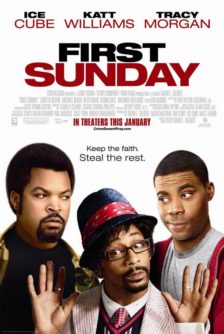
FIRST SUNDAY
A redemptive church comedy that is better kept at home for adults.
Should You Watch It?
First Sunday has a genuinely positive center. Its two petty criminals are pulled toward repentance, forgiveness, faith, kindness, and a better life through their unexpected time inside a Christian church. The pastor and most church members are positive influences, and the film ultimately presents Christianity as a source of redemption and hope.
The trouble is that the comedy does not consistently earn its laughs. The plot and characters can feel forced and predictable, and the humor is not always moral. Strong obscenity, sexual references, off-color jokes, criminal schemes, and some comical but threatening violence make the movie unsuitable for children and young teens.
If you are an adult who can weigh those concerns, watch it at home rather than taking the family to it.
The Story
NO SPOILERS — WE KEEP THE SURPRISESDurell and LeeJohn are incompetent petty criminals and childhood friends. Durell needs money to keep his beloved son nearby, while LeeJohn has gotten them into trouble with Jamaican gangsters.
Their desperate solution is to rob a neighborhood Christian church. But when they discover that someone inside the church has already taken the money, they must remain there overnight to find their rival. In the process, the two men encounter the church, its followers, and the possibility of a changed life.
Is It Any Good?
Two stars means First Sunday has some worthwhile elements but is not consistently entertaining. The film’s strongest feature is its redemptive direction, especially as the story moves toward repentance, forgiveness, and faith. The pastor is a solid, positive character, and the church’s spiritual influence eventually gives the comedy a meaningful center.
The humor, however, is weaker than the film wants it to be. The plot and characters are sometimes forced and predictable. Tracy Morgan lays the goofy, stupid, mush-mouthed friend characterization on too thickly, while the church members can seem quirky. The movie is uneven and not as entertaining as the comedies named for comparison in the source review.
The Worldview
First Sunday presents a strong positive Christian worldview, especially toward its conclusion. It recognizes that crime, greed, deceit, and other sinful choices damage lives, while kindness can lead people toward repentance, faith, forgiveness, and joy. Christianity is not treated merely as a setting: the Gospel and the Bible stand against stealing, lust, envy, greed, and deceit.
The film also acknowledges that churches contain sinful people, including thieves and hypocrites. Some church members are quirky, and the movie includes lawless qualities that can send mixed moral messages because wrongdoing is sometimes played for laughs. Still, the pastor and most of the church members are positive figures, and the story ultimately celebrates the God of second chances and the beginnings of a better life.
The film’s depiction of the African-American community may upset some viewers because of stereotypical portrayals. That concern is part of the work’s unevenness and should be weighed alongside its positive Christian message.
The central longing is for redemption after a life shaped by destructive choices. Scripture gives that hope a firm foundation: “If we confess our sins, he is faithful and just to forgive us our sins and to cleanse us from all unrighteousness” (1 John 1:9).
The Content Guide
The specifics — spoilers included by nature — so you can judge for your own family.
Content Summary
Ultimately strong, but uneven, Christian worldview about redemption and leading to it, including two unchurched men repent and join a Christian church, but with some antinomian or lawless qualities that could send mixed moral, biblical messages but church members and pastor are mostly positive figures, though sometimes quirky, and undeserved kindness overcomes sin, leading to repentance and faith, plus homosexual jokes where man gets massage from woman who turns out to be a man, which causes him to run away, and worship director acts effeminate and off the cuff mentions he’s not HIV positive; 33 or 34 obscenities (including many a-- words), one GD, one possible light profanity, and an obscene gesture; some comical violence such as trying to blow up a safe which doesn’t do much, wheelchairs spill out of van and cause crashes, police chase criminals, gangsters threaten protagonists with guns, pastor tied up, and man holds people in church hostage with gun, which goes off at least once; no sex scenes but men jokingly refer to woman’s body, especially her rear end, as they watch her from across the street, and man leers at woman’s rear end, plus the aforementioned homosexual jokes; no nudity, but some female cleavage; no apparent alcohol use; no smoking but a joke about marijuana with car bumper sticker saying, “Honk if you like weed”; and, protagonists try to fence stolen wheelchairs, protagonists try to rob church, embezzlement rebuked, and protagonists hold people hostage in church, but miscellaneous immorality is played for laughs and used to teach overall moral lesson, plus stereotypical depictions of African-American community may upset some people, perhaps rightly so.
Talk About It
Questions for the drive home, the dinner table, or the youth group.
Durell and LeeJohn’s choices bring trouble into their lives. What does Scripture say about the path from sinful desire to destructive action?
James 1:14–16 · Galatians 6:7–8The story points toward repentance and a better life. How is biblical repentance more than simply feeling sorry?
2 Corinthians 7:10 · Acts 3:19The film presents kindness and forgiveness as forces that can overcome sin. When have you received undeserved kindness, and how can you extend it to someone else?
Ephesians 4:32 · Colossians 3:12–13The church includes imperfect people, yet the film presents the church as a place where lives can change. What should Christians expect from the church, and what should they contribute to it?
Hebrews 10:24–25 · Galatians 6:1–2The Final Word
First Sunday has a worthwhile message about repentance, forgiveness, faith, and second chances. Its uneven comedy, strong obscenity, off-color humor, and criminal behavior make it a poor family choice. Watch it at home, if at all, and reserve it for discerning adults. WAIT FOR HOME — ADULTS ONLY. For cleaner family viewing, see.


