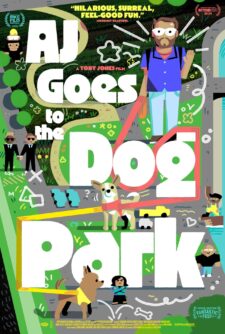
AJ GOES TO THE DOG PARK
A scrappy, absurd comedy with real heart — and real bite.
Should You Watch It?
Here's the decision. Writer-director Toby Jones has made something genuinely creative out of almost no money — an absurd comedy that's funny, well produced, and carried by a cast that clearly believes in it. There's a real reward here for anyone who loves scrappy, inventive filmmaking, and by the end it lands on something worth landing on: friends and loved ones matter more than any goal.
But this is not a family movie, and it isn't quite a clean one either. The violence runs strong and strange — punches that draw blood, a father swinging a scythe at his son, a flaming skull, a monster leveling a town. There's an "f" word, a crude "pounding" innuendo, and a worldview that treats personal happiness as an entitlement before it grows up.
So: if you're a teen or adult who enjoys offbeat comedy and can weather the rough edges, this one's worth your time — but watch it at home, where you control the room. If you're choosing for children, choose something else.
The Story
NO SPOILERS — WE KEEP THE SURPRISESAJ is a man of habit. Same routine, every single day — and the anchor of it is taking his two chihuahuas to the dog park.
Then one morning the park is gone. The mayor has turned it into a "blog park," swarmed with people at desks working on laptops, and AJ and his dogs are promptly thrown out. AJ decides there's only one way to get his park back: unseat the mayor and take the job himself. To do it, he'll have to survive a gauntlet of very unconventional challenges — and that's where the trouble really begins.
Is It Any Good?
Three stars, and they're earned the hard way. Shot on a micro budget, this movie makes a virtue of its limits — the deliberately basic visual effects and action scenes lean into the comedy rather than hiding from it, and Jones puts his animation background to work with playful animated touches. The cast is the engine; their committed performances are what drive the whole thing.
The problem is length. The movie runs well past where it should have stopped, piling on multiple climaxes and endings until the momentum sags. Late in the film it feels as though the writers simply started tossing in random subplots. What could have been a tight little gem instead overstays its welcome — a very good idea stretched thinner than it needed to be.
The Worldview
At heart this is a story about a man who wants what he wants. AJ treats self-fulfillment and happiness as things he's owed — his individual right — and to chase them he abandons the friends and even the dogs he loves. That's the film's pagan, Romantic engine: right and wrong driven mostly by feelings, desire treated as its own justification.
The good news is that the movie doesn't leave him there. Once AJ finally gets what he was chasing, he discovers it's hollow without the people and pets he pushed away. The back half turns toward reconciliation and humility, and those virtues are genuinely honored as AJ sets out to make things right and defend those he loves. There's even a nod to Scripture, though the film has a character misquote a Bible verse in one scene.
So the picture is mixed. It stumbles toward a real truth — that a life spent only on your own ambition ends up empty — but it never grounds that truth in anything higher than emotion. What the movie feels in its bones, Scripture says plainly: a man can gain everything and lose the things that mattered most. "For what does it profit a man to gain the whole world and forfeit his soul?" (Mark 8:36).
The Content Guide
The specifics — spoilers included by nature — so you can judge for your own family.
Dominant Worldview and Other Worldview Content/Elements
Mixed pagan worldview with Romantic, pagan, moral elements where self-fulfillment and happiness are viewed as an entitlement, mixed with some moral, redemptive values highlight the importance of good relationships, main character reconciles with those whom he ignored and left behind in pursuit of a goal, he also protects his town and those he loves from an evil monster that surfaces to take out his town, plus main character misquotes a verse from the Bible in one scene
Foul Language
Three obscenities (including one “f” word), one light profanity, and a woman calls a man a demon.
Violence
Strong and light violence includes man gets punched in the face and blood is seen, man punches a dummy’s head off (the dummy is a stand-in for the real person the man hates), man catches the dummy’s head and dunks it in a basketball hoop, father tries to injure his son with a scythe, the son retaliates and knocks his father unconscious with one punch, scene depicts a man with bugs crawling out of his mouth and blood running down his chin, woman holds a gun to a man’s head intending to shoot him, woman burns down a house, two people are hired to kill a man, a large skull made up of flames is seen in a fire, man drives over a cliff into lava, large monster called a demon slayer tries to annihilate a town, helicopters shoot at the monster, the monster destroys the helicopters along with some shops, and skeletons attack main character.
Sex
No sex scenes, but there’s a crude sexual innuendo involving the word “pounding,” different couples kiss, one couple talks about kissing
Nudity
No nudity
Alcohol Use
Man drinks wine, and a man talks about beer
Smoking and/or Drug Use and Abuse
No smoking or drugs;
Miscellaneous Immorality
A man is kidnapped, man abandons his family to pursue fishing and never returns, woman burns down someone’s house in revenge, and a man leaves behind his friends and family to pursue his goals, but later realizes and makes up with them.
Talk About It
Questions for the drive home, the dinner table, or the youth group.
AJ becomes convinced that his own happiness and success are things he's owed. Where does that belief lead him — and what does Scripture say about treating our desires as entitlements?
Philippians 2:3–4 · James 4:1–3When AJ finally gets what he chased, he finds it empty without his friends and dogs. Have you ever reached a goal only to find it hollow? What actually fills that gap?
Ecclesiastes 2:10–11 · Mark 8:36The last stretch of the film turns on reconciliation and humility as AJ makes things right with the people he abandoned. What does real reconciliation cost, and who might you need to seek out?
Matthew 5:23–24 · Colossians 3:12–13A character in the movie misquotes the Bible. Why does it matter that we handle Scripture carefully and accurately, rather than bending it to fit what we want?
2 Timothy 2:15 · Proverbs 30:5–6The Final Word
This is a real charmer of a low-budget comedy — creative, funny, and warmer than you'd expect — that happens to be too long and too rough for the whole family. There's merit here for the right viewer, so here's our answer, the same one we started with: wait for home — adults only. Planning family movie night instead? Start with our latest family-friendly picks.