
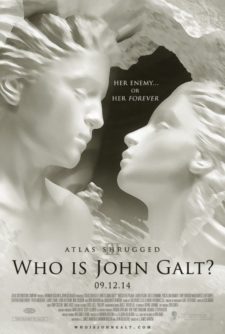
ATLAS SHRUGGED: WHO IS JOHN GALT?
A strong liberty message best reserved for discerning adults at home.
Should You Watch It?
The best parts of Who Is John Galt? are genuinely exciting and profound. Its conflict between John Galt and the socialist government makes a strong case for personal liberty, private property, creativity, business, and charity outside government control.
But this is the least successful film in the trilogy. Clunky narration interrupts the story, the romance can feel melodramatic, and the limited budget shows most clearly in the ending. More importantly, the movie’s humanist and atheist philosophy attacks biblical ideas about moral responsibility and forgiveness of sins.
The PG-13 version also contains a partially depicted fornication scene, along with strong violence and foul language. Adults interested in the movie’s message should wait to watch it at home, while families with children or young teens should choose something else.
The Story
NO SPOILERS — WE KEEP THE SURPRISESDagny Taggart, a brilliant railroad magnate, crashes into the hidden Rocky Mountain colony founded by the mysterious John Galt. There, leading industrialists, inventors, intellectuals, and artists have abandoned a society increasingly controlled by a socialist government.
John asks Dagny to join their movement. Instead, she returns to New York to defend her family’s railroad, while John continues trying to awaken the country to his pro-capitalist ideals. Their paths soon bring them into direct conflict with the government.
Is It Any Good?
Three stars means this film has real strengths but falls short of its potential. The movie is most effective when John Galt confronts the government, especially when he replaces the Head of State’s speech and when the two men finally face each other. The second half gains momentum as the conflict and jeopardy increase.
The weaknesses are substantial. Philosophical conversations slow the opening, the romance sometimes feels like a corny soap opera, and the narrator explains too much. The ending is exciting and suspenseful but lacks the larger action and spectacle it needs.
The Worldview
The film strongly supports American liberty, capitalism, private property, creativity, charity, and limited government. It argues that government control of business, inventions, money, and property destroys liberty and prosperity. These concerns can align with biblical principles about work, responsibility, and the dangers of concentrated power.
The movie departs from a biblical worldview in its humanist and atheist emphasis on individual self-actualization apart from God. Its libertarian philosophy also presents moral responsibility to others and the need for forgiveness of sins in ways that attack or distort biblical teaching. A couple of characters make positive references to God, but they are not central to the film’s worldview.
The story also fails to fully explain why some successful businessmen support bigger government. It does not recognize the biblical account that government power must be limited because people are sinful and power can lead to slavery and tyranny. Scripture warns about the dangers of kings who take power for themselves: “And in that day you will cry out because of your king, whom you have chosen for yourselves, but the LORD will not answer you in that day” (1 Samuel 8:18).
The Content Guide
The specifics — spoilers included by nature — so you can judge for your own family.
Content Summary
Strong humanist worldview with a very strong Pro-American, pro-capitalist and anti-socialist viewpoint, but from a secular libertarian viewpoint, mitigated by a couple positive references to God from a couple characters, but also containing somewhat implied attacks in a couple lines on the need for forgiveness of sins and the biblical doctrine of the dignity of each individual human being because they are made in the image of God; 19 obscenities (all “h” and “d” words except for an SOB expletive) and one light “Good God!” profanity; strong violence in one scene when man is delivered electrical shocks several times by a machine and light violence, such as shots of an airplane crashing, woman is injured, guard protecting torturers refuses to disobey orders and is shot to death, man beaten up; partially depicted fornication in one scene with images of woman in bra lying down receiving pleasure, preceded by passionate kissing as the couple starts to disrobe; upper male nudity in sex scene and brief shots of woman in bra during the scene; alcohol use; no smoking; and, kidnapping, corruption, power-mad politicians and government officials.
Talk About It
Questions for the drive home, the dinner table, or the youth group.
The film argues that personal liberty and private property should not be controlled by government. What responsibilities should individuals and governments still recognize?
Romans 13:1–7 · Galatians 5:13The story presents charity as something families and individuals—not government—should provide. What does Scripture teach about caring for the poor and needy?
Deuteronomy 14:28–29 · James 2:14–17The movie presents self-actualization apart from God. What changes when we understand our identity as people made in God’s image?
Genesis 1:26–27 · Ephesians 2:10The film includes ideas about sin and forgiveness that conflict with Scripture. Why do Christians need forgiveness, and where does it come from?
1 John 1:8–9 · Ephesians 1:7The Final Word
This third chapter has meaningful ideas and several strong confrontations, but its clunky storytelling, adult content, and humanist worldview make it better suited to discerning adults at home. For family viewing, choose another title. Our verdict is WAIT FOR HOME — ADULTS ONLY.









