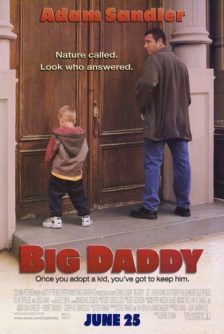
BIG DADDY
A warm moral turn buried beneath a mountain of gross-out humor.
Should You Watch It?
Big Daddy has a worthwhile moral center. Sonny begins as a selfish, irresponsible adult, but caring for Julian gradually teaches him love, protection, nurturing, responsibility, marriage, and raising children. The boy’s adorableness and the story’s ultimately moral conclusion give the comedy some heart.
The cost is high. The movie leans heavily on body fluids, toilet humor, vomiting, urination, spit, lewd gestures, and many obscenities. The source review also notes sexual material, alcohol use, smoking, and pagan elements used for comic effect.
The practical answer is to wait for home, where discerning adults can control the experience; this is not a movie for children or young teens.
The Story
NO SPOILERS — WE KEEP THE SURPRISESSonny Koufax is a 32-year-old law graduate who avoids career, marriage, responsibility, and even cleaning his apartment. After his girlfriend leaves him, Sonny takes in five-year-old Julian, whose mother has recently died, while falsely claiming to be the boy’s biological father.
Sonny has no idea how to care for a child. With help from friends and Layla, a lawyer’s sister, he begins learning what Julian needs—and what adulthood may require of him.
Is It Any Good?
Three stars means a comedy with genuine warmth and a worthwhile moral conclusion, but also substantial weaknesses. The boy is adorable, and Sonny’s eventual growth gives the story heart. The movie also uses its comedy to show an irresponsible man correcting his major failures in child care and facing marriage and raising children.
The humor is frequently crude and sophomoric, with many gross-out jokes and body-fluid gags. The entertainment depends largely on Sonny’s bumbling, errant behavior before he changes. The source review notes that audiences cheered, but describes the overall result as producing small guffaws rather than mature comedy.
The Worldview
The film ultimately presents responsibility for a child as morally important. Sonny moves from selfishness and irresponsibility toward love, protection, nurturing, and accountability. It also treats marriage and raising children as responsibilities an adult should face rather than avoid.
The source review notes that many pagan elements are used for comic effect. It also identifies the inclusion of a homosexual couple as major supporting players. The film’s treatment of a Hooters job is critical, making fun of those who work there and presenting the job as degrading.
The film’s central moral movement—from self-protection toward responsibility and love—connects with Scripture’s call to care for others. “Bear one another’s burdens, and so fulfill the law of Christ” (Galatians 6:2).
The Content Guide
The specifics — spoilers included by nature — so you can judge for your own family.
Content Summary
Ultimately moral worldview where slacker adult assumes responsibility for child, giving him love, protection & nurturing, with many pagan elements used for comic effect & the inclusion of a homosexual couple as major supporting players; 38 obscenities (mild & strong), 10 profanities, man & boy urinate outside, boy vomits, & lewd gestures; very little action violence including man throws himself in front of stopping car for comic effect, man puts stick in path of rollerblader causing rollerblader to fall & implied killing of pigeons by boy with slingshot (images of dead pigeons); implied fornication, a homosexual kiss & some sexual talk; woman in underwear & many cleavage shots; alcohol use; and, smoking.
Talk About It
Questions for the drive home, the dinner table, or the youth group.
Sonny begins by avoiding responsibility and ends up learning to care for a child. What responsibilities are you tempted to avoid, and what would faithful care look like?
Galatians 6:2 · Philippians 2:4The film presents love, protection, and nurturing as important parts of caring for a child. How does Scripture describe the responsibilities adults have toward children?
Ephesians 6:4 · Mark 10:13–16Sonny’s growth involves giving up selfishness. Where do you see selfishness affecting relationships, and what does putting others first require?
Philippians 2:3–4 · 1 Corinthians 13:4–7The movie uses crude humor to get laughs. How should Christians think about humor that makes light of bodily functions or degrading situations?
Ephesians 5:3–4 · Philippians 4:8The Final Word
Big Daddy has real warmth and a moral conclusion about growing up, loving a child, and accepting responsibility. But its gross-out humor and extensive obscenity make it a poor family choice. For discerning adults, WAIT FOR HOME — ADULTS ONLY. For another option, see.