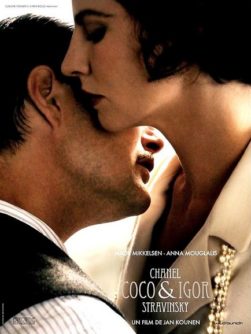
COCO CHANEL & IGOR STRAVINSKY
A sensual portrait of passion that costs too much.
Should You Watch It?
COCO CHANEL & IGOR STRAVINSKY offers fine lead performances, a wonderful musical score, and precise direction. Its deliberate, character-driven approach gives the central relationship room to develop, while the story presents the pursuit of passion without regard for personal cost as tragic.
That tragedy is also the movie's defining problem. Adultery drives the story, and strong sexuality and nudity make the affair sensual rather than merely discussed. The movie includes some positive elements, especially Igor's wife's unfailing love and continued faith, but those moments are eclipsed by the adulterous theme.
If you are an adult who wants to consider a morally tragic drama at home, where you can discuss its ideas carefully, this may have limited merit; families and young teens should choose something else.
The Story
NO SPOILERS — WE KEEP THE SURPRISESIn Paris in 1913, clothing designer Coco Chanel is mesmerized by Russian composer Igor Stravinsky's controversial new symphony. Seven years later, after the Russian Revolution, Igor lives in exile in Paris with his wife and children while seeking a place to rework his music.
Coco offers her countryside villa. Igor moves his family there, and Coco begins visiting on weekends. As admiration turns into forbidden attraction, the household becomes the setting for a dangerous emotional conflict.
Is It Any Good?
Two stars means this is a watchable but limited drama. The movie is very methodical and character-driven, with fine performances from its two leads. Its musical score, mirrored from Stravinsky's actual compositions, is amazing, and the direction is precise and solid.
The film's strengths are real, but they do not overcome its central weakness. The adulterous relationship and sensuality dominate the experience, leaving the movie's positive elements—and its artistic accomplishments—unable to carry the whole work.
The Worldview
The film presents a mostly mixed pagan worldview and makes adultery its central moral theme. It portrays the pursuit of personal passion whatever the cost as destructive, showing people losing family and ultimately ending up alone because of all-consuming drive and obsession.
The movie departs from a biblical view by centering an adulterous affair and treating sensual desire as the engine of the story. It aligns more closely with Scripture in showing the damage caused by unfaithfulness and in presenting Igor's wife as loving and faithful despite his betrayal. Her continued faith, including prayer, is a brief but meaningful counterpoint to the film's moral confusion.
The story also includes references to Marxism and the Russian Revolution, a feminist character, and pagan and occult elements. These ideas and images contribute to the film's mixed spiritual atmosphere.
The movie's longing for love and fulfillment cannot be satisfied by personal passion alone. Scripture directs that longing toward God: “Our Father in heaven, hallowed be your name” (Matthew 6:9).
The Content Guide
The specifics — spoilers included by nature — so you can judge for your own family.
Content Summary
; Mostly mixed strong pagan worldview with anti-biblical theme of adultery, mention of Marxism and the Russian revolution, a feminist character, people play with occult Tarot cards, dancers portray pagan ritual sacrifice during theatrical piece, and Russian Orthodox family prays the Lord’s Prayer and thanks God, but the husband is an adulterer and he loses his family over the affair but ends up- alone; one obscenity and one profanity; violence includes opera crowd riots and police come in to keep the peace as well as brief war footage of Russian Revolution, and woman is dying of consumption; strong depicted adultery in several scenes, implied unmarried couple live together, married kissing, unmarried kissing, and adulterous kissing; upper female nudity, upper male nudity, side female nudity, and rear male nudity in several scenes; alcohol use and drunkenness; cigarette smoking throughout; and lying and overall theme of adultery.
Talk About It
Questions for the drive home, the dinner table, or the youth group.
The film presents passion pursued without regard for personal cost. How does Scripture describe the difference between desire that rules us and self-control?
Galatians 5:22–23 · 1 Corinthians 6:12Igor's wife remains loving and faithful in the face of unfaithfulness. What does biblical faithfulness look like when another person has wounded you?
Ephesians 4:32 · Colossians 3:12–13The story includes prayer but also a worldview shaped by many competing ideas and spiritual influences. Why does Scripture call us to worship God alone?
Exodus 20:3 · Matthew 6:9The Final Word
This is a methodical drama with fine performances, an amazing musical score, and precise direction. But its adultery, sensuality, nudity, and mixed worldview overwhelm its positive elements. For discerning adults who choose to engage its tragic ideas, WAIT FOR HOME — ADULTS ONLY. For other options, see.