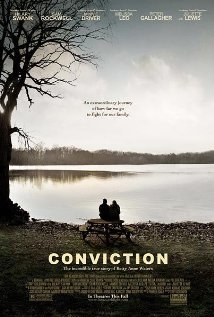
CONVICTION
A powerful story of sacrificial love, redemption, and second chances.
Should You Watch It?
Conviction is a profoundly moving true-life drama about a woman who sacrifices nearly everything to prove her brother innocent. Its emotional center is the bond between Betty Anne and Kenny Waters, siblings who held on to each other after their dysfunctional parents let them down.
The film offers real moral nourishment: familial love, perseverance, remorse, truth-telling, redemption, and reconciliation. Kenny also receives a second chance to become a father to the daughter he has barely known. But that uplift comes through strong language, violence, drinking, smoking, nudity, and deeply dysfunctional behavior.
If you are an adult who can engage those problems with discernment, this is worth seeing; it is not suitable for children or young teens.
The Story
NO SPOILERS — WE KEEP THE SURPRISESBetty Anne Waters spends 18 years studying from her GED through a law degree so she can fight for her brother Kenny, who has been imprisoned for a brutal murder he did not commit.
Their childhood bond, forged while their parents repeatedly failed them, becomes the foundation of Betty Anne’s extraordinary quest. As she enters the legal fight, she must face a broken system, painful family history, and the cost of standing by the person who believes she cannot abandon.
Is It Any Good?
Four stars means this is an unusually strong film, both artistically and morally despite its content problems. The script is impressively efficient, Tony Goldwyn’s direction is stirring yet subtle, and the performances are stunning across the board.
Hilary Swank carries the emotional weight of Betty Anne’s sacrifice. Sam Rockwell and Juliette Lewis are particularly good, bringing fire and heartbreaking humanity to their colorful roles. The film’s flashbacks effectively show the siblings’ powerful bond, while the true-life story provides compelling emotional and cerebral entertainment.
The Worldview
Conviction presents a light Romantic worldview alongside strong moral and redemptive elements. It exalts familial love, sacrifice, perseverance, truth, remorse, repentance, reconciliation, and the possibility that people can rise above destructive family histories.
The film’s moral vision aligns with a biblical view when it portrays perjury as grievous injustice, acknowledges the damage caused by lies, and shows people feeling remorse and admitting the truth. It also celebrates noble action in the face of a dysfunctional past. At the same time, the story includes arrogant and drunken behavior, petty lawbreaking, and a corrupt justice system. The film’s redemptive hope is powerful, though its world is marked by serious moral disorder.
At its heart, the movie longs for restoration within a family: a brother freed, a sister vindicated, and a daughter able to receive her father again. Scripture likewise speaks of new beginnings through redemption: “Therefore, if anyone is in Christ, he is a new creation. The old has passed away; behold, the new has come” (2 Corinthians 5:17).
The Content Guide
The specifics — spoilers included by nature — so you can judge for your own family.
Content Summary
Light Romantic worldview but strong moral, redemptive elements in powerful tale of redemption, familial love, repentance, and reconciliation; more than 37 “f” words, plus about 20 “S” words, and three “GDs”; strong violence includes brief barfight which ends with main male character threatening to kill other man, three or four instances of violence or vandalism in which characters throw objects and fight with police, though the police are ultimately shown as corrupt, and young child brother and sister shown fighting as children cheer; no sexual activity; upper and rear male nudity in one scene when male lead character strips shirt off in a bar while drunk, then he drops his trousers and bares his rear end momentarily as a joke; main female works as a bartender with casual drinking shown around her and main male character gets drunk on a couple of occasions, which leads to bad behavior; light smoking shown on a couple of occasions; strong miscellaneous immorality includes perjury forces man to be imprisoned unfairly for 18 years, bad attitude shown by male lead, who is seen as often arrogant and drunk and willing to break minor laws, including himself and young sister committing petty thievery and breaking into a home, many dysfunctional family moments, though the entire point of the movie is that, even with no good examples, people can rise above their immoral family or personal pasts to express true love through noble actions.
Talk About It
Questions for the drive home, the dinner table, or the youth group.
Betty Anne sacrifices years of study and much of her personal life for her brother. What does sacrificial love look like in your family, and where does love need wisdom as well as perseverance?
1 Corinthians 13:4–7 · Philippians 2:3–4The story shows how lies and perjury can destroy a person’s life. Why does God care so deeply about truth, and how should we respond when we have harmed someone through dishonesty?
Exodus 20:16 · Ephesians 4:25Several characters feel remorse and eventually admit the truth. How is biblical repentance different from merely feeling bad?
2 Corinthians 7:10 · Luke 3:8Kenny receives a new chance to become a father to his daughter. What helps rebuild trust after years of separation, and how does Scripture describe reconciliation?
Colossians 3:12–14 · 2 Corinthians 5:18–20The Final Word
Conviction is exceptionally well acted and morally stirring, with a powerful vision of familial love and redemption. Its strong language and other serious content make it unsuitable for children and young teens. For discerning adults, the answer is WORTH THE TRIP — ADULTS ONLY. For another family movie night, see.