
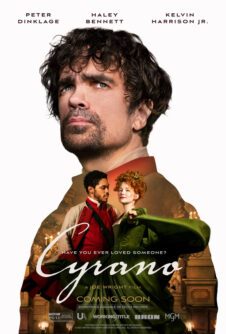
CYRANO (2021)
An entertaining, confessional musical about love, pride, and redemption.
Should You Watch It?
This is a surprisingly entertaining and profound musical drama. Its direction, dialogue, character interactions, and songs work together so naturally that it is easy to forget you are watching a musical. The story also offers a thoughtful contrast between romance based on appearances and love rooted in the soul.
The film includes intense moments, action violence, sexual references, deception, and mature romantic situations. Still, the violence is portrayed with grace rather than excess, and the story’s Christian references, prayers, and themes of faith, salvation, forgiveness, conversion, and redemption give it a strong moral center.
Older viewers can come away encouraged by its insight into pride and true love. Young children may be better served by another choice. For middle schoolers and up, CYRANO is worth the trip.
The Story
NO SPOILERS — WE KEEP THE SURPRISESCyrano is a brilliant poet and swordsman who is in love with his friend Roxanne. Roxanne, however, falls for Christian, a young soldier who struggles to express his feelings.
Christian asks Cyrano to help him write love letters to Roxanne. As their complicated arrangement continues, a powerful duke also pursues Roxanne and places Cyrano and Christian in danger.
Is It Any Good?
Four stars means this is an extraordinary film, and the source review’s praise is specific. Joe Wright’s direction makes the theatrical sets, period atmosphere, dialogue, and character interactions especially effective. The songs are so integral to the characters that the musical form feels natural rather than distracting.
The intense moments are handled with grace and do not go over the top. The film also delivers a surprising moral conclusion, giving its romantic story unusual depth. Overall, CYRANO is an exceptionally well-made and entertaining musical drama.
The Worldview
CYRANO presents romance based purely on looks as inadequate and ultimately refutes it through themes of faith, salvation, conversion, forgiveness, and redemption. Pride is treated as a destructive force, while the realization that “pride goes before the fall” becomes central to the story. Every major character references God, and the film includes Christian settings and prayers, including a final scene in a convent involving an attempt to convert Cyrano.
The film also presents a self-centered duke who wants Roxanne and places others in danger because of his desire. Deception, bullying, and lying are eventually confronted, while the story’s deeper vision is that great love overcomes pride and romantic notions.
The film’s casting presents diversity as a visible part of the production: Cyrano is portrayed as a midget rather than having a long nose, and several key figures are African, although that likely would not have been the case in that period of French history. The direction makes these casting choices an asset rather than a detriment.
The film’s longing for love and redemption connects with the biblical truth that “love is patient and kind” (1 Corinthians 13:4).
The Content Guide
The specifics — spoilers included by nature — so you can judge for your own family.
Dominant Worldview and Other Worldview Content/Elements
Ultimately a story of forgiveness and the realization that pride goes before the fall with a lot of Christian references, settings, prayers, and including the last scene in a convent where a nun is trying to convert Cyrano, a duke is very self-centered and wants Roxanne, a Romantic love based on images is refuted in the end
Foul Language
A very clear OMG with some references that may be positive or may be derogatory about faith, but very little objectionable language
Violence
Action violence without much blood, cruelty or malice, including swordfights, and a battle scene between the French and the Spanish, which ends up with several people being killed, but not excessive visualization of the violence, fighting off of people sent to kill him Cyrano throws a couple off the roof after they try to hang him and wins swordfights with others, defeating 10 assassins, Cyrano battles a count who is very effete
Sex
Some references to sexual activity such as the a man tells a woman he will take her physically whether she agrees or not, Roxanne exhibits desire on reading Christian’s notes to her which were actually written by Cyrano, an some kissing, but no excessive sex
Nudity
No nudity
Alcohol Use
References to alcohol and to stronger drink but nothing shown
Smoking and/or Drug Use and Abuse
Cyrano asks at one point what “have you been smoking";
Miscellaneous Immorality
Deception but eventually revealed, bullying, lying, and one statement about rejecting the Gospel, which is eventually refuted when Cyrano admits it was his pride.
Talk About It
Questions for the drive home, the dinner table, or the youth group.
Roxanne is drawn first to romantic images and later to something deeper. How does Scripture distinguish outward appearance from the heart?
1 Samuel 16:7 · 1 Corinthians 13:4–7Cyrano’s pride keeps him from telling the truth. When have pride or fear made honesty difficult, and what does Scripture say about humility?
Proverbs 16:18 · Philippians 2:3–4The story includes deception that is eventually revealed. Why does truth matter even when a lie seems to serve love?
Ephesians 4:25 · Proverbs 12:22The film connects love with forgiveness and redemption. What does Christian forgiveness require, and how is it different from simply ignoring wrong?
Ephesians 4:31–32 · Colossians 3:12–13The Final Word
CYRANO combines excellent direction, memorable dialogue, natural musical numbers, Christian references, and a surprising moral conclusion. Its mature romantic themes and intense moments call for parents’ discernment with younger children, but teenagers and adults can find much to value. Our answer is clear: WORTH THE TRIP — MIDDLE SCHOOL AND UP.









