
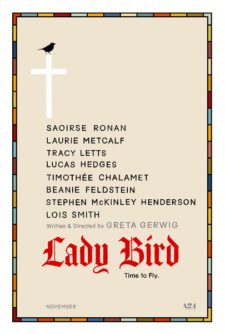
LADY BIRD
A charming coming-of-age story with abhorrent content to skip.
Should You Watch It?
There is real quality here. Lady Bird is witty, charming, and emotionally perceptive, with realistic performances and a particularly rich depiction of a mother-daughter relationship. The Catholic school’s authority figures are portrayed positively, and the story takes family love and the ache of home seriously.
But the content is not a side issue. Teenagers engage in sexual situations, heavy drinking, drunkenness, marijuana use, rebellion, and strong profanity. The film also includes nudity, an obscene insult toward a nun, and an objectionable response to a woman presenting the pro-life position.
The source review’s judgment is clear: despite its strengths and somewhat positive ending, Lady Bird contains too many abhorrent elements to be acceptable entertainment. The practical answer is simple: skip it.
The Story
NO SPOILERS — WE KEEP THE SURPRISESChristine has renamed herself Lady Bird, hoping to separate herself from her family and become her own person. A high school senior at a conservative Catholic school in Sacramento, she dreams of leaving home for college in New York.
As Lady Bird navigates school, friendships, romance, family conflict, and the pressure of growing up, she struggles to find a place where she belongs. Her longing to escape home becomes the center of her journey.
Is It Any Good?
Three stars means this is a well-made, engaging drama whose strengths are limited by its content and mixed worldview.
The film is character driven, with each scene focused on people first. Its Sacramento setting receives beautiful visuals across the changing seasons, but the performances are the main attraction. Saoirse Ronan and Laurie Metcalf give rich, raw performances that capture the ups and downs of a mother-daughter relationship. The movie is witty, charming, and emotional, with realistic and authentic acting.
The Worldview
Lady Bird presents a mixed worldview. It portrays a Catholic school positively: authority figures are generally shown in a favorable light, and students are seen praying and receiving communion. The film also recognizes the importance of family love and eventually gives its protagonist a deeper appreciation for home.
At the same time, the story treats teenage rebellion, sexual behavior, underage drinking, drunkenness, marijuana use, and profanity as part of growing up. Lady Bird calls a nun an obscene name and plays a joke on her. A mother encourages her daughter to use condoms, and Lady Bird gives an objectionable response to a woman presenting the pro-life position. The source review therefore finds the worldview mixed at best and ultimately unacceptable.
The film’s central longing is to find identity and a place to call home. Scripture points beyond earthly belonging to a better home: “they desire a better country, that is, a heavenly one” (Hebrews 11:16).
The Content Guide
The specifics — spoilers included by nature — so you can judge for your own family.
Content Summary
Very strong mixed, unacceptable pagan worldview where a teenage girl attends a Catholic high school, sins and strays from her family but realizes her wrongdoings and returns to them with love with an overt Christian setting at the Catholic school that depicts the authority figures there in a positive light that also shows the students praying and receiving communion, but the teenagers are rebellious, protagonist calls one nun an obscene name and plays joke on her, and mother encourages daughter to use condoms, plus female protagonist sees her boyfriend kissing another boy; 29 obscenities (about 14 “f” words), three strong profanities (one GD and two referencing Jesus), five light profanities, drunk girl vomits; girl jumps out of a running car when getting into argument with her mom and later shows up in a cast; strong and light sexual content includes briefly depicted fornication between teenager protagonist and boy (boy has shirt off), teenagers kiss, two boys seen kissing, girl discusses condoms with her mother who encourages her to use them, teenage boy confesses of losing count of how many girls he has violated, teenagers discuss touching female breasts, teenagers sometimes talk about sex, and implied masturbation; girl buys a Playgirl magazine and full frontal male nudity in the photos is shown, upper male nudity, images of teenage girl in bikini and another girl in her underwear; heavy underage drinking, teenagers drink at parties and get drunk, girl gets alcohol poisoning from excess drinking and is rushed to the hospital; smoking and teenage girl smokes marijuana with her brother’s girlfriend; and, moderate miscellaneous immorality includes lying, teenage rebellion, stealing, revenge, greed, and dysfunctional family portrayals.
Talk About It
Questions for the drive home, the dinner table, or the youth group.
Lady Bird wants to escape her family and create a new identity. How can you grow into maturity without despising the people and place God has given you?
Ephesians 6:2–3 · Philippians 2:3–4The story connects growing up with romance and sexual choices. What does Scripture say love and sexual faithfulness are meant to look like?
1 Corinthians 6:18–20 · 1 Thessalonians 4:3–5The teenagers’ drinking and rebellion are treated as part of their social world. How can Christians resist pressure to fit in?
Romans 12:2 · 1 Peter 1:14–16The film presents a Catholic school and Christian practices positively while also including serious moral confusion. How should we recognize truth without accepting everything a story celebrates?
Philippians 4:8 · 1 Thessalonians 5:21–22The Final Word
Lady Bird has wit, emotional depth, strong performances, and an appreciation for family and home. But its abhorrent teen content and mixed worldview make it unacceptable entertainment for families. Our answer is SKIP IT. For better options, see.









