
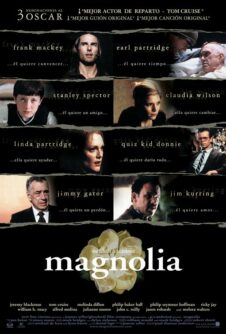
MAGNOLIA
A searching drama about broken families, repentance, and hope — for adults only.
Should You Watch It?
Magnolia is a three-hour drama about broken family relationships, regret, and the possibility of reconciliation. Its strongest material takes repentance, forgiveness, redemption, and hope seriously. A Christian policeman becomes one of the story’s heroic figures, and the film ultimately offers a positive resolution to his relationship with a troubled woman.
The cost is substantial. Strong foul language is frequent, some sex scenes appear early, violence and drug use are present, and the film includes a disturbing image of fathers. Its treatment of fate also carries pagan implications, even though the Christian character and a later biblical miracle partly counterbalance that idea.
The performances and direction make this a significant adult drama, but the content rules it out for family viewing. Adults who can handle the material may find genuine moral and emotional value; everyone else should choose something safer. For adults, it is worth the trip; for families and young viewers, it is not.
The Story
NO SPOILERS — WE KEEP THE SURPRISESSeveral troubled families and individuals move through intersecting stories of abandonment, illness, regret, addiction, and loneliness. Two fathers try to reconcile with older children, while a healthcare worker attempts to fulfill a dying man’s final request.
A Christian policeman is drawn to a woman struggling with a drug problem. Meanwhile, a child on a television game show feels increasingly alienated from his father. These lives gradually converge in an unusual drama about whether broken relationships can be healed.
Is It Any Good?
Four stars means Magnolia is an exceptional piece of filmmaking, even though its length and complexity create problems. Paul Thomas Anderson directs with remarkable skill, and the ensemble structure gives the film unusual ambition and originality.
The performances are a major strength. Tom Cruise, Julianne Moore, and Philip Seymour Hoffman give some of the year’s best work, while John C. Reilly and Melora Walters bring needed lightness to the film’s dark mood. Jeremy Blackman is also good as the child on the television game show.
The main weakness is that Anderson tries to do too much, which helps explain the three-hour running time. Even so, the direction and acting make this a powerful, carefully made drama.
The Worldview
Magnolia presents an apparent Christian worldview through its Christian policeman, who prays before a crucifix and talks to God. The film also emphasizes repentance, regret, forgiveness, reconciliation, and implied redemption. Its ending offers a smile of hope, particularly through the possibility of redemption for deeply disturbed characters.
The film’s worldview is not consistently biblical. Its narrated prologue treats “fate” in a cynical, pagan way, although that idea is partly rebuked. The bizarre miracle near the end seems more like an act of God than an act of fate. The story also gives a negative picture of every father, including one who becomes repentant, without offering a more positive fatherly model to balance those images.
The film’s central moral concern is the healing of broken relationships. Scripture calls believers to show mercy because God is merciful: “Be merciful, even as your Father is merciful” (Luke 6:36). That hope for forgiveness is one of the film’s strongest qualities, even amid its serious departures from a biblical worldview.
The Content Guide
The specifics — spoilers included by nature — so you can judge for your own family.
Content Summary
Christian worldview with elements of repentance, forgiveness, implied redemption, & a heroic Christian character who prays silently in one scene before a crucifix & talks to God in other scenes, plus strong pagan content, including some discussion about “fate,” that is partially rebuked, & negative role models of fathers; at least 242 mostly strong obscenities, at least 34 mostly strong profanities & lewd descriptions about seducing & taking advantage of women sexually; moderate level of dramatic violence such as man killed by accidental shotgun firing, screaming, angry man overturns table, angry man throws chair, three attempted suicides, policeman handcuffs irate woman to couch, several vehicles crash, & bizarre natural phenomenon smashes cars, hits houses, breaks windows, & kills one dog off screen; briefly depicted sex scenes in early part of movie, implied fornication, possible incest discussed, & strong sexual references in dialogue; upper & rear male nudity, upper female nudity on TV, & obscured upper female nudity through shower glass; alcohol use & drunkenness; smoking & heavy drug use, including cocaine & pills to attempt suicide, but drug use is rebuked; man expresses homosexual desires for muscle-bound bartender; and, adult issues regarding adultery, taking advantage of children to earn money, spousal abandonment, returning stolen money, & incest, combined with some elements of repentance, forgiveness & implied redemption.
Talk About It
Questions for the drive home, the dinner table, or the youth group.
Several characters carry regret over abandonment, adultery, and other past sins. What is the difference between merely feeling sorry and turning toward repentance?
2 Corinthians 7:10 · Psalm 51The film asks whether broken family relationships can be healed. What would truthful forgiveness require in a relationship damaged by betrayal?
Ephesians 4:31–32 · Colossians 3:12–13A child is treated as a source of money rather than as a person. What responsibilities do adults have toward children entrusted to them?
Mark 9:42 · Ephesians 6:4The story contrasts “fate” with a more hopeful sense of divine purpose. How should Christians respond when life seems ruled by chance or suffering?
Romans 8:28 · James 1:2–4The Final Word
Magnolia is exceptionally directed and acted, with real insight into repentance, forgiveness, and redemption. But its strong language, sexual content, violence, drug use, and troubled worldview make it unsuitable for children and young teens. For discerning adults, WORTH THE TRIP — ADULTS ONLY. For family viewing, choose another film.









