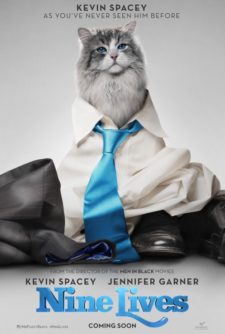
NINE LIVES
A cheesy cat comedy with lessons best learned at home.
Should You Watch It?
NINE LIVES has a decent lesson inside a very cheesy package. Tom Brand is a workaholic billionaire who must learn that family matters more than money and professional success. The movie extols family, rewards good, punishes evil, and gives its selfish protagonist positive lessons to learn.
The problem is execution. Much of the humor falls flat, the story requires a major suspension of disbelief, and the cat’s mysticism is never fully explained. There are also several profanities, drinking, slapstick danger, and a few elements that call for a conversation with children.
Animal lovers and children may find some enjoyment here, especially because it is hard to dislike a cute cat. For most families, though, the modest laughs and redemptive message are better experienced at home, where parents can pause and talk.
Practical answer: wait for home, and use your discernment about younger children.
The Story
NO SPOILERS — WE KEEP THE SURPRISESTom Brand is a New York billionaire whose work has pushed his wife and children aside. When his 11-year-old daughter asks for a cat, Tom buys one from a mysterious pet-store owner.
Then a freak accident transfers Tom’s soul into the cat’s body while his human body lies in a coma. To become human again, Tom must learn to be a good husband and father—and try to reconnect with the family he has neglected.
Is It Any Good?
Two stars means NINE LIVES has some mild enjoyment, but its weaknesses are hard to miss. The movie has a cute cat, a few good laughs, and a premise that animal lovers and children may appreciate. It is also unusual to see a movie this unabashedly cheesy.
Much of the humor falls flat. Kevin Spacey’s voice work is only passable, and the cat’s unmoving mouth makes the effect confusing. The story makes little sense if you examine its how and why too closely, so viewers must simply roll with it. Do that, and the movie is mildly enjoyable.
The Worldview
NINE LIVES presents an overall moral worldview in which good is rewarded, evil is punished, and a selfish protagonist must change his ways. It places family above material wealth and shows that professional success cannot replace love, presence, and sacrifice.
The film also contains questionable spiritual ideas. Cat mysticism and cat magic appear in the story, while reincarnation and karma are mentioned. A mysterious pet-store owner seems able to know all and communicate with cats, but the movie never explains this ability. These elements may require a conversation with children.
The movie’s central moral is sound: a man must learn to sacrifice for his family instead of living for money and status. Scripture similarly calls people to leave behind their former ways and be changed: “put off your old self” (Ephesians 4:22).
The Content Guide
The specifics — spoilers included by nature — so you can judge for your own family.
Content Summary
Overall moral worldview where good is rewarded and evil is punished, with a protagonist who must learn to change his ways, protagonist refers to his first wife as “Satan,” some pagan hedonism where protagonist places a priority of material wealth over that of his family, reincarnation and karma are mentioned in one scene, one character does research into cat mysticism, and the main character is a billionaire who runs a very successful company; nine obscenities and profanities (some “d” words, one “h” word and one “Jesus” word), cat urinates on things several times, girl drops her mean stepsister’s cell phone into a toilet; most of the violence is slapstick humor with the cat, a man is struck by lightening and falls off the roof of a skyscraper before crashing into a window below, a security guard is accidentally tasered, a man puts a cat in a bag and tries to throw him in the dumpster, it appears that a man is about to commit suicide but this turns out not to be the case, a family makes the decision to pull life support in the hospital, but the comatose patient recovers before this is done (this is part of the movie’s jeopardy), a cat attacks a man; no sex but protagonist thinks his second wife is cheating on him, but this turns out not to be the case; upper male nudity in a video and brief female cleavage; a cat pours himself some whiskey and gets drunk with a hangover, and several scenes show characters drinking martinis; and, protagonist is divorced and mean but changes, protagonist’s second wife reveals she’s thinking about divorcing her husband, man lets protagonist fall off a skyscraper in hopes that he’ll die, one character lies multiple times to cover up his evil plans, a mother proclaims that she’s not a good role model for children, a girl throws her mean stepsister’s cell phone into the toilet in revenge.
Talk About It
Questions for the drive home, the dinner table, or the youth group.
Tom uses money and work to compensate for neglecting his family. What do your time and attention communicate to the people you love?
Ephesians 5:15–16 · 1 Timothy 5:8The film’s protagonist must learn to sacrifice for his family. What does biblical love require us to give up for others?
Philippians 2:3–4 · 1 John 3:16–18The story includes cat mysticism, reincarnation, and karma. How should Christians respond when entertainment presents spiritual ideas that differ from Scripture?
1 John 4:1 · Acts 17:11What is the difference between feeling guilty about wrongdoing and genuinely changing?
2 Corinthians 7:10 · Ephesians 4:22–24The Final Word
NINE LIVES has a worthwhile lesson about family, sacrifice, and changing selfish ways. Its flat humor, questionable spiritual elements, language, and drinking make it a better home viewing choice. For older children and adults with parental discernment, WAIT FOR HOME. For other options, see.