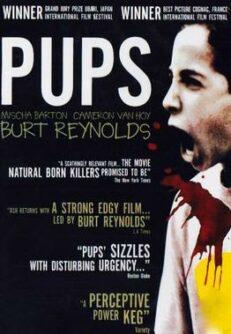
PUPS
A gripping, troubling hostage drama for discerning adults.
Should You Watch It?
PUPS is a small, low-budget film with a serious question: why do confused young teenagers commit terrible violence? Its look at media violence, absentee parents, moral confusion, and the effects of America's culture is fascinating, even though it offers no solutions.
The movie is also uneven and filled with offensive language. It includes a teenage suicide gag, guns, a bank hostage situation, violence, crude sexual remarks, and other irresponsible behavior. The performances by Burt Reynolds and Kurt Loder hold the film together, while the young actors bring real confusion to their roles.
This is worthwhile only for discerning adults who can engage its disturbing material without being harmed by it. For family viewing, choose something else.
The Story
NO SPOILERS — WE KEEP THE SURPRISESStevie and Rocky are two aimless 13-year-olds in suburban Los Angeles. After Stevie finds a gun at home, the pair impulsively decide to rob a small bank.
When police arrive, the teenagers take the employees and customers hostage. An FBI agent begins negotiating with them while the frightened young criminals try to control a situation they do not understand.
Is It Any Good?
Three stars means PUPS is a worthwhile but uneven film. Shot in a guerrilla style in only 16 days, it has the roughness of a quickly made independent production.
Burt Reynolds gives one of his best performances, and Kurt Loder is nearly perfect while portraying himself. Cameron van Hoy and Mischa Barton offer strong, though not fully successful, performances as the confused teenagers. The movie's questions are compelling, but its lack of answers and uneven execution keep it from being more than a minor gem.
The Worldview
PUPS presents teenage violence as a problem shaped by media violence, absentee parents, moral confusion, and a culture that has trained young people through secular, nihilistic, violent, and perverted entertainment. It raises serious questions but provides no solutions, not even non-biblical ones.
The film includes a discussion of the design argument for God's existence. Stevie says he believes in God when he sees the intelligent, beautiful design of the universe. But when he sees the world's evil, he says he does not believe God exists. The movie presents this contradiction as part of his confusion rather than answering it biblically.
The story does show that violent actions have consequences. Stevie's crimes are eventually punished, and the film's violence is ultimately rebuked in various ways. Yet its moral worldview remains undeveloped, and its treatment of pagan and other miscellaneous immorality does not offer a clear biblical framework.
The question of whether creation points to God has a clear biblical answer: “The heavens declare the glory of God, and the sky above proclaims his handiwork” (Psalm 19:1).
The Content Guide
The specifics — spoilers included by nature — so you can judge for your own family.
Content Summary
Undeveloped moral worldview, including discussion of the design argument for the existence of God, that presents the problems regarding teenage violence in America, & most of the causes, including the effects of media violence, but offers no solutions, even non-biblical ones; 251 oscenities & 28 profanities plus some crude remarks & obscene gestures; extreme violence avoided but many threats of violence uttered by two young teenagers plus 13-year-old boy jokingly puts noose around his neck at home, fires two shots [one misfire] at home, holds up bank, wounds security guard & handicapped man, & threatens people with gun, but is punished for his crimes; some crude sexual references & 13-year-old girl starts her menstruation cycle; no nudity; alcohol use; smoking & minor character secretly smokes marijuana while being held hostage; and, strong pagan and other miscellaneous immorality such as mother neglects 13-year-old, who goes on a violent rampage, most of which, however, is eventually rebuked at one time or another.
Talk About It
Questions for the drive home, the dinner table, or the youth group.
The film points to media violence as one possible influence on teenage behavior. How should Christians think about what enters their minds through entertainment?
Philippians 4:8 · Psalm 101:3Stevie is left alone by his mother before the violence begins. What responsibilities do parents and older Christians have toward vulnerable young people?
Deuteronomy 6:6–7 · Titus 2:3–5Stevie sees evidence of design in the universe but struggles to believe in God because of evil. How would you answer his question without ignoring the reality of suffering?
Psalm 19:1 · Romans 1:20The film shows violent actions bringing serious consequences. Why is justice necessary, and how is biblical justice different from revenge?
Romans 12:19 · Micah 6:8The Final Word
PUPS is a fascinating but uneven warning about teenage violence, media influence, and moral confusion. Its strong performances and serious questions cannot erase its obscenity-filled content and troubling behavior. For discerning adults willing to face those concerns, it is WORTH THE TRIP — ADULTS ONLY. For everyone else, choose.