
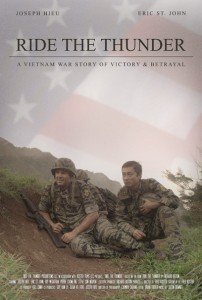
RIDE THE THUNDER
An eye-opening Vietnam War docudrama about courage, loyalty, and freedom.
Should You Watch It?
RIDE THE THUNDER offers a compelling account of the Vietnam War through the friendship between American Marine John Ripley and Vietnamese Marine Le Ba Binh. Its scripted story, historical media clips, and interviews with survivors work together to challenge what the film presents as the common American misrepresentation of the war.
The movie’s strongest qualities are its positive Christian worldview, high production values, informative material, and emphasis on loyalty, friendship, courage, and justice for the oppressed. It also depicts painful wartime experiences, including torture and abuse, so younger children may be disturbed.
If your family includes teenagers or adults who can process those scenes thoughtfully, this is worth seeing for its historical perspective and moral convictions.
The Story
NO SPOILERS — WE KEEP THE SURPRISESRIDE THE THUNDER follows the bond between John Ripley, an American Marine legend, and Le Ba Binh, a Vietnamese war hero. As the Vietnam War reaches its final days, the film moves between their experiences, interviews with survivors, and media footage from the period.
Their friendship becomes a window into the relationship between American soldiers and the South Vietnamese people, as well as the film’s argument about America’s involvement in the war.
Is It Any Good?
Three stars means RIDE THE THUNDER is an engaging, worthwhile docudrama with some limitations. It has high production values and combines informative material and real interviews with a visually appealing scripted story.
The blend of survivor interviews, historical media clips, and dramatized scenes keeps the film engaging while educating viewers about the war. Its central story gives the information a human focus.
The Worldview
RIDE THE THUNDER presents a strong Christian, moral, and anti-communist worldview. It exalts love, loyalty, compassion, faithfulness, courage, commitment, and the moral duty to bring justice to the oppressed. American and South Vietnamese soldiers are shown as committed to fighting what they believe is wrong, while the film emphasizes the dedication of American soldiers to saving South Vietnam from communism.
The film also presents forgiveness, grief, and faith as important responses to suffering. It suggests that good will prevail even when it goes unseen, and it ends with the idea that courage is not the absence of God but faith that God is working through people.
The film’s perspective is openly positive toward America’s involvement in the Vietnam War and argues that American soldiers were misunderstood rather than the enemy. Its treatment of communism is strongly negative, emphasizing oppression in contrast with the freedom and opportunity found in America.
The film’s central longing is for courage and faith in the midst of suffering. Scripture says, “I can do all things through him who strengthens me” (Philippians 4:13).
The Content Guide
The specifics — spoilers included by nature — so you can judge for your own family.
Content Summary
Strong Christian, moral, anti-communist worldview, with biblical virtues of love, loyalty, compassion and faithfulness displayed among American and South Vietnamese soldiers committed to continue to fight against what they know is wrong (communism), war survivors discuss forgiving those that mocked them for being soldiers, soldiers talk about their grief in the deaths of many innocent people, and references to God getting people through difficult times; light foul language, with three obscenities, including one “s” word and one “h” word; strong violence such as man falls to his knees and coughs blood, North Vietnamese solider hits South Vietnam men with a gun, kicks, pushes, spits, and knocks them around with his fists, man with blood dripping from his head shown on side of the road, bloody and bruised soldiers with open wounds suffer from exhaustion and verbal abuse from North Vietnamese soldiers, one scene of a bomb blowing up a bridge in the distance, men fight with each other, innocent victims held hostage against their will, North Vietnamese seek revenge on the South Vietnamese and murder anyone that goes against their desire for communism; no sexual content, one scene of wife kissing husband on the cheek; no nudity; light drunkenness displayed at a bar, angry men drink beer and ridicule soldiers; no smoking or drugs; and, greed, revenge, blackmail, and lying.
Talk About It
Questions for the drive home, the dinner table, or the youth group.
The film presents courage as faith that God is working through us. Where do you need courage that depends on God rather than on your own strength?
Philippians 4:13 · Joshua 1:9American and South Vietnamese soldiers are portrayed as loyal friends. What does biblical faithfulness look like when friendship becomes costly?
Proverbs 17:17 · John 15:13The story emphasizes justice for oppressed people. What does Scripture require of those who see suffering or injustice?
Micah 6:8 · Proverbs 31:8–9Survivors discuss forgiveness and grief. How can Christians grieve honestly while also moving toward forgiveness?
Ephesians 4:31–32 · Romans 12:19The Final Word
RIDE THE THUNDER is an informative, visually appealing docudrama with a strong Christian worldview and a clear moral perspective. Its violence and painful accounts call for discernment, especially with younger viewers. For teenagers and adults, it is WORTH THE TRIP — TEENAGERS AND ADULTS.









