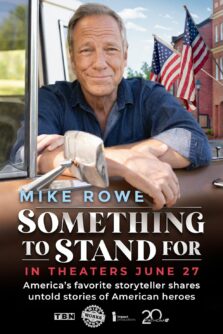
SOMETHING TO STAND FOR WITH MIKE ROWE
A stirring July Fourth documentary — a few cautions for younger kids.
Should You Watch It?
Here is the decision. Mike Rowe — TV personality, raconteur, and motivational speaker — has made a stirring, inspiring, superb documentary just in time for July Fourth. He tells re-enacted patriotic stories about the Founding Fathers, forgotten soldiers, two Medal of Honor recipients, a future President, two Supreme Court Justices, and even a word of advice the Rev. Martin Luther King, Jr., once gave a young singer. It celebrates liberty, patriotism, duty, honor, and sacrifice, and it does so with real energy.
There are a few cautions. The film fudges a handful of historical facts. It has re-enacted, sometimes slightly bloody, war violence, a few light obscenities, and a humorous but somewhat off-color story about a rancher and his bulls. For those reasons, parents of younger and older children should exercise judgment.
So: if you love American history and want your family to feel a renewed spirit of patriotism, this one is well worth seeing on the big screen. Just weigh the war scenes and the earthier humor for your youngest viewers.
The Story
NO SPOILERS — WE KEEP THE SURPRISESPatterned after newsman Paul Harvey's Rest of the Story, this documentary hands the microphone to Mike Rowe, who tells a string of true American tales in his usual informal, passionate manner.
He opens on the shores of Tripoli in 1805, then ranges across the centuries — Medal of Honor recipients, a duel two decades before the Civil War, three forgotten signers of the Declaration of Independence, the Tomb of the Unknown Soldier, the fall of the Berlin Wall, and more. Along the way, Rowe visits America's monuments and Arlington Cemetery, and lets a few veterans speak. The rest of each story is his to tell.
Is It Any Good?
Four stars, and here is what they mean. Mike Rowe wrote and produced this film, and he infuses it with an energetic style that carries you from one story to the next. The material is well chosen and genuinely moving — one standout follows two teenage soldiers whose bravery delayed a major British bombardment of a fort protecting Baltimore in the War of 1812, an action that may have kept the United States from losing that war.
The one asterisk is accuracy. Rowe fudges a few historical facts — in the Tripoli segment, for instance, he leaves out the hundreds of mercenaries who fought alongside Lt. Pressley O'Bannon's Marines, and the Army lieutenant who commanded the land campaign. It's a storyteller's shorthand, not a fatal flaw, and it doesn't dim what is a stirring, inspiring, superb piece of work.
The Worldview
This is a film with a very strong moral and patriotic heart. It celebrates American values — liberty, equality, civil rights, the Declaration of Independence, duty, honor, and service to country — and it means every word. Woven through the stories are strong redemptive elements: again and again, men lay down their lives, or risk them, to save others. That impulse is one Scripture honors directly.
The film's patriotism is unabashed, and most of what it exalts aligns with a biblical vision of courage, sacrifice, and honoring those who serve. There are brief glimpses of two politically correct signs from the 1963 Civil Rights march favoring big-government policies of "full employment" and minimum wage laws — a minor note that discerning viewers will simply register and move past.
What the film keeps returning to is sacrifice: the willingness to give everything for others. That longing points beyond any nation to the One who defined it. "Greater love has no one than this, that someone lay down his life for his friends" (John 15:13).
The Content Guide
The specifics — spoilers included by nature — so you can judge for your own family.
Dominant Worldview and Other Worldview Content/Elements
Very strong moral, patriotic worldview celebrates American values of liberty equality, civil rights, the Declaration of Independence, duty, honor, serving your country, with strong redemptive elements promoting sacrifice your life to save others, brief images of two politically correct signs during the 1963 Civil Rights march on Washington favoring big government socialist policies of “full employment” and minimum wage laws
Foul Language
Four light obscenities and two light exclamatory “Good Lord!” profanities, plus jokes about rancher cutting off and roasting and eating the testicles of bulls to make them docile and more manageable
Violence
Re-enacted, sometimes slightly bloody, scenes of war violence with some newsreel footage include American soldiers fire at unseen Japanese soldiers, and man jumps on two grenades, but he survives (one grenade explodes under him, lifting his body up into the air, but the other one didn’t), scenes of American soldiers in a World War I trench with explosions, and soldiers flying, scenes of a fort being bombarded during the War of 1812, and a black and bloodied private mortally wounded falls to the ground during an intense battle war as chaos reigns around him, British general is shot in the chest and falls off his horse, surgeon tries to remove bullet from the general’s bloody chest, British troops forcibly arrest a medical doctor causing trouble
Sex
No sex
Nudity
Upper male nudity as a surgeon tries remove a bullet from the bloody chest of a mortally wounded general, plus there are images of chopped-off bull testicles being held up and in a bucket, and rancher roasts two of them for himself and for his daughter’s suitor, both of whom eventually became famous and worked together more than 10 years though they married two other people
Alcohol Use
No alcohol use
Smoking and/or Drug Use and Abuse
Brief cigarette smoking, but no drugs;
Miscellaneous Immorality
Nothing else really objectionable.
Talk About It
Questions for the drive home, the dinner table, or the youth group.
So many of these stories turn on a soldier risking or giving his life for others. Why does that kind of sacrifice move us so deeply, and where does Scripture say it comes from?
John 15:13 · Romans 5:7–8The film celebrates duty, honor, and service to country. How do we honor rightful authority and serve our neighbors while keeping God first?
Romans 13:1–7 · 1 Peter 2:17Rowe admits — or the review does — that a few historical facts get "fudged" for a better story. Why does truth-telling matter, even in a good cause?
Proverbs 12:22 · Ephesians 4:25The Rev. Martin Luther King, Jr., gave one young woman advice that changed her life. Whose words have shaped your path, and whose lives might your words shape?
Proverbs 25:11 · Colossians 4:6The Final Word
Mike Rowe has made something rare: a documentary that's both superb and genuinely stirring, a celebration of sacrifice and service worth watching as a family. Mind the war violence and the earthier humor for your youngest, and know it takes a few liberties with history. But our answer stands, the same one we opened with: worth the trip — ages 10 and up.