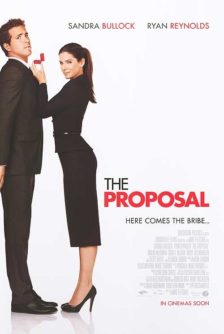
THE PROPOSAL
A funny, well-acted romance that earns its laughs — and its caution.
Should You Watch It?
Here's the short answer: this is a very well-made romantic comedy, and it's also one that warrants real caution before you watch it — let alone before your teenager does.
Sandra Bullock and Ryan Reynolds carry the film with real comedic chemistry, and Betty White steals scenes as the grandmother. The story has heart: a self-absorbed woman discovers a loving family and, in the end, chooses to sacrifice her own interests rather than hurt the people around her. That's a genuinely moral turn.
But the comedy leans hard on a fake engagement, which means constant sexual innuendo and an assumption that unmarried couples will sleep together. One scene has the two leads collide, both naked, prepping for a shower — nothing explicit is shown, but it's unmistakable. And the grandmother's Native American pagan chanting toward "spirits" is treated warmly and comedically, not critically.
If you're an adult who can watch that content without it forming your conscience, this is a genuinely funny watch. If you're choosing for your family, look elsewhere.
The Story
NO SPOILERS — WE KEEP THE SURPRISESMargaret is a powerful, controlling book editor facing deportation to Canada. Her solution: talk her younger assistant, Andrew, into a marriage of convenience. The newly "engaged" couple heads to Andrew's family home in Alaska — with an immigration officer trailing close behind — and Margaret, so used to running Manhattan from the top, suddenly finds herself the fish out of water in a family she's never had.
Is It Any Good?
Three stars means this is a genuinely good romantic comedy, and the source is emphatic about why: Bullock is at her comedic best, bringing real emotion alongside the laughs, and her chemistry with Reynolds carries the film. The writing is sharp, the music is fun, and Betty White's grandmother is a comic highlight. It's a well-crafted studio comedy that earns its laughs honestly rather than coasting on them.
The Worldview
At its center, this film gets something right: a woman who has spent her life self-absorbed and in control discovers, through a family that welcomes her, what it means to belong to people who love her without conditions — and she ultimately sacrifices her own advantage rather than let her deception hurt them. That's a real moral arc, and it's worth crediting.
The film muddies that with two other currents. The comedy is built on sexual innuendo and a casual assumption that an unmarried couple sharing a fake engagement will also share a bed — treated as expected, not examined. And the grandmother's pagan Native American chanting to "spirits in the trees," including talk of "going to the spirits" after death, is played not as something foreign or false but as warm, humorous, and inviting — Margaret even joins in.
The film's real longing — to be truly known and truly home, rather than performing for a career — is a good one. Scripture answers that longing more fully than any speech in Alaska can: "for I know the plans I have for you, plans for welfare and not for evil, to give you a future and a hope" (Jeremiah 29:11 — paraphrased in spirit here toward belonging), or more precisely, the promise that those far off are brought near and grafted into a true family (Ephesians 2:19).
The Content Guide
The specifics — spoilers included by nature — so you can judge for your own family.
Content Summary
Strong mixed pagan worldview with some solid moral elements, but mixed with Romantic elements and false religious material where elderly woman performs pagan Native American chants, including clear discussion of thanking the spirits in the trees and “going to the spirits” when one dies; four obscenities and 12 profanities; no violence; much discussion of sex and assumption that unmarried people will sleep together; man and woman, both naked accidentally and comically collide with one another, all private parts are covered up, man in speedo, upper male nudity; drinking of beer and wine; no smoking; and lying and fraud, much of which is ultimately rebuked.
Talk About It
Questions for the drive home, the dinner table, or the youth group.
Margaret realizes she knows nothing real about the people around her because she's been so self-absorbed. What does it look like to truly know and be known by others?
Philippians 2:3–4The film treats the grandmother's chants to "spirits" as harmless and even joyful. How does Scripture ask us to think about spiritual practices outside the truth of God, even ones that seem warm or family-centered?
Deuteronomy 18:9–13 · Colossians 2:8In the end, Margaret sacrifices her own advantage to protect people she's come to love. What does real sacrificial love cost, and where do we see it modeled fully?
John 15:13 · 1 Corinthians 13:4–7The movie assumes an unmarried couple will share a bed as a matter of course. How does that assumption compare with how Scripture calls us to treat marriage and intimacy?
Hebrews 13:4 · 1 Corinthians 6:18–20The Final Word
This is a genuinely funny, well-made romantic comedy with real heart at its core — and real content adults need to reckon with before they watch, from sexual innuendo to warmly-portrayed pagan spirituality. Our answer stands: worth the trip — adults only. Looking for something to watch with the kids instead? Start here:.